Vietnamese labourers assisted to live, work in Japan

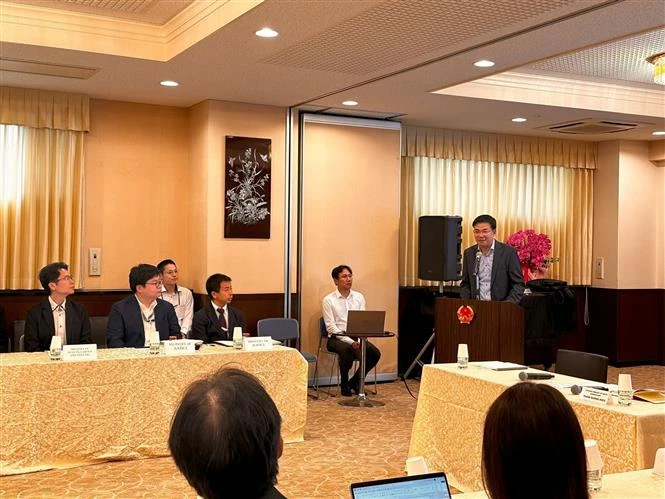
The Vietnamese Embassy in Japan on July 30 held a seminar on promoting support for Vietnamese workers in Japan to integrate into the local community, develop themselves and their careers, with the participation of representatives of relevant Japanese agencies, departments and localities.

Vietnamese Ambassador to Japan Pham Quang Hieu speaks at the seminar. (Photo: VNA)

Tokyo (VNA) - The Vietnamese Embassy in Japan on July 30 held a seminar on promoting support for Vietnamese workers in Japan to integrate into the local community, develop themselves and their careers, with the participation of representatives of relevant Japanese agencies, departments and localities.

There are currently nearly 600,000 Vietnamese living, studying, and working across 47 prefectures and cities of Japan

In his opening remarks, Vietnamese Ambassador Pham Quang Hieu said that the majority of Vietnamese people are hardworking, eager to learn, and live harmoniously and amicably. They have continuously improved their Japanese language skills to better themselves, support their families, and contribute to Japan's economy, as well as enhancing the friendship between the two countries.

He noted that following the Japanese Government's policy revision allowing talented foreign workers to reside and work for a long-term in Japan, the number of Vietnamese workers in the East Asian country is expected to continue rising in the near future.

Therefore, the embassy organised this event to exchange opinions with Japanese agencies, departments, sectors and localities on measures for Vietnamese workers to choose Japanese localities as a destination to work and live for a long term, become a part of the local society and effectively contribute to the socio-economic development of that locality, added Hieu.

Yasuhisa Arai, a representative from Japan's Ministry of Justice, provided an overview of the new recruitment and training system announced by the government on June 21. He explained that under the new law, the technical apprentice training system, which involves skill transfer, will be fundamentally re-evaluated, while a new recruitment and training system will be established to develop and ensure human resources in fields where Japan is experiencing a labour shortage.

At the seminar, representatives from Yamanashi, Kanagawa, and Aichi prefectures briefed participants on their respective locality’s efforts to attract foreign labourers, particularly those from Vietnam.

Hieu emphasised the need to focus on Japanese language training, Japanese culture popularisation, and skill development for Vietnamese workers. He also highlighted the importance of continuous training activities, starting before their arrival in Japan and maintaining it throughout their time living and working in the country./.
VNA

See more

Zambia's Minister of Agriculture Reuben Mtolo Phiri (first, left), learns about the OM19 rice variety grown at Tien Thuan cooperative in Thanh Quoi commune,, Can Tho city (Photo: VNA)

Can Tho shares agricultural transformation experience with Zambia

Rice production remains Can Tho’s key industry. Alongside maintaining production, Can Tho has encouraged value chain linkages among farmers, cooperatives and businesses, while accelerating the application of science and technology, mechanisation and digital transformation in farming.

Staff members of the Hanoi Public Administrative Service Centre handle administrative procedures for local residents. (Photo: VNA)

Hanoi: 95% of administrative procedures to be handled from home

The plan targets that at least 80% of administrative procedures under the city’s authority will be provided as fully online public services, while more than 95% of applications will be received and processed entirely online. By June 30, 2026, about 80% of administrative procedures are expected to be restructured based on integrated data systems, with the figure rising to 95% by the end of the year.

Delegates at the SEAN Future Forum NextGen Workshop 2026 held in Jakarta, Indonesia on March 9 (Photo: VNA)

Vietnam contributes youth perspectives to AFF NextGen initiative

The ambassador expressed confidence that fresh perspectives, innovative thinking and lessons drawn from the workshop will be proposed to AFF 2026, representing the voice of the younger generation in shaping ASEAN’s future in line with their aspirations.

A young volunteer donates blood during the 2026 Red Sunday programme. (Photo: VNA)

Nearly 5,000 people join blood donation campaign in Ho Chi Minh City

According to health authorities, Vietnam collected nearly 1.75 million units of blood in 2025, with 98% from volunteer donors, equivalent to around 1.75% of the population participating in blood donation. Large-scale campaigns such as Red Sunday have played a key role in achieving these results.

More than 30 kilogrammes of various drugs trafficked from Cambodia to HCM City were seized in a police operation in March 2025. (Photo: VNA)

Ho Chi Minh City aims to become drug free by 2030

Every commune, ward or residential area in Ho Chi Minh City is expected to meet official drug-free standards by the end of 2029, while schools, hospitals, government offices, businesses and social organisations across the city are to remain free of drug activity.

Military forces take a resident from a flooded area. Photo: VNA

Da Nang, Oxfam join hands to support flood victims

In the coming time, the Da Nang Red Cross Society will continue to coordinate with Oxfam to implement support activities in Nong Son commune, helping residents overcome difficulties and stabilise their livelihoods.