Vietnamese preschool shines bright among top architecture projects

A preschool project in the northern province of Son La has just been listed among the top 10 new architecture projects in the Art & Design column in UK-based newspaper The Guardian.
Vietnamese preschool shines bright among top architecture projects ảnh 1An overview of the project (Photo: archdaily.com)
Hanoi (VNS/VNA) - A preschool project in the northern province of SonLa has just been listed among the top 10 new architecture projects in the Art& Design column in UK-based newspaper The Guardian.

The list was made based on posts on several architecture websites includingDezeen, ArchDaily, Designboom, Archinect, or the pickier Domusweb, Archpaper,the Architectural Review and Wallpaper since early March.

The list highlights the projects that “... make the world a little moreinteresting and a little more enjoyable”.

“The best of these projects are theatres for life, whether that life is seeingart, living in your home, going to school or meeting friends, and wherever itmight take place: in an ancient city, in a refugee camp, in deep countryside.They aim to make that life richer, fuller and more surprising,” the articlesays.

Mentioning Bo Mon Preschool in Tu Nang commune, Yen Chau district of Son La province by Kientruc O (O Architecture), the article comments: “It’s a simpleenough idea: a big distinctive roof that casts a big distinctive shadow thatmoves around during the course of the day. So the shadow becomes an animatedthing in its own right, not just the absence of sun. The curvy shapes might besaid to have some harmony with the surrounding hills. A tree is hugged at theentrance. The corrugated metal construction is basic, with somesensible-looking devices to ensure ventilation. Charming and deft and does whatit says on the tin.”

Curvy shapes of the roof have some harmony with natural surroundings.

Ho Chi Minh City-based Kientruc O (O Architecture) company said on archdaily.comthat architecture is not a simple plan to meet some specific demands ofutility, aesthetics, and stability.

“Daily used architecture should create an interesting atmosphere for users,”the company’s representative wrote.

“It turns to be more and more difficult and challenging to create meaningfularchitectures because it requires non-stop changes and many surprises happeningduring long constructing time, especially when the project has a limited sourceof budget and should be implemented in severe conditions,” the post continued.

According the company, Bo Mon Preschool has been built for various purposes.Besides serving as a preschool for local children, the building has been alsoused as a communal house for locals.

The courtyard is a multi-functional open area for children to play.

“Through the separation of the classrooms, teacher accommodation and supportingrooms over a common yard, a central layout is formed, making the courtyard theheart where all activities happen,” the article on ArchDaily said.

“The courtyard is essentially a multi-functional open area under a shady awningwhere children play together.

“When school is in session, the yard is a place where siblings from the schoolnext door gather to wait for each other before going home, an outdoorclassroom, and a communal space for local festivals to take place throughoutthe year.

“The soft shape of the roof creates a shady area that transits slowly from thewall to the floor as the sun changes its course, animating a present that connectsthe architecture with its natural context, where it sits among the indefinitemountains and hills, and where it blends itself between the cloud and the mistof a highland afternoon.”

The top projects mentioned in The Guardian also included the Museum ofContemporary Art Helga de Alvear, in Cáceres, Spain, by Emilio Tuñón; TainanSpring, in Taiwan, by MVRDV; Mac House, in Novelda, Spain, by La Errería;Alex’s guesthouse, in Berlare, Belgium, by Atelier Vens Vanbelle; Stone Garden,in Beirut, by Lina Ghotmeh; Emergency Scenery, in Olot, Spain, byunparelld’arquitectes; UHP synagogue, in Asunción, Paraguay, by Equipo deArquitectura; and Fass school and teachers’ residence, in Fass, Senegal, byToshiko Mori.

Kientruc O is led by duo Dam Vu and Anni Le, who also teach at the ArchitectureUniversity of HCM City.

The company seeks architectural manifestations that both satisfy human needsand stimulate coexistence between humans and the natural ecology.

The company has won various domestic and international prizes including theArcasia Awards for Architecture 2016, American Architecture Prize 2016 and wasamong finalists at the World Architecture Festival 2015./.
VNA

See more

950 years on, Quoc Tu Giam continues to inspire Vietnam’s pursuit of knowledge ​

950 years on, Quoc Tu Giam continues to inspire Vietnam’s pursuit of knowledge ​

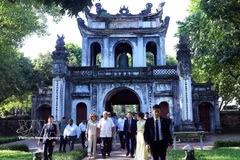
The 950th founding anniversary of Quoc Tu Giam (Imperial Academy), Vietnam’s first national university, is an occasion to reaffirm the enduring values of the country's tradition of learning, respect for teachers, and promotion of talent, which have shaped the nation’s intellectual foundations and continue to support its development in a new era.

Chair of the Canada-Vietnam Cultural & Educational Council (CVCEC) Phan Thi Quynh Trang (first from left) (Photo: VNA)

Vietnam’s learning tradition gets Canadian reboot

The Canada-Vietnam Cultural & Educational Council (CVCEC) is building culture lessons on Vietnamese landmarks, with the Temple of Literature as a core module. Kids will hear stories about teacher Chu Van An, and practice greetings, gratitude to teachers and respect for elders.

Panamanian President José Raúl Mulino and his spouse visit the Temple of Literature (Photo: VNA)

Quoc Tu Giam at 950: A meeting point for Vietnam’s cultural diplomacy

Van Mieu - Quoc Tu Giam is a symbol of Vietnam's culture and education and a regular pick for high-ranking leaders and politicians. That lifts it from national heritage to a valuable platform for promoting cultural diplomacy and showcasing Vietnam's cultural soft power, helping to convey the country's image and cultural identity to the international community.

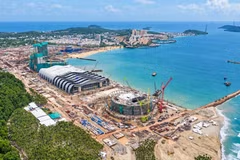
Construction on APEC Phu Quoc Multi-purpose Performance Hall (Photo published by VNA)

APEC 2027: Inside the making of Asia’s landmark theatre

One year in, Sun Group’s APEC Phu Quoc Multi-purpose Performance Hall is taking shape as one of Asia’s largest theatres. It boasts 54,680 sq.m of floor area, 17,250 sq.m of roof, six above-ground floors plus a basement, and 4,030 seats, larger than Hollywood’s Dolby Theatre, the Oscars venue.

Visitors will enjoy free admission to the Vietnam Museum of Ethnology on Vietnam Culture Day (November 24). (Photo: nhandan.vn)

Free admission to museums, historical sites, national parks on Vietnam Culture Day

Organisations and individuals will be entitled to free admission every year on November 24 to eight museums: the Museum of Oceanography, the Vietnam Museum of Ethnology, the Museum of the Cultures of Vietnam’s Ethnic Groups, the Vietnam National Museum of History, the Vietnam National Fine Arts Museum, the Yersin Museum, the Vietnamese Women's Museum and the Vietnam Military History Museum, as well as the Independence Palace historical site.

Vietnamese Consul General in Perth Pham Hai Anh (Photo published by VNA)

Vietnamese community in Australia seen as bridge for bilateral ties

Vietnamese identity and life in Australia are complementary rather than separate. The more successful overseas Vietnamese became in Australia, the greater their ability to contribute to their homeland and bilateral ties, said Vietnamese Consul General in Perth Pham Hai Anh.

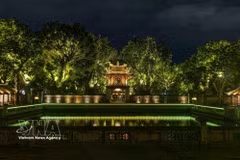
Van Lake within the Temple of Literature (Photo: VNA)

UNESCO Representative: Quoc Tu Giam offers inspiration for new approaches to education

UNESCO Representative to Vietnam Jonathan Wallace Baker said one of the things that stands out in Vietnam is the deep and enduring respect for education, learning and scholarship. Van Mieu –Quoc Tu Giam is a remarkable expression of that tradition, reminding that knowledge, talent and ethical responsibility have long been closely connected in Vietnamese society.

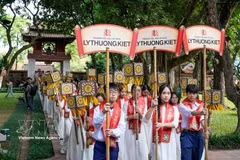
A highlight of the programme is the participation of 950 students in performances staged within the Temple of Literature complex (Photo: VNA)

950 years of Quoc Tu Giam: Continuing Vietnam’s enduring tradition of learning

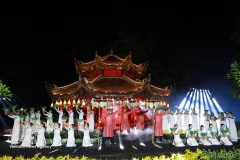
Through evocative images of students of the Quoc Tu Giam, alongside performances by students and artists, the programme vividly recreated the journey of Vietnam’s scholarly tradition, from the era of the imperial examinations to the spirit of learning in contemporary society. It also helped bring the cultural values of Thang Long-Hanoi to life today.

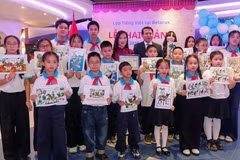
Students pose for a photo at the ceremony (Photo published by VNA)

Mother tongue connects Vietnamese community in Belarus

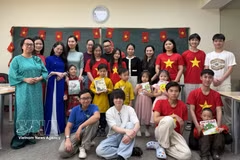
Vietnamese language education in Belarus not only helps younger generations take pride in their heritage and better understand and appreciate traditional culture, but also serves as a bridge for promoting Vietnamese culture among international friends.

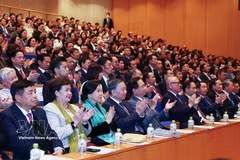
General Secretary of the Communist Party of Vietnam Central Committee and President To Lam (fourth from left, first row) and his spouse, Ngo Phuong Ly, attend the Vietnam-Japan Friendship Concert in Kanagawa Prefecture on November 10 evening. (Photo: VNA)

Vietnam-Japan Friendship Concert fosters cultural cooperation

In his welcoming remarks, Vietnamese Ambassador to Japan Pham Quang Hieu said the concert brought together talented musicians from the Vietnam National Symphony Orchestra and artists who are current or former members of renowned Japanese orchestras, including the NHK Symphony Orchestra, Tokyo Metropolitan Symphony Orchestra, New Japan Philharmonic and Kanagawa Philharmonic.

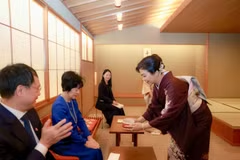
Madame Ngo Phuong Ly offers the first bowl of tea to Akiko Santo, former President of the House of Councillors of Japan. (Photo published by VNA)

Top Vietnamese leader’s spouse experiences traditional Japanese culture

After learning about the history of the tea ceremony, Madame Ly was invited to enjoy traditional sweets and tea, and then to try preparing tea herself. She respectfully offered the first bowl of tea to Akiko Santo, former President of the House of Councillors of Japan and the oldest guest present.