Vietnam’s 2020 retail sales see lowest growth in nine years

Vietnam’s total revenue from retail trade and services reached over 5 quadrillion VND (219.5 billion USD) in 2020, representing a modest yearly rise of 2.6 percent, according to the General Statistics Office (GSO).
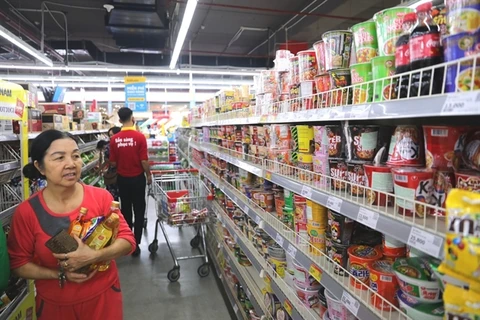
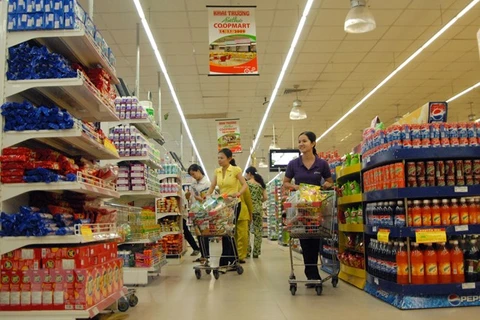
Vietnam’s 2020 retail sales see lowest growth in nine years ảnh 1Fruits being showcased at a VinMart supermarket in Hanoi. (Photo: VNA)

Hanoi (VNS/VNA) - Vietnam’s total revenue from retail trade and servicesreached over 5 quadrillion VND (219.5 billion USD) in 2020, representing amodest yearly rise of 2.6 percent, according to the General Statistics Office (GSO).

Thisyear’s retail sales growth was much lower than 9.5 percent seen in 2019 and wasalso the lowest rate in the 2011-2020 period due to the significant impact ofthe COVID-19 pandemic.

Revenuefrom retail sales of consumer goods exceeded 3.9 quadrillion VND, up 7 percentyear-on-year or accounting for 79 percent of the total. Especially, revenueincreased by 10.7 percent for food and foodstuff; 7.5 percent for the group ofhousehold appliances, tools and equipment; 3 percent for garments and 1 percentfor cultural and educational services.

Meanwhile,revenue from accommodation and catering services dropped by 13 percentyear-on-year to 510.4 trillion VND, making up 10 percent of the total. Lastyear, the revenue from these services saw a yearly increase of 9.8 percent.

Otherservices also experienced a slight revenue decline of 4 percent to 535 trillionVND in 2020.

However,VNDirect Securities forecast that the nation's retail sales growth wouldbounce back to pre-COVID-19 levels next year, reaching 8.5-9 percentyear-on-year.

Theprojection was made on the back of the country’s successful containment ofCOVID-19, which was a major contributor to the economic rebound in the thirdquarter that saw unemployment fall 0.23 percent against the previous quarter to2.5 percent. 

VNDirect alsopredicted that consumer confidence would likely recover soon, against abackdrop of COVID-19 vaccines expected to be available in 2021.

Withthe rapid growth of the middle class and rising per capita income, domesticconsumption remained the main growth driver of the retail industry, even duringCOVID-19.

TheMinistry of Industry and Trade expected the domestic trade sector’s added valueto contribute 13.5 percent to GDP by 2025 and total retail sales of goods andservices to grow around 9-9.5 percent annually over the next five years.

Theministry forecast that total retail sales would reach nearly 350 billion USD by2025.

Themarket’s recovery offers huge opportunities for retailers to expand theirdistribution networks.

SaigonCo.op is targeting to add at least 2,000 stores to its chain over the next fiveyears, with revenue rising 8-10 percent annually. 

MajorJapanese retailer Muji, which sells a wide variety of household and consumergoods, has opened its first store in Vietnam, in HCM City, and is planning toopen another in Hanoi, it added./.
VNA
See more

Toy production at a Hong Kong-invested factory (Photo: VNA)

Vietnam targets deeper market penetration in Hong Kong in 2026

Vietnam-Hong Kong trade hit 62.3 billion USD in the first 11 months of 2025, soaring 73.1% annually. Vietnamese exports to Hong Kong amounted to 36.8 billion USD, a 90.6% hike, ranking fourth among Hong Kong’s import sources, while imports from Hong Kong stood at 25.5 billion USD, up 52.9% and ranking third.

Vietnam’s start-up market enters restructuring phase

Vietnam’s start-up market enters restructuring phase

In 2026, venture capital inflows into Vietnam’s start-up ecosystem are expected to recover gradually, though in a more selective manner. VinVentures forecasts that capital will focus on start-ups that have survived the rigorous screening of 2024–2025, possess clear business models, strong commercialisation capacity, and the ability to generate real cash flows.

Workers process tra (pangasius) for export (Photo: VNA)

Vietnam–Singapore trade continues to thrive

For the year as a whole, Vietnam retained its position as Singapore’s 10th largest trading partner. Bilateral trade reached a record high of nearly 40 billion SGD, up 26.2% from the previous peak of 31.67 billion SGD recorded in 2024.

Eric Van Vaerenbergh, an energy expert and lecturer at the Brussels Engineering School (ECAM) (Photo: VNA)

Belgian expert optimistic about Vietnam’s economic outlook

Vietnam should move from a growth model based mainly on expanding capital and labour to one driven by productivity improvements. He said that this requires enhancing the quality of the workforce, particularly engineers, technicians, and managers in industrial sectors.

Workers at the VSIP Hai Phong industrial and urban complex, which specialises in producing electronic components for office equipment. (Photo: VNA)

Roadmap aims to improve business climate and boost competitiveness

By the end of 2026, Vietnam aims to rank among the world’s top 50 performers in the United Nations Sustainable Development Goals, advance at least three places in the International Property Rights Index, and climb at least one position in the Global Innovation Index.

Vietnam is strengthening its position in the technology value chain, becoming a major manufacturing hub for complete consumer electronics products. (Photo: VNA)

ESG standards offer opportunities to reposition Vietnam’s electronics firms

The 2025-2027 period will be a critical turning point, as exporters to the European market will be required to strictly comply with ESG standards, including net-zero emissions roadmaps, labour standards, corporate governance and transparency requirements. As a key export sector, the electronics industry is being directly and strongly affected by this shift.

A production line for camera modules and electronic components at the factory of MCNEX VINA Co. Ltd, a Republic of Korean-invested company in Phuc Son Industrial Park, Ninh Binh province. (Photo: VNA)

Science, technology, innovation as engines of economic growth

To ensure that science and technology truly act as a powerful growth engine, experts emphasised the need for the Government to put in place supportive mechanisms and policies that encourage enterprises to invest in research and development, while strengthening cooperation among the State, research institutions and the business sector.