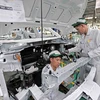
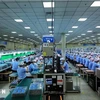
The domestic auto industry is unlikely to achieve the 10 percent growth in 2017 (Photo: VNA)
 Hanoi (VNS/VNA) - With a continuous year-on-year decline in sales this year, the domestic auto industry is unlikely to achieve the 10 percent growth predicted by the Vietnam Automobile Manufacturers’ Association (VAMA).
The 21,870 autos sold in October marked a year-on-year drop of 22 percent.
In the January-October period, a total of 204,999 automobile units were sold, down nine percent year-on-year, according to a VAMA report.
The sales of passenger cars decreased by 10 percent, commercial vehicles by six percent and special-use vehicles (cranes, canal diggers, street-cleaning trucks, waste trucks, passenger bus at airports, lift trucks in warehouses and small cars serving golf courses) by 18 percent during the period.
Although auto businesses have engaged in aggressive marketing to boost year-end sales, offering discounts and promotions from few dozens to hundreds of millions of dong on ordinary cars to luxury cars, they have not achieved expected results.
The Truong Hai Automobile Joint Stock Co (Thaco) offered price reductions of 5 million VND (219 USD) to 26 million VND in October for its Morning, Cerato and Sorento models.
Meanwhile, Toyota Motor Vietnam supported buyers with registration fees reductions of 30 million VND for Vios, 15 million VND for Innova and 50 million VND for Camry 2017.
Mitsubishi Vietnam also launched a discount of 214 million VND for the SUV Pajero, bringing its retail price down from 2.12 billion VND to around 1.9 billion VND.
Apart from its poorly selling models, Huyndai Thanh Cong announced a special promotional programme offering a discount of 230 million VND for its bestselling new-version model SantaFe, which brought the price down to 898 million VND.
In its luxury car segment, Mercedes-Benz Vietnam also offered a 50 million VND registration fee discount and three free maintenance passes for all cars that the company is producing and distributing in the Vietnamese market.
[Ministry forecasts demand for cars to boom in 2020]
Despite all the price reductions and promotions, many consumers were still waiting for a further reduction or until early 2018, hoping to buy cheaper vehicles once the import tax rate for completely built units drop from 30 percent to zero percent in the Southeast Asian (ASEAN) region.
However, such hopes were dashed last month when the Government issued Decree 116/2017, effective from the day of signing, introducing several strict regulations for locally-assembled automobile businesses as well as importers.
These regulations will not only make it difficult for small businesses to import autos, but also for official distributors in Vietnam and local assemblers.
VAMA has sent a petition to the Prime Minister expressing concern over some of the new regulations in the decree that relate to automobile manufacturing, assembly and importing enterprises.
For example, the decree requires that when conducting inspections and tests, auto importers must provide quality management bodies with papers including copies of quality certificates issued by foreign authorised agencies or organisations for imported cars. VAMA has said that many countries do not have such certification, making it difficult for importers to do business.
However, the Ministry of Industry and Trade has said that the new decree will help domestic enterprises and foreign investment companies to compete more fairly, ensuring the interests of consumers.
Another regulation in the decree requires domestic auto assemblers to have an auto testing track with a minimum length of 800m, including flat, rocky, rugged and rippled, as well as sloping, wet and curved surfaces.
VAMA said it was difficult for its members to meet this requirement because there was not enough space to build or expand the testing track. Furthermore, the rent for such space would be very costly.
Auto importers, meanwhile, are required to have authorised certification to recall products, but small and medium enterprises cannot meet this requirement because they always buy vehicles through middlemen. In addition, for batches of cars imported by small businesses or official distributor, management bodies will check each lot and model representing the type of cars in the batch, thus increasing expenses for the importers.
Nguyen Tuan, the director of Thien Phuc An, an auto importer, said the test would be very expensive, costing some 100 million VND for each batch, not to mention the two months or so it would take, which would lead to many other expenses, forcing businesses to sell at higher prices.
Tuan said the conditions stipulated in the decree made it very difficult for small and medium enterprises and non-authorised car dealers (who buy cars from the automakers in foreign countries and import them into Vietnam). With this decree, the domestic car market will remain wholly controlled by joint ventures and some official distributors in Vietnam, and there will not be much competition that would benefit end users, he added. -VNA
Tuan said the conditions stipulated in the decree made it very difficult for small and medium enterprises and non-authorised car dealers (who buy cars from the automakers in foreign countries and import them into Vietnam). With this decree, the domestic car market will remain wholly controlled by joint ventures and some official distributors in Vietnam, and there will not be much competition that would benefit end users, he added. -VNA
VNA