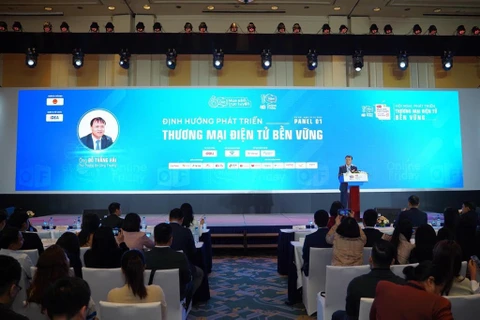
Illustrative image (Photo: tapchicongthuong.vn)
 This is firstly because the competition on the e-commerce platforms Shopee, Lazada, and TikTok Shop is currently very fierce.
"There are many suppliers operating on the same platform to sell the same goods, so the competition on the exchanges is huge," commented Thanh.
According to Ho Chi Minh City’s Department of Industry and Trade, with the strong and rapid development of e-commerce activities, state management of e-commerce is still limited, especially in promotion and development policies and tax management policies, origin management, and goods flow.
The growth and development of e-commerce has created opportunities but also challenges in state management, especially in building a healthy business environment, contributing to promoting the city's economy.
Besides, uneven development among localities is also said to create a threat to e-commerce in the future.
Currently, nearly 70% of the population lives in rural areas, but big cities like Hanoi and HCM City account for 70% of online retail sales nationwide.
In fact, revenue on e-commerce platforms mainly comes from these two cities, over 42 trillion VND (1.75 billion USD) in Hanoi and 57 trillion VND in HCM City.
Not only that, issues such as environmental pollution due to product packaging; limited policies and regulations; high cost of creating and maintaining a booth; and logistics issues are also reasons why it is difficult for Vietnamese e-commerce to develop sustainably.
In order to improve the efficiency of e-commerce activities, the Ministry of Industry and Trade will focus on reviewing legal regulations, especially the Law on Electronic Transactions and the Law on Consumer Protection; decentralisation to localities to comprehensively manage transactions between buyers and sellers online.
In the future, the industry and trade sector will strengthen management and supervision activities in the online environment, proactively request social networks and e-commerce platforms to remove product information and goods that violate the law.
The authorities will also enhance the sharing of connection databases to exploit information to serve state management in this issue.
The Ministry of Industry and Trade (MoIT) said that e-commerce continued to be one of the bright spots in Vietnam's digital economic development, with an estimated revenue of 20.5 billion USD this year.
In 2018, the country's retail e-commerce revenue only reached about 8 billion USD but by 2019, it had surpassed the 10 billion USD mark, reaching 10.8 billion USD and increased to 11.8 billion USD in 2020.
The number rose by 20% last year compared to the previous year, reaching 16.4 billion USD, accounting for 7.5% of retail revenue of consumer goods and services nationwide.
The number of consumers participating in online shopping is over 54.6 million, with the online shopping value per person reaching nearly 270 USD per year.
From there, it can be affirmed that Vietnamese e-commerce has grown strongly for many years and is one of the pioneering fields of the digital economy, creating motivation for economic development and leading digital transformation in business.
In fact, e-commerce sites have constantly been born and developed with four applications Shopee, Lazada, Tiki and TikTok Shop being the most popular and constantly competing with each other to rise to a higher position in the field of e-commerce.
In addition, there are many other new e-commerce sites that still have the potential to compete with major e-commerce sites, such as Sendo, and Mobile World.
Anti-counterfeiting and consumer protection on e-commerce
E-commerce had been posing many new challenges for enforcement agencies in the fight against counterfeit goods and consumer protection, said Tran Huu Linh, Director of the Vietnam Directorate of Market Surveillance (DMS).
The DMS coordinated with the National Economics University to organise a forum on anti-counterfeiting technology and consumer protection in e-commerce in Vietnam in Hanoi this week.
To prevent violations in the online environment, it was necessary to have human resources, especially appropriate tools and methods, said Linh.
Without appropriate sanctions, the online environment would become a place to store, distribute and trade counterfeit goods, thereby reducing consumer confidence and hindering the development of the economy, he said.
Le Duc Anh, Director of the Centre for Information and Digital Technology (CID) under the Vietnam E-commerce and Digital Economy Agency (iDEA), Ministry of Industry and Trade (MoIT), pointed out that it was necessary to apply advanced technology solutions in identifying sellers and buyers, and tracing the origin of goods in e-commerce to prevent counterfeit goods.
Functional units of the MoIT had been making efforts to improve the infrastructure, legal framework and policies to develop e-commerce and digital economy, said Anh.
Most recently, this year, the iDEA built a digital ecosystem to strengthen the protection of consumer rights including a system for managing and resolving complaints and online disputes in e-commerce between people and businesses.
Also at the forum, referring to anti-counterfeit solutions and consumer protection on e-commerce, Dinh Le Hai Ha from the National Economics University said that in e-commerce, it was not just about preventing counterfeit goods, but it was necessary to ensure the full rights of customers.
He proposed that it was necessary to manage merchants providing goods and services along with merchants organising e-commerce floors and e-commerce ecosystems.
It was also necessary to legally regulate the information use of shop owner and customer at e-commerce platforms and application providers, he added.
Ha also recommended enhanced delivery invoice management; identifying joint responsibilities in anti-counterfeiting and consumer rights protection and technical solutions to provide warning levels and prevent commercial fraud in the online environment./.
VNA