Vietnam's folk paintings on display in Hanoi's Old Quarter

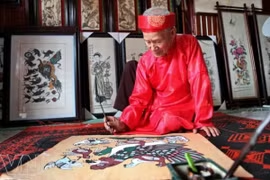
Surrounded by a crowd in a corner of the Centre of the Old Quarter's Culture Exchange, artisan Nguyen Dang Giap spreads colours carefully on different woodblocks to create a Dong Ho folk painting.
Vietnam's folk paintings on display in Hanoi's Old Quarter ảnh 1Artisan Nguyen Dang Giap demonstrates how to create Dong Ho folk painting at the Centre of the Old Quarter's Culture Exchange (Photo: VNA)

Hanoi (VNA) – Surrounded by a crowd in a corner of the Centre of the Old Quarter's Culture Exchange, artisan Nguyen Dang Giap spreads colours carefully on different woodblocks to create a Dong Ho folk painting.

Giap is the only member of his family that pursues this traditional job, which originates from the Dong Ho village in Thuan Thanh district in Bac Ninh province, about 30km east of Hanoi.

While explaining to curious viewers about the painting's natural materials, the old artist focuses on each step, which he has known by heart since he was young.

The printing paper used for the paintings is made from the bark of the do (poonah) tree. It is soaked in water for months and then mixed with seashell powder (diep) and glutinous rice.

Because of the texture of seashells and glutinous rice, the paper possesses an exotic and sparkling hard background and is able to retain colours used in the painting.

Giap's demonstration is part of the on-going folk paintings exhibition Net Xuan (Spring's Feature), organised by the Centre of the Old Quarter's Culture Exchange and the Hanoi Museum of Terracotta and Porcelain.

Opened to public since January 29 night, the exhibition presents paintings and wood-blocks from five famous lines of folk painting in Vietnam.

Alongside Dong Ho paintings, the exhibition also displays a collection of Hang Trong paintings which have been linked to the rituals of ancestor worship for hundreds of years.

The paintings generally have two main themes: worship and Tet (Lunar New Year festival), which focus on people and subjects.

Common themes include kings, lords, Buddha and saints, children and three gods symbolising longevity, prosperity and happiness.

The exhibition also features colourful Southern glass paintings, which came to Vietnam in the early of the 20th century when Chinese immigrants opened glass shops in Cho Lon and Saigon.

In the 1920s, the art form developed rapidly along with other crafts, spreading throughout six southern provinces. It has developed mass products with various themes such as God, Buddha worship, celebration and interior decorative painting. Some glass paintings were drawn with multi-coloured paint, or with mother of pearl, or combined with coating mercury on the glass surface.

The exhibition also introduced to visitors Sinh village paintings, which originates in Phu Vang district in Hue in about the 15th century, and Kim Hoang paintings – an art form combines both Dong Ho and Hang Trong style and originates from Hanoi's Hoai Duc suburban area in middle of the 18th century.

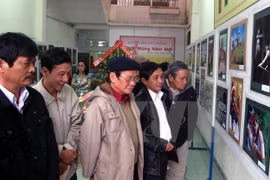
On another wall in the centre of the Old Quarter, several woodblock paintings, accompanied by introductions on painting techniques, have caught the attention of many visitors.

All the paintings and woodblocks on display belong to folk paintings collector Nguyen Thi Kim Hoa, who aims to preserve "an important part of Vietnamese traditional fine arts and culture".

"As I continue to spend more time to collect the paintings, I realise that most of these folk paintings lines have been fading seriously as the number of artisan and craftsmen drops," said Hoa, who is also Director of the Hanoi Museum of Terracotta and Porcelain.

Hoa expects the exhibition to offer foreign tourists a glimpse of Vietnamese culture.

The free entry exhibition runs until February 22 at 50 Dao Duy Tu street.-VNA
VNA

See more

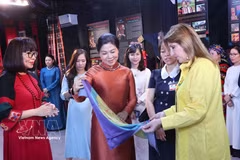
The Vietnamese and Panamanian first ladies experience cultures of Vietnam's ethnic groups. (Photo: VNA)

Vietnamese, Panamanian first ladies bond over ethnic textiles at Hanoi cultural event

The two ladies were briefed on the cultural diversity of Vietnam's ethnic groups and shown traditional costumes, along with weaving, embroidery and pattern-making techniques preserved and handed down through generations. The materials, colours and patterns of the costumes reflect aesthetic values as well as stories of history, customs, traditions and the distinct identity of each community.

Historical cinema helps foster patriotism, strengthen Vietnam’s soft power

Historical cinema helps foster patriotism, strengthen Vietnam’s soft power

When history is told through human stories, using modern cinematic language and backed by adequate investment, films can both nurture patriotism and national pride and become competitive cultural industry products. This is also a way for cinema to help turn the spirit of Politburo Resolution No. 80-NQ/TW into reality by transforming Vietnamese values into an internal resource and a source of national soft power.

Vietnamese athletes compete against Iran in the women’s team kata final in karate at ASIAD 2026 on September 22. (Photo: Xinhua/VNA)

ASIAD 20 prompts Vietnam to sharpen focus on key sports

Vietnam’s gold medals came from karate and sepak takraw, reaffirming its strengths in sports with established traditions and focused investment. Meanwhile, bronze medals in canoeing and teqball showed potential in events where Vietnamese athletes are gaining international experience.

Lieutenant General Phan Xuan Tuy, Director of the Political Academy of the People's Public Security under the Ministry of Public Security, provides information about the conference. (Photo: quochoi.vn)

National conference to promote Vietnamese cultural values

More than 200 delegates are expected to attend a national scientific conference in Hanoi on October 10 to discuss ways to promote Vietnamese cultural values as an important driving force for national development in the new era

Young girls perform a Cham dance throughout the ritual of carrying the attire of the goddess Po Sah Inu. (Photo: baolamdong.vn)

VFF leader extends Kate wishes to Brahmanist Cham community

In her letter, Hoai She praised the dignitaries and the Brahmanist Cham community for their contributions to upholding patriotic traditions, preserving cultural identity, promoting socio-economic development and strengthening great national unity.

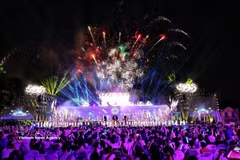
Fireworks display at the closing ceremony of the second Cultures of the World Festival. (Photo: VNA)

Cultures of the World Festival closes, leaving impressions on visitors

The 2026 festival was particularly significant as it coincided with the 50th anniversary of Vietnam’s membership in UNESCO, marking five decades during which Vietnam has evolved from a country emerging from war into an active and responsible member, increasingly contributing initiatives to UNESCO and the international community.

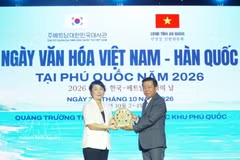
An An Giang leader presents gift to Park Chan A, First Secretary at the Republic of Korea Embassy in Vietnam and Director of the Korean Cultural Centre. (Photo: VNA)

Vietnamese, Korean cultures showcased on Phu Quoc island

Addressing the opening ceremony, Vice Chairwoman of the Phu Quoc Special Zone People’s Committee Nguyen Thi Kim Loan emphasised that the event is a chance for people from Vietnam and the RoK to meet, experience and appreciate each other’s cultural values, thereby fostering mutual understanding, respect and friendship.

Traditional costumes from around the world come together, creating a vibrant multicultural space in the heart of Hanoi. (Photo: VNA)

“Colours of Five Continents” bring cultural vibrancy to Hanoi’s Hoan Kiem Lake

Themed “Heritage Convergence – Future Creation,” the festival provided a vibrant and open platform for cultural exchange, showcasing distinctive Vietnamese cultural values through ao dai, performing arts and street activities, while giving participating countries an opportunity to share and celebrate their cultural identities.

Hanoi festival celebrates Vietnamese and global cultures (Photo: VNA)

Hanoi festival showcases Vietnamese and world cultures

Through diverse cultural experiences, the second Cultures of the World Festival in Hanoi 2026 highlights culture as a bridge connecting people, promoting mutual understanding and supporting international cooperation and sustainable development.

Visitors explore the “Books Unlock Knowledge – Technology Leads the Future” space at the Hanoi Book Fair 2026. Photo: VNA

Hanoi Book Fair connects knowledge and technology

Hanoi Book Fair is not only a place where readers can discover good books, but also a space that inspires a spirit of learning; a place where the values of the past are connected with the knowledge of the present and the technologies of the future, helping develop human resources, cultural strength and a knowledge foundation for sustainable development.