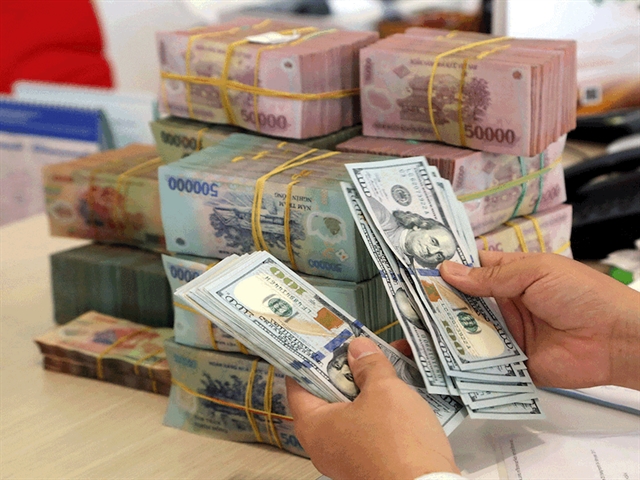
Vietnam's foreign exchange reserves will recover to the level of three months of imports.(Photo: nhadautu.vn)
 Analysts of VNDirect have made forecasts and said that with the US Federal Reserve (Fed) slowing down the rate of interest rate hikes this year and improving Vietnamese foreign exchange reserves, it would stop the decline price of Vietnamese dong.
At the same time, the rate at the end of this year is likely to decrease by 1-2%.
Besides, experts also expect a trade surplus of 13.4 billion USD this year, from a trade surplus of 12.4 billion USD last year.
In addition, the current account will turn into a surplus at 1.4% of GDP this year from a projected deficit of 0.8% of GDP last year.
According to data published in March 2022, Vietnam’s foreign exchange reserves are at a record high of nearly 110 billion USD.
However, after that, the State Bank of Vietnam (SBV) faced many difficulties in balancing the three main goals of controlling inflation, stabilising exchange rates and interest rates to support growth.
SBV had to sell a large amount of foreign exchange reserves to stabilise the exchange rate, which is estimated at approximately 20% of foreign exchange reserves, in the first 10 months of last year.
This has caused Vietnam’s foreign exchange reserves to fall below the level recommended by the International Monetary Fund (IMF) when it was less than three months of imports.
VNDirect expects a trade surplus of 12 billion USD next year, from an expected trade surplus of 10.4 billion USD last year.
At the same time, VNDirect also expects the current account to turn into a surplus in to 0.4% of GDP this year from a projected deficit of 1.3% of GDP last year.
Therefore, the securities company said that Vietnam’s foreign exchange reserves will recover to the level of three months of imports and reach 102 billion USD by the end of this year from the current level of 89 billion USD.
However, VNDirect said that there were several key risks to the forecast including higher-than-expected inflation and a stronger-than-expected US dollar which could put additional pressure on the Vietnamese dong and the stronger-than-expected recession of Vietnam’s major trading partners.
In fact, Vietnamese dong once depreciated by 7-8% last year compared to the end of 2021, but by the last trading day of last year, Vietnamese dong only depreciated by 3.53%, equivalent to half of the two previous months./.
VNA