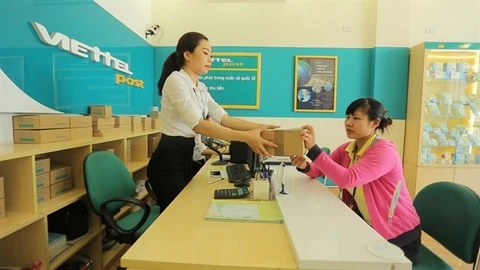
Illustrative image (Photo: Viettel)
 Hanoi (VNS/VNA) - Telecom providers Viettel and Mobifone have received licences from the Ministry of Information and Communications (MIC) to commercially test fifth-generation (5G) broadcast in Hanoi and HCM City.
The military-run group can test in Hanoi with a maximum of 140 base transceiver stations (BTSs) while MobiFone can do so in HCM City with 50 BTSs. Viettel will use planned broadbands of 2,500-2,600MHZ, 3.700-3.800MHz and 27.100-27.500MHz for the commercial test. Meanwhile, MobiFone will use the broadband of 2.600MHz according to the national planning on radio frequency spectrum and regulations on radio frequency management.
The licence will be evaluated by the end of June 2021.
The tests are expected to help the companies evaluate their technology and market size before launching commercial operations.
Both Viettel and MobiFone are allowed to test mobile ground telecommunication networks using radio frequency bands with International Mobile Telecommunications-2020 (IMT-2020 Standard) technology according to 5G specifications (3GPP) standard version 15 and subsequent versions.
Mobile subscribers of the network operators who are connected to public telecommunications networks can join the commercial test.
The companies need to follow cybersecurity safety and privacy regulations while running the tests, the ministry said.
The first 5G phone call in the country was made on January 17 using equipment manufactured by Viettel, which has been conducting non-commercial tests and installing equipment since last year.
The number of 5G subscriptions could hit 6.3 million or 6 percent of total mobile subscriptions by 2025, according to a forecast from technology conglomerate Cisco.
5G is said to offer speeds 100 times faster than 4G and support new applications like remote medical procedures and autonomous driving.
Earlier, Viettel and Vingroup JSC signed a co-operation agreement to develop a 5G gNodeB mobile base station system.
The two sides agreed last month to complete the set of specifications for 5G base station products and complete two laboratories for each side.
It is expected that the two sides will make the first test call on the 3,600 - 3,800 MHz band next month./.
The military-run group can test in Hanoi with a maximum of 140 base transceiver stations (BTSs) while MobiFone can do so in HCM City with 50 BTSs. Viettel will use planned broadbands of 2,500-2,600MHZ, 3.700-3.800MHz and 27.100-27.500MHz for the commercial test. Meanwhile, MobiFone will use the broadband of 2.600MHz according to the national planning on radio frequency spectrum and regulations on radio frequency management.
The licence will be evaluated by the end of June 2021.
The tests are expected to help the companies evaluate their technology and market size before launching commercial operations.
Both Viettel and MobiFone are allowed to test mobile ground telecommunication networks using radio frequency bands with International Mobile Telecommunications-2020 (IMT-2020 Standard) technology according to 5G specifications (3GPP) standard version 15 and subsequent versions.
Mobile subscribers of the network operators who are connected to public telecommunications networks can join the commercial test.
The companies need to follow cybersecurity safety and privacy regulations while running the tests, the ministry said.
The first 5G phone call in the country was made on January 17 using equipment manufactured by Viettel, which has been conducting non-commercial tests and installing equipment since last year.
The number of 5G subscriptions could hit 6.3 million or 6 percent of total mobile subscriptions by 2025, according to a forecast from technology conglomerate Cisco.
5G is said to offer speeds 100 times faster than 4G and support new applications like remote medical procedures and autonomous driving.
Earlier, Viettel and Vingroup JSC signed a co-operation agreement to develop a 5G gNodeB mobile base station system.
The two sides agreed last month to complete the set of specifications for 5G base station products and complete two laboratories for each side.
It is expected that the two sides will make the first test call on the 3,600 - 3,800 MHz band next month./.
VNA