White Paper on Vietnam private economic forum debuts

The White paper: “Vietnam Private Economic Forum – Opportunities, Challenges and Solutions,” debuted at a press conference in Hanoi on July 8.
White Paper on Vietnam private economic forum debuts ảnh 1Illustrative image (Source: VNA) 

Hanoi (VNA) – The White paper: “Vietnam Private Economic Forum – Opportunities, Challenges and Solutions,” debuted at a press conference in Hanoi on July 8.

The paper details a joint statement and thematic declarations adopted by the 2016 Vietnam Private Economic Forum, including an analysis of general context and firms’ viewpoint on the state of Vietnam’s private economic sector.

It also features major proposals on policies for the digital economy, agriculture, vocational training, distribution and logistics, financial market and capital mobilisation, the support industry, clean energy and energy saving, as well as recommendations on start-up and innovation, industrial clusters, integration and globalisation.

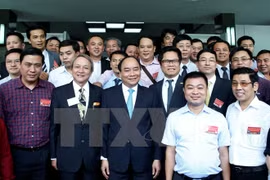
The first Vietnam private economic forum held on June 3 attracted more than 700 businesspeople representing seven fields and three economic sectors, representatives from the government and international organisations, domestic and foreign economists, scholars and experts in investment, finance, industry and agriculture.

According to the organising board, the annual forum aims to maintain the public-private dialogue mechanism, becoming a launch pad for promoting connectivity and international cooperation.

Chairman of the Vietnam Young Entrepreneurs’ Association (VYEA) Bui Van Quan said the forum is expected to become a more important driver of the country’s development and integration amid the setting of globalisation.

The conference was co-hosted by the VYEA, the Central Committee of the Ho Chi Minh Communist Youth Union and the Vietnam Youth Federation.-VNA
VNA

See more

Vietnamese Deputy Minister of Industry and Trade Phan Thi Thang speaks at the forum (Photo: VNA)

Vietnam, Georgia look to more business opportunities

For Vietnamese firms, Georgia can serve as a gateway to broader regional markets, given its strategic location connecting the South Caucasus, Central Asia and China with European markets via the Black Sea.

Chairman of the Vietnamese Business Association in Laos (AVILA) Duong Dinh Bang (Photo: VNA)

PM’s visit injects fresh momentum into Vietnam-Laos special relations

At the 2026 Laos-Vietnam Investment Promotion Conference in Vientiane, the two PMs held direct dialogue with businesses and investors from both countries, affirming their determination to address bottlenecks in institutional frameworks, administrative procedures, transport infrastructure and payment connectivity. The goal of these efforts is to boost bilateral trade to 10 billion USD by 2030.

Deputy Secretary of the An Giang provincial Party Committee and Secretary of the Party Committee of the Phu Quoc special zone Dinh Van Noi speaks at the dialogue (Photo: baoangiang.com)

Phu Quoc moves to resolve infrastructure bottlenecks ahead of APEC 2027

Deputy Secretary of the An Giang provincial Party Committee and Secretary of the Party Committee of the Phu Quoc special zone Dinh Van Noi said an official information portal will be launched to receive public feedback, while hotlines for local leaders will allow businesses and residents to raise concerns directly.

Deputy Minister of Industry and Trade Phan Thi Thang at the forum. (Photo: VNA)

Vietnamese firms explore investment opportunities in Georgia

Priority areas with great cooperation potential include manufacturing, logistics infrastructure, renewable energy, tourism, hospitality, information and communications technology (ICT), and business process outsourcing (BPO), said a Georgian official.

Prime Minister Le Minh Hung and delegates launch the digital platform of the Vietnam Association of Small and Medium Enterprises (August 2026). Photo: VNA

Vietnamese businesses, entrepreneurs make growing contributions to national development

Vietnam Entrepreneurs’ Day is an opportunity to recognise businesses’ contributions and reinforce the entrepreneurial spirit, the pursuit of legitimate prosperity and national responsibility. With stronger policies and greater innovation, Vietnamese enterprises are expected to play an increasingly important role in economic growth and the country’s ambition to become a strong, prosperous nation.

A view at a CO.OPMART supermarket in Bac Ninh city (Photo: bacninh.gov.vn)

Bac Ninh’s CPI up 4.07% in nine months

The consumer price index (CPI) in Bac Ninh city rose 4.07% year-on-year in the first nine months of 2026, with housing and construction materials, education and transport recording the sharpest increases, according to the municipal Statistics Office.

Vietnam's textile - garment and footwear industries are aiming to shift from processing and assembly to stages with higher added value, increasing technology content and competitiveness. (Photo: VNA)

Vietnam’s supporting industries seek stronger domestic links

As global supply chains undergo major changes and environmental standards and digital technology requirements become more demanding, developing supporting industries has become essential to improving the competitiveness of the economy. This requires coordinated efforts by the Government, multinational corporations and domestic businesses.

Prime Minister Le Minh Hung speaks at the meeting (Photo: VNA)

PM orders power plan overhaul to meet double-digit growth

Securing adequate power supply is an urgent priority and a prerequisite to successfully achieve socio-economic development goals 2026, a foundational year for accelerating progress, with breakthroughs to follow in 2027 and the goals for the full term to be delivered, said Prime Minister Le Minh Hung.

General Secretary of the Communist Party of Vietnam Central Committee and President To Lam speaks at the meeting (Photo: VNA)

Top leader pledges support for firms, presses tech self-reliance

The country needs more firms that master technologies, build trusted brands and run production networks able to compete globally. Progress over the next five to 10 years must show up in productivity, job quality and market position, said top leader To Lam.