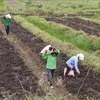
Vuong explains to farmers his methods of breeding worms (Photo courtesy of Le Minh Vuong)
 Hanoi (VNA) - Small earthworms hide giant benefits that have not been fully exploited in Vietnam’s agriculture. The hope that they will be used more widely and be less expensive has motivated 25-year-old Le Minh Vuong to keep pursuing his studies of worms during the past five years.
“Worms can eat organic waste and transform themselves into organic and nutritious food for cattle, chickens, pigs, fish and shrimps while their compost is especially useful for enriching the soil,” he said.
“Fresh earthworms, fed by organic food such as discarded vegetables and fruits, can be used as nutritious food for human, or as ingredients to make up a variety of medicinal and beauty products. This is because they contain a variety of precious vitamins, amino acids and enzymes,” Vuong said.
With such enormous benefits, he strongly believes that earthworms can make a revolution in agriculture.
Vuong was born into a poor farmers’ family in Ninh Hai district in the central province of Ninh Thuan. While his two elderly siblings had to quit school at an early age to help their parents in farm work, Vuong and his other two siblings were given a proper education in the hope they would do something better for the family and community when they grew up.
“When I was small, I used to hide from my parents and go fishing at noon. I used to dig up earth to find worms as bait. There would be always worms in the damp earth. The relationship between worms, nutrition and plants came into my mind,” Vuong said.
During his secondary school years, he witnessed the mass death of shrimps and the huge amount of waste mud in the canals. Many local shrimp farming households had to sell their houses to pay debts.
He wanted to find the causes and solutions to the waste mud, which he realised could only be gained through study. With his keen interest in nature, Vuong decided to focus on biology to accumulate fundamental knowledge.
During his university years, he successfully conducted a study on producing organic fertiliser from earthworms which are fed with waste mud in shrimp ponds.
The young researcher dedicated himself to his studies and started to dream about popularising organic agriculture in Vietnam.
After graduation, Vuong worked as a researcher specialising in earthworms for a high-tech agriculture company in HCM City. The company focused on producing products from earthworms for plants and animals.
He is putting a final touch to an eco-agriculture project on an eco-farm, earthworms raising and eco-tourism on a total area of 10 hectares. On this farm, Vuong produced a variety of products, such as organic fertiliser from earthworms, pesticides from plants and solar lighting.
According to Vuong, breeding earthworms is simple as long as three essential elements are ensured - abundant of food, which is organic waste, cool conditions, and industriousness.
However, he said the huge benefits that can be made from the small creatures have not been fully exploited by Vietnamese farmers.
“Farmers have got used to applying chemicals, but there is a trend now for organic farm produce, which is forcing farmers to gradually take up organic farming, including the application of organic products, such as earthworm compost,” he said.
Another problem, Vuong said, was the unstable quality of the earthworms produced by commercial companies, which has affected the reputation of honest earthworm farmers. Furthermore, there are few specialists to offer satisfactory answers or directions for farmers.
“I have therefore nurtured a dream of becoming a specialist in earthworms to contribute to my home town’s agriculture,” he says.
Together with other members of the The He Uu Tu (Eminent Generation) group who share the same passion, Vuong has hosted various seminars which introduce methods to improve impoverished soil, grow organic vegetables, produce organic pesticides and particularly, how to make use of earthworms.
This amounts to helping farmers apply new methods for sustainable agriculture, reducing the use of chemicals, utilising discarded farm produce, and increasing productivity at the same time.
Vuong’s experience has been compiled into four handbooks, which have been distributed free to all farmers interested in the subject.
Since the end of 2016, his earthworm farm has been busy welcoming farming tourists at weekend. The tours are free and have been organised by Vuong himself.
The participants experience a variety of farming activities, such as planting trees, harvesting fruit, working the land, and exchanging ideas with the garden owner to gain practical knowledge to apply on their own farms.
“There are many shrimp ponds in my hometown,” said Vo Van Phuong, a visitor from the southern province of Ca Mau. “However, the local environment is polluted by shrimp output and waste in the ponds. Joining this tour, I want to learn from Vuong and discuss with him how to breed earthworms from such waste.”
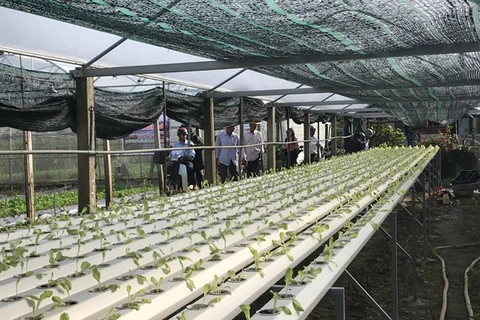
The tours also include senior farmers who wish to take advantage of cattle dung to raise earthworms or set up their own earthworm farms. Vuong explains to them in detail how to nurture, feed and harvest the creatures before showing them aubergine farms grown by vermicomposting.
“It’s quite arduous to feed the earthworms on my farm because there is such a large quantity. Sometimes my body is covered with cow dung, but on seeing the results of my work, which are rows of fresh vegetables, I’m filled with happiness,” Vuong said.-VNA
“Worms can eat organic waste and transform themselves into organic and nutritious food for cattle, chickens, pigs, fish and shrimps while their compost is especially useful for enriching the soil,” he said.
“Fresh earthworms, fed by organic food such as discarded vegetables and fruits, can be used as nutritious food for human, or as ingredients to make up a variety of medicinal and beauty products. This is because they contain a variety of precious vitamins, amino acids and enzymes,” Vuong said.
With such enormous benefits, he strongly believes that earthworms can make a revolution in agriculture.
Vuong was born into a poor farmers’ family in Ninh Hai district in the central province of Ninh Thuan. While his two elderly siblings had to quit school at an early age to help their parents in farm work, Vuong and his other two siblings were given a proper education in the hope they would do something better for the family and community when they grew up.
“When I was small, I used to hide from my parents and go fishing at noon. I used to dig up earth to find worms as bait. There would be always worms in the damp earth. The relationship between worms, nutrition and plants came into my mind,” Vuong said.
During his secondary school years, he witnessed the mass death of shrimps and the huge amount of waste mud in the canals. Many local shrimp farming households had to sell their houses to pay debts.
He wanted to find the causes and solutions to the waste mud, which he realised could only be gained through study. With his keen interest in nature, Vuong decided to focus on biology to accumulate fundamental knowledge.
During his university years, he successfully conducted a study on producing organic fertiliser from earthworms which are fed with waste mud in shrimp ponds.
The young researcher dedicated himself to his studies and started to dream about popularising organic agriculture in Vietnam.
After graduation, Vuong worked as a researcher specialising in earthworms for a high-tech agriculture company in HCM City. The company focused on producing products from earthworms for plants and animals.
He is putting a final touch to an eco-agriculture project on an eco-farm, earthworms raising and eco-tourism on a total area of 10 hectares. On this farm, Vuong produced a variety of products, such as organic fertiliser from earthworms, pesticides from plants and solar lighting.
According to Vuong, breeding earthworms is simple as long as three essential elements are ensured - abundant of food, which is organic waste, cool conditions, and industriousness.
However, he said the huge benefits that can be made from the small creatures have not been fully exploited by Vietnamese farmers.
“Farmers have got used to applying chemicals, but there is a trend now for organic farm produce, which is forcing farmers to gradually take up organic farming, including the application of organic products, such as earthworm compost,” he said.
Another problem, Vuong said, was the unstable quality of the earthworms produced by commercial companies, which has affected the reputation of honest earthworm farmers. Furthermore, there are few specialists to offer satisfactory answers or directions for farmers.
“I have therefore nurtured a dream of becoming a specialist in earthworms to contribute to my home town’s agriculture,” he says.
Together with other members of the The He Uu Tu (Eminent Generation) group who share the same passion, Vuong has hosted various seminars which introduce methods to improve impoverished soil, grow organic vegetables, produce organic pesticides and particularly, how to make use of earthworms.
This amounts to helping farmers apply new methods for sustainable agriculture, reducing the use of chemicals, utilising discarded farm produce, and increasing productivity at the same time.
Vuong’s experience has been compiled into four handbooks, which have been distributed free to all farmers interested in the subject.
Since the end of 2016, his earthworm farm has been busy welcoming farming tourists at weekend. The tours are free and have been organised by Vuong himself.
The participants experience a variety of farming activities, such as planting trees, harvesting fruit, working the land, and exchanging ideas with the garden owner to gain practical knowledge to apply on their own farms.
“There are many shrimp ponds in my hometown,” said Vo Van Phuong, a visitor from the southern province of Ca Mau. “However, the local environment is polluted by shrimp output and waste in the ponds. Joining this tour, I want to learn from Vuong and discuss with him how to breed earthworms from such waste.”
The tours also include senior farmers who wish to take advantage of cattle dung to raise earthworms or set up their own earthworm farms. Vuong explains to them in detail how to nurture, feed and harvest the creatures before showing them aubergine farms grown by vermicomposting.
“It’s quite arduous to feed the earthworms on my farm because there is such a large quantity. Sometimes my body is covered with cow dung, but on seeing the results of my work, which are rows of fresh vegetables, I’m filled with happiness,” Vuong said.-VNA
VNA