12,000 to be selected to work in RoK

The Centre of Overseas Labour at the Ministry of Labor, Invalids and Social Affairs (MoLISA) has announced a plan to select around 12,000 Vietnamese people to work in the Republic of Korea (RoK) under the host country’s Employment Permit System (EPS).
12,000 to be selected to work in RoK ảnh 1Workers have to take a Korean language proficiency test and a skill test. (Photo: VietnamPlus)

Hanoi (VNA) - The Centre of Overseas Labour at the Ministry of Labor, Invalids and Social Affairs (MoLISA) has announced a plan to select around 12,000 Vietnamese people to work in the Republic of Korea (RoK) under the host country’s Employment Permit System (EPS).

The workers will be employed in the fields of manufacturing (6,344), construction (901), agriculture (841), and fisheries (4,035). Each candidate is allowed to submit only one registration form.

The workers have to take a Korean language proficiency test and a skill test.

The registration for the first test, scheduled for May 8-26, will last from March 20-24, while its results will be announced on June 5.

The Korean language proficiency test will be taken on a computer and consist of two sections - listening comprehension and reading comprehension.

The test has a total of 40 multiple-choice questions, and the time limit is 50 minutes. The minimum passing score for the first round is 110 for the manufacturing industry, 80 for the construction and agricultural industries, and 60 for the fisheries industry. The maximum score is 200.

Those who meet the Korean proficiency requirements will take the skill test and be evaluated based on the number of positions available in each industry, with 110% of the recruitment target for each industry being allocated based on the criteria of highest to lowest scores.

To prevent cheating during the test, the centre will closely monitor the workers' identification documents, including their test registration cards and personal identification papers. Suspected cases of cheating will be checked by comparing their identifying features and fingerprint records on their ID cards, and their registration information will also be verified.

The centre will also use integrated data synthesis software and fingerprint scanners, which will capture photos and fingerprints of the workers. The fingerprint records will be stored in a database and used to verify the workers' identity at skill testing, orientation training, and departure.

Those failing to pass the identity verification procedures will be denied of further processing, and those caught cheating disqualified from the programme, according to the centre.

The software will also issue a warning when it detects the same person attempting to register for the exam for multiple times. Any worker found to have improper behaviour will be documented and stopped from participating in the programme for four years.

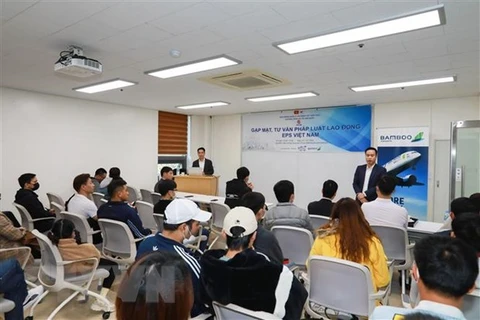
12,000 to be selected to work in RoK ảnh 2Labourers complete procedures to work in the RoK. (Photo: VietnamPlus)

Meanwhile, the registration for the second round will take place from June 5-9, and the second test will be held from June 26-30 for the manufacturing sector, and from July 17-21 for construction, agriculture, and fisheries.

The centre will announce the time and venue of the tests on April 24 through municipal and provincial Departments of Labour, Invalids and Social Affairs, and via its website http://www.colab.gov.vn.

Test results will be released at http://www.colab.gov.vn, http://www.eps.go.kr, and http://eps.hrdkorea.or.kr/epstopik.

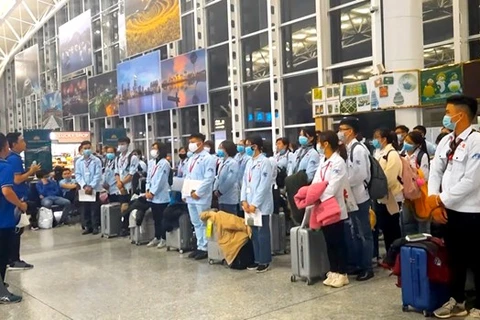
12,000 to be selected to work in RoK ảnh 3The Korean language test is scheduled for May 8-26. (Photo: VietnamPlus)

Vietnamese workers participating in this year’s EPS programme must meet requirements such as having a clean criminal record according to Vietnamese law and having never been deported from the RoK.

For those who have resided in the RoK on work visas of non-professional employment (E9) or vessel crew (E10), the duration of residence must be less than five years.

Workers who have previously worked in the RoK under the EPS programme must return to Vietnam upon the expiration of their contracts.

Figures from MoLISA showed that Vietnam has to date sent over 110,000 workers to the RoK under the EPS programme, with an average income of 1,800 USD per month./.

The MoLISA on March 10 announced that the EPS programme with the RoK will be suspended for eight districts, towns, and cities in four provinces due to Vietnamese workers’ overdue and illegal stay in the host country.

They are Nghi Xuan and Cam Xuyen districts in the central province of Ha Tinh; Chi Linh city of the northern province of Hai Dương; Cua Lo town, and Nghi Loc and Hung Nguyen districts in the central province of Nghe An; and Dong Son and Hoang Hoa districts in the central province of Thanh Hoa.

Each of these localities were reported to have more than 70 illegal workers residing in the RoK, and over 27% of the labourers who did not return to Vietnam upon the expiration of their contracts.
VNA

See more

Representatives of the Club of Cambodian Journalists and the Vietnam Journalists Association at the working session in Hanoi on May 12 (Photo: VNA)

Vietnamese, Cambodian journalists strengthen cooperation

The Vietnam Journalists Association and the Club of Cambodian Journalists agreed to enhance coordination and information sharing between media agencies, exchange experience in professional training and technology application in journalism, and regularly organise training programmes for reporters and editors.

Ca Mau province has consistently attached importance to developing human resources and investing in infrastructure in ethnic minority areas. (Photo: VNA)

Vietnam steps up implementation of ethnic affairs strategy through 2030

To accelerate the implementation of the the Ethnic Affairs Strategy by 2030, with a vision toward 2045, the Prime Minister requested ministries, agencies and local authorities to continue thoroughly carrying out the Party and State’s policies on ethnic affairs, enhancing the effectiveness of State management and strengthening oversight of policy implementation.

Officials from the Market Surveillance Department of Da Nang conduct inspections at business establishments in Hai Chau ward. (Photo: VNA)

No “blind spots” in crackdown on smuggling, counterfeit goods

In the Jan-April period, authorities nationwide uncovered and handled nearly 44,000 cases related to smuggling, trade fraud and counterfeit goods, while initiating 1,464 criminal cases involving 2,277 suspects, according to the National Steering Committee for Combating Smuggling, Commercial Fraud and Counterfeit Goods (National Steering Committee 389).

A delegation of 60 exemplary overseas Vietnamese from 20 countries and territories offers incense to commemorate the Hung Kings. (Photo: VNA)

Overseas Vietnamese community contributes to national unity, development

According to Chairman of the State Committee for Overseas Vietnamese Affairs Nguyen Trung Kien, many overseas Vietnamese entrepreneurs have achieved success in developed economies, gaining experience in corporate governance, advanced technologies, and international-standard operations.

A market surveillance team carries out an unannounced inspection at a fashion business in Hanoi. (Photo: VNA)

Hanoi steps up crackdown on counterfeit goods, IP infringements

The agency has set a target of increasing the number of handled cases by at least 20% compared to the same period last year between May 7 and 30. Inspection and monitoring activities will continue beyond May 30 on a regular, focused and systematic basis across the city.

Construction of Tran Hung Dao bridge, one of seven bridges spanning the Red River, launched in 2025, alongside Hong Ha, Me So, Tu Lien, Ngoc Hoi, Van Phuc and Thuong Cat bridges (Photo: VNA)

📝OP-ED: Beyond rhetoric, urban reconstruction moves ahead

Transport infrastructure development is a key task in the capital’s major development strategies, closely linked with the Hanoi Capital Master Plan with a 100-year vision and the implementation of the revised Capital Law. A series of major projects, including ring roads, urban railways, national railways and regional economic connectivity projects such as the Red River Landscape Boulevard Axis, are being implemented to enhance connectivity, promote the growth of Hanoi and the country, and lay the foundation for urban reconstruction in a modern, synchronised and sustainable direction.

 Dong Nai – aspiration to rise in new era

Dong Nai – aspiration to rise in new era

Following its merger and status elevation to Vietnam’s seventh centrally-run city starting April 30, 2026, Dong Nai is entering a pivotal phase to reposition its role and standing within a broader development landscape. More than an administrative upgrade, the move—coupled with strategic projects such as Long Thanh International Airport—is opening new space for the southern locality to make socio-economic breakthroughs, strengthen regional connectivity and reshape its development model toward services, tourism and innovation.

Passengers check in at Tan Son Nhat Airport in Ho Chi Minh City (Photo: VNA)

Vietnam to roll out pre-arrival information system nationwide

The PAI system enables international travellers to provide essential information related to their trips prior to arrival in Vietnam. Once declarations are completed, immigration authorities can analyse the data and process entry procedures in a timely manner, helping travellers avoid long queues and waiting times at immigration checkpoints.

Government approves framework to overhaul adoption law

Government approves framework to overhaul adoption law

Three broad policy directions for amending the Law on Adoption have been endorsed in Resolution 123 issued on May 6, which tasks the Ministry of Justice with drafting a revised law for Government review by June. Deputy Prime Minister Le Tien Chau will oversee the process.