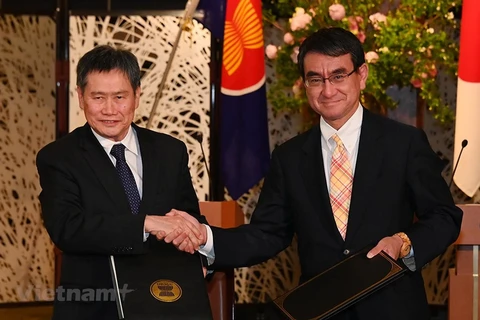
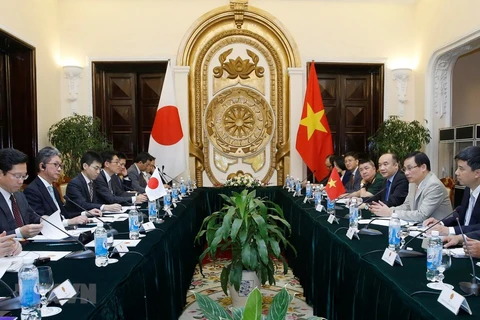
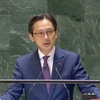
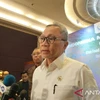
Heads of delegations to the 34th ASEAN-Japan Forum (Photo: VNA)
 Hanoi (VNA) – The 34th ASEAN-Japan Forum took place in Hanoi on June 3 under the chair of Vietnamese Deputy Foreign Minister Nguyen Quoc Dung and his Japanese counterpart Takeo Mori.
At the annual forum, delegates affirmed the significance of the strategic partnership between the Association of Southeast Asian Nations (ASEAN) and Japan.
The comprehensive cooperation between the two sides has developed strongly over the past time, significantly contributing to peace, security and stability in the region, they said.
ASEAN member countries spoke highly of Japan’s active participation in efforts to promote dialogues and cooperation, and build regional trust, through forums hosted by ASEAN like ASEAN 3, the East-Asia Summit, the ASEAN Regional Forum, the ASEAN Defence Ministers’ Meeting Plus and the Expanded ASEAN Maritime Forum.
They thanked Japan for its support for ASEAN’s central role and solidarity, and contributions to consolidating the regional architecture that is open, transparent, inclusive and rules-based.
The delegates acknowledged the dynamic economic, trade and investment ties between the two sides.
Japan continued to be ASEAN’s leading trade partner with turnover reaching 219 billion USD and Japan’s foreign direct investment (FDI) in the ten-member group hitting 13.2 billion USD, ranking second among investors in the region.
The countries welcomed the signing of the first protocol amending the ASEAN-Japan Comprehensive Economic Partnership Agreement which aims to boost trade and investment links between the two sides.
ASEAN member countries thanked Japan for helping the group promote connectivity and narrow development gap, towards people.
The two sides agreed to continue effectively realising the Implementation Plan of the Vision Statement on ASEAN-Japan Friendship and Cooperation, step up regional connectivity, develop high-quality human resources and expand cultural and people-to-people exchanges.
They consented to soon complete negotiations of the Regional Comprehensive Economic Partnership (RCEP) in 2019.
Regarding regional and international issues, they spoke of recent progress on the Korean Peninsula and outcomes of summits between the US and the Democratic People’s Republic of Korea in Singapore and Hanoi.
The delegates voiced their support for peace, stability and denuclearization on the Korean Peninsula, and called on relevant sides to continue addressing their differences in the spirit of dialogue and cooperation, and seriously and effectively implementing commitments to complete denuclearization on the peninsula.
The forum also touched upon the progress of negotiations of the building of a Code of Conduct in the East Sea (COC) between ASEAN and China.
They shared the views that unilateral attempts to change the status quo and militarize in the East Sea have sparked concern, eroded trust and seriously affected security and stability in the area.
The countries reiterated the significance of maintaining peace, security, safety and freedom of navigation and overflight in the East Sea, exercising self-restraint, not using or threatening to use force, avoiding actions that complicate the situation, peacefully addressing disputes in line with international law and the 1982 United Nations Convention on the Law of the Sea.
Sovereignty claims should be made on the basis of international law, they said, underlining the need to seriously and fully materialise the Declaration on the Conduct of Parties in the East Sea (DOC) and build an effective and efficient COC.
Deputy Foreign Minister Dung lauded Japan for its contributions to regional peace, security and development, and agreed that the two sides should enhance cooperation in the areas of mutual concern like maritime cooperation and security, connectivity, sustainable development, development gap narrowing, youth and people-to-people exchanges, natural disaster and climate change combat and public health care.
Vietnam, as the coordinator of the ASEAN-Japan relations, will closely coordinate with Japan and other ASEAN member countries to advance the ASEAN-Japan strategic partnership comprehensively, meeting interests of both sides as well as for the sake of the region and the world at large, he said.-VNA
VNA