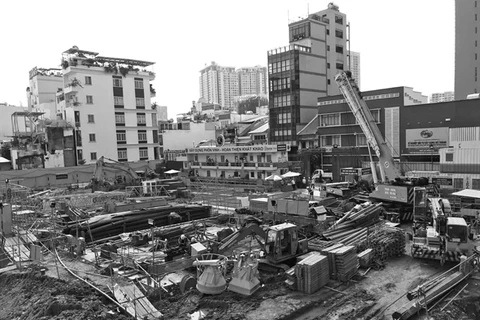
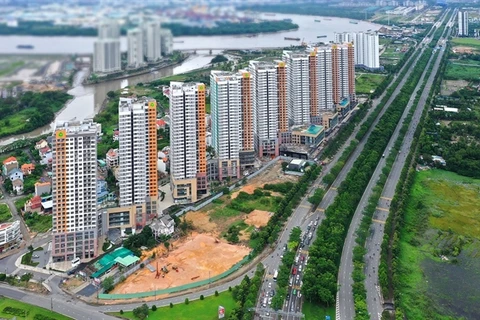
A view of Da Nang. The real estate market has been least affected by the pandemic. (Photo: tapchitachinh.vn)
 Hanoi (VNS/VNA) - While COVID-19 continues to impact the whole economy, most millionaires in Vietnam have been investing in the real estate market.
Experts who took part in a recent seminar themed "Vietnam Real Estate 2020-2021: Ready for a new cycle" in Thanh Hoa city, said that among the country's more than 12,000 millionaires, 90 percent of them had invested in realty. At the same time, among the 100 richest people in the country with fortunes of more than 30 million USD each, investment in the real estate sector directly and indirectly had reached 99.1 percent.
Dang Van Quang, director of Jones Lang Lasalle Vietnam Co, Ltd (JLL), told the seminar: “Even though there is a trend of factories relocating around the world which is helping Vietnam benefit from foreign businesses that want to enter the country, the pandemic is making it harder for investors to visit and survey the local market.”
Quang added that even if they were able to, the process for investment could take some years, saying: “Vietnam does not have to wait for the leading enterprises in the world to come. Instead, it can welcome the right businesses, maybe smaller but more compatible among domestic investors.”
Sharing the same idea, Nguyen Van Dinh, vice chairman of the Vietnam Association of Realtors (VARS), said: “There is always an effort to attract foreign investment to boost businesses in Vietnam, but over the past 20 years local real estate development has mainly been contributed by domestic investors.”
Dinh said: “Most of the development of new areas in Vietnam such as the current city of Ha Long in the coastal province of Quang Ninh has been done by local investors, not foreign investors."
“It clearly shows that domestic investors are investing in real estate with very strong growth,” he said, while recommending that in the current context, the Government should adopt appropriate investment policies to attract domestic resources to develop real estate projects.
Finance and banking expert Can Van Luc said that at the present time while Vietnam is dealing with the second wave of COVID-19 and local GDP growth was likely to fall to 1.5-2 percent this year, the realty market was one of the least affected sectors.
Luc said normally when the economy was in trouble, securities and real estate were among the worst affected. However, in Vietnam he said: “Our assessment of the 15 main sectors, contributing 80 percent to GDP, shows that real estate was one of the eight least impacted areas by COVID-19.“
Luc also proposed strong support for the real estate market.
He considered three bright spots of the sector: industrial real estate, real estate and logistics.
“The Government is promoting public investment, and real estate will be one of the industries that will benefit the most. During the COVID-19 pandemic, the behaviour of investors has also changed dramatically. Therefore, real estate structure will also change a lot to adapt,” added the expert.
Dinh from VARS said: “Despite being affected by the COVID-19 pandemic, real estate is the fastest recovering market in Vietnam.”
Sharing that after the first wave of the pandemic, the market quickly recovered, Đính said: “Real estate will be one of the first areas to be restored when the second wave is under control.”
More positively, Nguyen Duc Huong Nguyễn Đức Hưởng, former chairman of LienVietPostBank, said: COVID-19 was "a revolution" that changed the local realty market and made it more valuable for foreign investors.
Huong also suggested a better mechanism for foreigners to buy real estate in the country, mentioning Singapore and Australia where foreigners can easily buy real estate if they meet the tax requirements as two examples.
In the current situation, the VARS leader advised local people to invest in real estate even during the pandemic if they have the money, saying: “Real estate is the most profitable and safest investment channel. Over the years, there has been no crisis where real estate prices have decreased. On the contrary, they have steadily increased on average by between 5 and 7 percent per year.
According to the "Wealth Report 2019" compiled by London-based estate agent Knight Frank with detailed statistics covering property, investment, geopolitics and everything in between, Vietnam had 12,327 dollar millionaires in 2018, up 23 percent compared to the previous five years. It is forecast that by 2023, the number of millionaires in Vietnam will increase to 15,776 people./.
VNA