About 52 percent of rural residents in Hanoi enjoy clean water

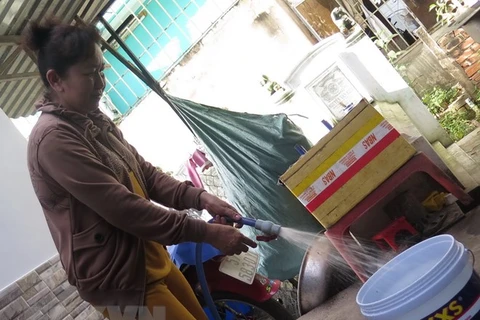
About 52 percent of residents in rural areas of Hanoi, or more than 2.23 million people, had get access to clean water by May 2018.
About 52 percent of rural residents in Hanoi enjoy clean water ảnh 1Illustrative Image (Source: VNA)

Hanoi (VNA) – About 52 percent of residents in rural areas of Hanoi, or more than 2.23 million people, had get access to clean water by May 2018, according to the municipal Department of Agriculture and Rural Development.

As scheduled, until the end of this year, projects to expand water supply networks will be completed, benefiting additional 61,000 households, and raising the ratio of rural people enjoying clean water to over 55 percent.

Hanoi has approved the proposals of 23 investors to carry out 34 projects covering 267 communes with 614,347 households and over 2.48 million people. Currently, contractors are installing pipes to supply water to local people.

A representative of Ha Dong Clean Water One-member Co. Ltd. said the firm is speeding up the construction of a pipe system to households for water supply projects in Ha Dong, Hoai Duc, Ung Hoa districts and Van Dinh town.

The percentage of people accessing clean water in many localities remains low, including in Ung Hoa district with only 29.5 percent and My Duc. 31.5 percent.

The reason behind the situation is limitation in coordination between investors and local administrations in some private-funded projects.

According to the department, in order to raise the ratio, the city will carry out an additional nine water supply projects for 78 communes with an aim to provide clean water to 673,180 people.

Hanoi also expects to increase the ratio of people enjoying clean water to about 55 percent at the end of the year. The city will also consider the approval of proposals on investment projects covering Me Linh, Ba Vi, Phuc Tho, Dan Phuong, Thach That and Chuong My districts. Hanoi also hopes that all communes will attract investors who are interested in water supply projects.-VNA
VNA

See more

NA Chairman Tran Thanh Man (left) and PM Le Minh Hung at the meeting with leaders of press agencies in Hanoi on June 14. (Photo: VNA)

NA, Government leaders meet with heads of press agencies

The press has taken a leading role in defending the Party’s ideological foundation, countering wrongful and hostile stances, and raising the volume and quality of mainstream information, contributing to a healthy, humane and responsible media environment, said NA Chairman Tran Thanh Man.

The UN Group of Friends for Combating Technology-facilitated Trafficking in Persons, makes its debut at a ceremony in New York on June 12 (Photo: VNA)

Vietnam joins UN group on combating technology-facilitated human trafficking

The ambassador affirmed that Vietnam attaches great importance to cooperation with countries, the UN, UNODC, and relevant partners in combating human trafficking. He also noted that the participation of several ASEAN countries as founding members reflects the region’s shared commitment to implementing the ASEAN Convention Against Trafficking in Persons, Especially Women and Children (ACTIP).

Prime Minister Le Minh Hung launches nationwide campaign for sustainable double-digit growth in Ho Chi Minh City on June 13. (Photo: VNA)

PM launches nationwide campaign for sustainable double-digit growth

Prime Minister Le Minh Hung called on ministries, sectors and localities to promptly translate the emulation movement into practical action plans and programmes, ensuring that emulation becomes not merely a campaign but a driving force for action, an ecosystem for discovering good models, replicating successful models and best practices.

NA Vice Chairwoman Nguyen Thi Thanh guides a student on how to use an English reading pen at the gift presentation event in Dien Bien province on June 12. (Photo: VNA)

NA Vice Chairwoman presents gifts to Dien Bien policy beneficiary families

Vice Chairwoman Nguyen Thi Thanh urged policy beneficiary families to carry forward revolutionary traditions, serve as role models for younger generations, and steer their children to follow Party’s guidelines and the State’s laws and policies, contributing to a more prosperous and civilised province.

The Vietnam Red Cross Society's members deliver gifts to needy people during the 2026 Humanitarian Month. (Photo courtesy of the VNRC)

Humanitarian Month raises nearly 762 billion VND

With the theme '80 Years - A Journey of Compassion for the Community', the campaign continues to affirm its role as a nationwide humanitarian initiative, mobilising participation across all levels, sectors, businesses, organisations, philanthropists and the general public to help those in difficult circumstances.

Participants of the 2026 Vietnam – China children’s exchange programme pose for a group photo (Photo published by VNA)

Vietnamese, Chinese children enhance mutual understanding, friendship

Participants gained deeper insights into the friendship between the revolutionary pioneers of Vietnam and China in their shared quest for national liberation, as well as a greater understanding that the achievements of national reunification in both countries were hard won and that the friendly neighbourly relationship and cooperation between them is of great value.

Border guards from Quang Tri and Khammouane provinces in the joint patrol (Photo: baochinhphu.vn)

Vietnam, Laos conduct joint patrol along shared border

Quang Tri and Laos’ Khammouane province agreed to strictly adhere to legal documents on border management, maintain delegation exchanges at all levels, increase cooperation in crime prevention and control, search and rescue, and run public awareness campaigns to encourage border residents to comply with border and border gate management regulations.

Students take Literature test (Photo: VNA)

Over 1.2 million students begin national high school graduation exam

Under the current examination format, candidates are required to complete the mandatory Literature and Mathematics tests, along with a combined test comprising two subjects selected from a range of options, including Physics, Chemistry, Biology, Informatics, Foreign Languages, History, Geography, Technology-Industry, Technology-Agriculture, and Economics-Law. Students may also choose to take a foreign language different from the one studied at school.