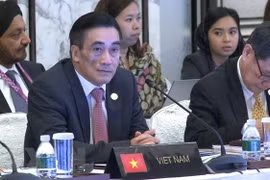
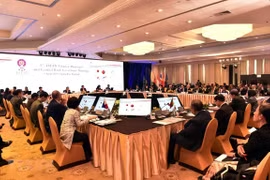
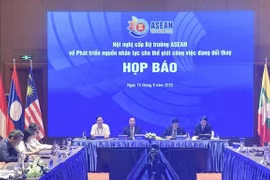
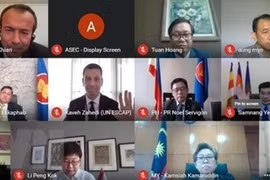
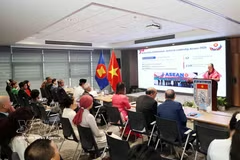
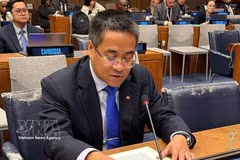
The 23rd ASEAN Finance Ministers’ and Central Bank Governors’ Meeting Plus Three (AFMGM 3) in Hanoi (Photo: VNA)
Hanoi (VNA) - The 23rd ASEAN Finance Ministers’ and Central Bank Governors’ Meeting Plus Three(AFMGM +3) was held virtually on September18, with discussions focusing on a wide range of measures to promote regional economic growth.
This is the most important meeting in a series of ASEAN 3 financial cooperationevents co-chaired by Vietnam and Japan this year.
ASEAN member nations’ Financial Ministers and Central Bank Governors and their Chinese,Korean and Japanese counterparts, along with leaders of international financial institutions,had a policy dialogue on global and regional macroeconomics as well as measuresto respond to the COVID-19 pandemic.
The Ministers and Governors also considered the implementation of cooperation initiativesunder the ASEAN+3 financial cooperation process and strategicdirections and new initiatives of the process, and adopted a joint statement ofthe meeting.
The participants shared views on risks and challenges posed by the COVID-19 pandemicto the global and regional economies as well as measures and policies regional economieshave been implementing to curb the health crisis and restore economic growth, includinga package of fiscal, monetary, and regulatory solutions to the financial system.
They alsomentioned that in the context of increasingly interdependent economies, the impactof the pandemic on global supply chains is even more severe.
This creates a requirement for financial and monetary management agencies to promptlyand effectively formulate and issue measures and macroeconomic policies, thus increasingthe resilience of economies to shocks and maintaining the stability and integrityof the financial system, they stressed.
The participantsemphasised the importance of financial cooperation for countries to strengthen theircapacity to respond to the impact of the pandemic and support economic recoveryin a sustainable manner.
Vietnamese Ministerof Finance Dinh Tien Dung said COVID-19 could not prevent cooperative activitiesamong regional countries.
Accordingto a report presented, working groups are still making ongoing efforts to pursuedirections set by Finance Ministers and Governors of Central Banks, and remarkableresults have been achieved, especially the improvements to the operational efficiencyof the ASEAN 3 Macroeconomic ResearchOffice (AMRO), the signingof the revised ChiangMai Initiative Multilateralisation (CMIM) Agreement,the implementation of activities under the Asian Bond MarketsInitiative (ABMI), and discussions on new cooperation initiativesin the future.
The participantsalso approved important technical issues, including amending the CMIM Agreement,which is important for tightening cooperation and increasing mutual support amongcountries in the context of the regional economy facing many difficulties and uncertainties.
They alsoappreciated AMRO’s efforts as an international organisation in the past time, activelyimplementing macroeconomic monitoring activities, providing assessments and analysisof the impacts caused by the COVID-19 pandemic on the region, and proposing policyrecommendations to ensure a stable macroeconomic and financial situation in theregion.
The attendeesalso acknowledged and highly valued the implementation and results of ABMI’s workinggroups on researching improvements to the environment to attract investors, developingnew investment tools, perfecting the legal framework, and developing infrastructurefor the bond market as well as implementing technical assistance programmes to developthe domestic bond markets of member economies.
To enhanceregional economic and financial stability, the participants welcomed the implementationof new initiatives within the framework of the Strategic Orientation of the ASEAN+3financial cooperation process.
The Ministers of Finance and Governors of Central Banks approved a joint statementof the meeting with high consensus.
The group’s member nations also appreciated Vietnam and Japan organising and chairingevents in 2020, and hoped that the 24th meeting will be successfullyheld in Tbilisi, Georgia, under the co-chair of Brunei and the Republic of Koreain 2021./.
VNA