Minister of Agriculture and Rural Development Le Minh Hoan visits local agricultural product stalls in Gia Lai. (Photo: VNA)
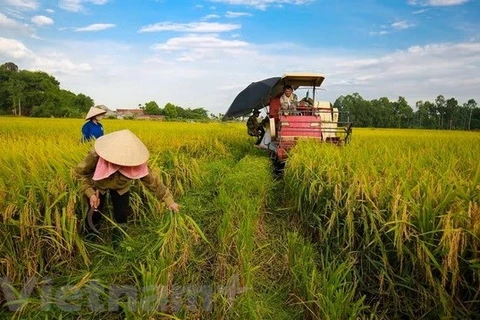
 Hanoi (VNA) - The farming sector will change its mindset from agricultural production to agricultural economy, which demands the formation of a professional workforce.
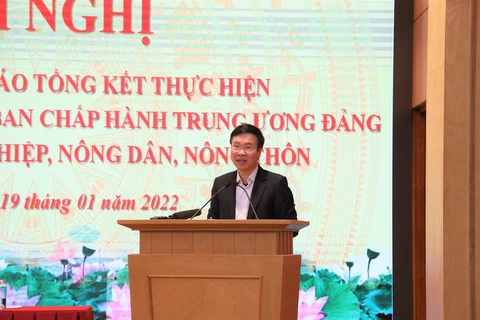
The promulgation of the strategy for sustainable agriculture and rural development to 2030 with a vision to 2050 is expected to identify the role, position and importance of agriculture and farmers, said Minister of Agriculture and Rural Development Le Minh Hoan.
Making the remarks at the ministry’s February 17 press conference to introduce the strategy, Hoan added that from such identification, localities will have commensurate investments in terms of capital and infrastructure serving the development.
Changing mindset
The strategy has set specific targets for the agro-forestry-fishery sector toward 2030, such as GDP growth at 2.5-3%, labour productivity increase at 5.5-6%; and export value growth at 5-6% on an annual basis.
The goals require the sector to innovate its production thinking, said Minister Hoan. This means a shift from agricultural production to agricultural economy to focus on value enhancement, efficiency and diversification following the value chain and market requirements, as well as from single-sector development to multi-sector integration, and from “single value” to “multi-value integration”.
Tran Cong Thang, Director of the Institute of Policy and Strategy for Agriculture and Rural Development (IPSARD), said in the new period, if you want to increase the scale of production and improve the position of farmers, it is imperative to cooperate effectively.
Cooperative economy, cooperative groups, and clubs are good models that need to be promoted further, Thang added.
The strategy has set the goals of improving efficiency and income from agricultural production; gradually forming a contingent of professional farmers; creating conditions for farmers to build their farm economy and cooperative economy. Therefore, developing a service economy in rural areas is expected to be a solution to creating jobs and attracting labour forces who are not engaged in agricultural production.
One of the solutions to build a professional workforce is to have a policy to support farmers in specialised farming areas to participate in training programmes to get certificates.
 At the press conference to announce the strategy for sustainable agriculture and rural development to 2030 with a vision to 2050 (Photo: VNA)
 Hoan emphasised that the process of transforming the growth model in agriculture sets certain requirements on the accessibility and application level of scientific, technical and advanced technological achievements.
The agriculture and rural development sector will have to make the most of existing resources to gradually build a modern farming industry with high productivity, quality, efficiency, sustainability and competitiveness; and to improve the quality of life, role and position of farmers and rural residents, said the minister.
Promoting land concentration
In order to realise the strategy of modern and sustainable agricultural development, experts believe that concerted efforts and participation from the Government, ministries and sectors, departments, associations, enterprises, cooperatives, farmers, local authorities at all levels are necessary.
Appropriate and breakthrough policies and mechanisms are also needed, they noted.
According to Thang from the IPSARD, policies on land use need to be amended flexibly, serving the development of the transaction market and promotion of land concentration.
Echoing the view, Nguyen Van Viet, director of the Planning Department under the Ministry of Agriculture and Rural Development, said the new strategy requires breakthroughs in land-related policies.
Vietnam can learn from the model of agricultural land transaction centers in a bid to promote land concentration and connect businesses and farmers, the official said.
Investment in basic infrastructure is considered a foundation for agricultural growth. Typically, the development of irrigation infrastructure must ensure multiple purposes, serving both fisheries and forestry. Meanwhile, attention should be paid to commercial infrastructure such as a system of markets and wholesale centers; and logistics infrastructure, including wharfs, regional connection centers, and traffic linking specialised farming areas./.