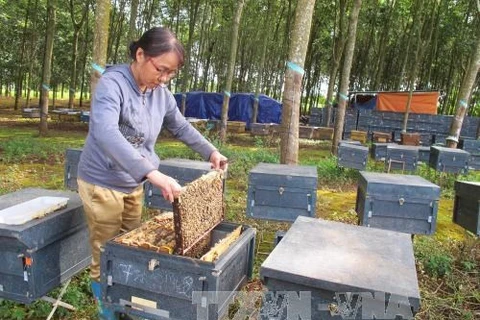
A customer chooses honey at an HCM City Honey Bee Joint Stock Company (Behonex) store in Phu Nhuan district. (Photo: courtesy of Behoney)
 As the US Department of Commerce (DOC) plans to apply its highest rate of more than 412 percent on raw honey imported from Vietnam, 35 Vietnamese companies exporting honey with an annual turnover between 70 million USD and 100 million USD are being put under pressure.
According to insiders, at the end of 2021, the DOC issued preliminary conclusions on the anti-dumping investigation into Vietnamese honey products, determining the dumping margin for honey products originating in Vietnam from 410.93 percent to 413.99 percent and imposed a corresponding temporary tax rate, adding that a conclusion on the application is set to be issued by next month.
Le Thanh Van, Chairman of the Vietnam Honey Exporters Association, said: “With such shocking and unbelievable anti-dumping tax rates, it is difficult to export honey to the market. America. This is an unreasonable tax because for honey to be exported to the US, it must meet strict standards from the US side, such as meeting the quality standards of the US Food and Drug Administration (FDA).”
Van, also chairman of Dak Lak Honey Bee Joint Stock Company, one of the two mandatory defendants of the lawsuit, said Vietnamese honey does not compete with US honey because it was mainly used in processing not sold directly to consumers like US honey.
In addition, Van said Vietnam has been exporting honey to the US since 1991 with stable output, and it was unreasonable for the US beekeeping industry to say that Vietnamese honey hurts them.
Van’s business has spent more than half a million US dollars to pursue the lawsuit. He told local media: “This amount is really too much for businesses, so the future will be even more difficult if there are adverse developments because it will cost many times more,” referring to the cases of shrimp and pangasius in foreign markets previously.
Similarly, Dang Ba Long, director of the HCM City Honey Bee Joint Stock Company (Behonex), which spent 12,000 USD to join the lawsuit, said: “As Vietnam’s honey industry is too dependent on the US market, if the above preliminary tax rate is imposed, the whole industry may be destroyed."
“The harvest season is from March to October every year. So if the DOC announce the rate in April, as the peak time of harvesting the products, the industry will face an oversupply crisis, and the price will plummet."
Long said that Behonex had been doing domestic business for a long time. However, the turnover rate in the local market was still low, less than 30 percent of total revenue, as most Vietnamese consumers do not consider honey as a daily food but a medicinal product, which they use very occasionally.
He said that although the price of honey was not much higher than sugar - a litre of honey costs only 100,000 VND (4.3 USD) - the value of honey was not recognised in Vietnam.
He calculated that if 100 million Vietnamese people used honey as in the US and EU, the output of the industry, about 70,000 tonnes per year, was not a problem, but until that day “losing the US market, the honey industry will be extremely difficult.”
Last month, spokesperson for the Ministry of Foreign Affairs Le Thi Thu Hang said Vietnam has strongly protested the DOC’s plan to impose an anti-dumping tariff on its raw honey products.
Previously, the Ministry of Industry and Trade and the Ministry of Agriculture and Rural Development (MARD) had discussions with the US at different levels, including the DOC, asking the US to make sure any measures imposed were based objective, fair and in line with World Trade Organization (WTO) regulations.
Tong Xuan Chinh, Deputy Director of MARD’s Department of Livestock Production, said the most critical solution was the close coordination from ministries, departments, branches and state management agencies to guide businesses and farmers to comply with requests from the US
Chinh said it was necessary to develop safety criteria for honey to have a basis for evaluating the quality of exported products.
“It is necessary to strengthen trade promotion to diversify honey export markets, avoiding dependence on each US market. Enterprises need to diversify products and promote domestic consumption so that consumers use honey more,” he said.
Lawyer and lecturer at Foreign Trade University Nguyen Ngoc Ha told local media: “Vietnamese businesses should consider taking advantage of some of Vietnam’s FTAs market such as the EU and other countries that have ratified the CPTPP to reduce dependence on the US.”
Ha said the Government might consider using an appropriate mechanism such as consultation, dispute settlement under the Anti-Dumping Agreement or the WTO Dispute Settlement Agreement to protect the industry.
Ha also suggested the Government keep negotiating so that the US recognised Vietnam as a market economy to avoid using the domestic selling price of a third country when determining the dumping margin.
Ha said: “Vietnamese enterprises need to determine their willingness to be subjected to trade remedies by foreign countries and develop an appropriate business strategy in which to diversify export markets to reduce dependence on a single market.”
At the same time, he told local enterprises to update the regulations on anti-dumping or trade remedies of the host country to be more positive in dealing with potential issues./.
VNA