Agriculture plan needs a boost

Minister of Agriculture and Rural Development Nguyen Xuan Cuong has spoken to local media about measures to boost agricultural restructuring to further develop the sector.
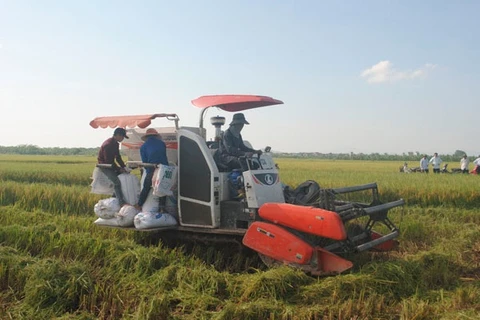
Agriculture plan needs a boost ảnh 1A farmer mans a combine harvester (Photo: VNA)

Hanoi (VNA) - Minister of Agriculture and Rural Development Nguyen Xuan Cuong has spoken to local media about measures to boost agricultural restructuring to further develop the sector. 

Q: Vietnam has implemented an agricultural restructuring master plan for three years but in the first six months of this year, the sector recorded a negative growth for the first time. Why do you think that is?

A: In the first six months of the year, the agricultural sector for the first time recorded a negative GDP growth rate of 0.18 percent. The agricultural sector still plays a very important part in the country’s economic development, with 70 percent of the population living in agricultural areas and 46 percent of the country’s workers being employed there. Therefore, the negative growth is a great concern because it will affect farmers, particularly in disadvantaged areas.

The key reason for the problems is the consequences of climate change that was more serious than our forecast, negatively affecting all agricultural production. Moreover, as Vietnam has integrated deeper into the world economy, we have more opportunities to export farm produce but we have to face fiercer competition from other countries.

To deal with that, the agricultural sector must be restructured toward the production of commodities and sustainable value chains.

Q: How has the agricultural sector changed after three years of implementing the agricultural restructuring master plan?

A: Initial results show as improvement in the awareness of business, society and people about agricultural restructuring as reflected in the fact that all 63 localities have specific action plans and programmes.

For example, the Central Highlands province of Lam Dong applied high technology in agricultural production on 25 percent of its farm land, bringing in an average income of 243 million VND (10,800 USD) per hectare. The Mekong Delta province of Dong Thap focused its development policies and planning on five key products, including flowers, rice, ducks, fruits and seafood. Or the northern mountainous province of Ha Giang focuses on exploiting its strengths in vegetables, herbal medicine and in reorganising the husbandry sector.

Besides, a number of sectors have recorded positive results in the restructuring process, such as the dairy and husbandry sectors. Pig raising produces an average of 4-4.5 million tonnes of meat each year.

However, agricultural restructuring takes time. After three years, according to our general assessment, positive changes have been recorded in some sectors and localities, while the remaining ones still need to carry out the restructuring plan more resolutely.

Q: Some people say businesses should invest in agriculture in order to carry out restructuring. What do you think?

A: In order to restructure agricultural production towards modernity, businesses will be a key factor, serving as a foundation for all commodity production. About 3,600 businesses have invested in agriculture, out of nearly 500,000 businesses in the whole economy, equivalent to nearly 1 percent. That figure is still too small.

In recent years, related policies and mechanisms are encouraging businesses to invest in agriculture. However, there are still a number of issues that make these policies and mechanisms hard to adopt. For example, Government Decree 210 on incentives for enterprises investing in the farming industry and rural areas targets all regions of the country, but the development conditions at each locality and region are different. Also, the post-investment support policy provides financial support worth a maximum of 2.5 billion VND (111,000 USD) for businesses, but investment in agriculture carries a high risk and a number of sectors require huge investment capital, so many localities lack funds to support businesses.

Besides, shortcomings remain in various types of credit supply or access to land funding. Therefore, the Prime Minister has entrusted the Ministry of Agriculture and Rural Development and relevant ministries and agencies to study, assess and recommend changes to Decree 210. This is meant to encourage businesses to invest in agriculture and to provide conditions to develop large-scale production.-VNA

VNA

See more

Ben Thanh Market in Ho Chi Minh City attracts a large numbers of domestic and international visitor.( Photo: VNA)

Vietnam targets 50 million international visitors by 2030

The Ministry of Culture, Sports and Tourism has outlined three scenarios for 2027–2030. Under the high-growth scenario, international arrivals would rise 15–18 percent annually to reach 45–50 million, while domestic tourism would reach around 160 million trips. Total tourism revenue is projected at 80–90 billion USD.

Factories and production facilities in the Chu Lai Open Economic Zone, Da Nang city, are equipped with modern production lines. (Photo: VNA)

Ready-built factories gain from new manufacturing FDI wave

Ready-built factories attracted 73% of new manufacturing FDI in northern Vietnam over the past two quarters, as foreign investment continued to surge at the region's industrial hubs during the first eight months of 2026. The trend points to growing demand for premises that can be put into operation quickly.

Vietnamese durian industry pivots from volume to value

Vietnamese durian industry pivots from volume to value

Durian has morphed from a high-value crop into a strategic Vietnamese export. But as output climbs and importing markets tighten rules on quality, food safety and traceability, the industry must pivot from volume growth to sustainable value chains, better quality and diversified markets.

A display area for Mid-Autumn Festival cakes at a supermarket (Photo: VNA)

Mid-Autumn Festival cake market heats up at affordable end

Industry insiders say competition is no longer just about the cake itself. Product quality, packaging, brand reputation, delivery services and personalisation are increasingly shaping consumer choices in a market crowded with both domestic and foreign players.

Minister of Foreign Affairs Le Hoai Trung (Photo published by VNA)

Vietnam, India set 25 billion USD trade goal

Vietnam and India agreed to make better use of complementary strengths, ease market access difficulties and facilitate business activities toward achieving the 25 billion USD bilateral trade target.

Delegates at the meeting between Vietnamese businesses operating in Cambodia and the Council for the Development of Cambodia (CDC) on September 14. (Photo: VNA)

Vietnamese businesses seek to expand investment in Cambodia

Vietnam currently has 223 investment projects in Cambodia with total registered capital of nearly 3.4 billion USD. Vietnamese companies operate in agriculture, particularly large-scale farming, finance and banking, telecommunications, aviation, processing, trade and services.

Children visit President Ho Chi Minh's hometown and learn about his childhood. (Photo: VNA)

Vietnam's tourism sector faces labour shortage

A 2026 survey by Hoteljob.vn found that nearly 90% of tourism businesses planned to recruit. In Ho Chi Minh City alone, 89.7% of businesses were hiring, while 71.8% said recruitment was difficult or very difficult. The biggest shortages were among frontline workers, particularly in housekeeping, engineering, food service, front-office operations, and kitchens.

Octopus processing for export at Huy Nam Company in An Giang province. (Photo: VNA)

New opportunities for Vietnam’s seafood exports

The Vietnam-EFTA Free Trade Agreement brings together two groups of highly complementary economies. EFTA members Switzerland, Norway, Iceland and Liechtenstein have strengths in technology, innovation, finance, clean energy and sustainable development, while Vietnam is one of Asia’s most dynamic economies and is emerging as a major regional manufacturing, trade and investment hub.

The saponin content of Lai Chau ginseng can reach as high as 23.85% in its natural state, a remarkably high level compared to many other ginseng species. (Photo: baolaichau.vn)

Lai Chau ginseng development gains momentum

Blessed with rare and distinctive ecological values, the northern mountainous province of Lai Chau is stepping up efforts to conserve and develop its native ginseng, with the medicinal plant expected to play a growing role in the forest-based economy and local livelihoods.

The Vietnamese delegation poses for a group photo at the third meeting of the Vietnam-Canada Joint Economic Committee (Photo: VNA)

Vietnam, Canada broaden economic cooperation beyond trade

Vietnam is currently Canada’s largest trading partner in ASEAN. Building on the Comprehensive and Progressive Agreement for Trans-Pacific Partnership (CPTPP), the two countries are expanding bilateral economic ties into higher value-added areas such as clean energy, critical minerals, advanced technology, manufacturing and value-chain linkages.