AI can help Vietnam become new technology hub

A stable economy, a rapidly developing ecosystem, a favourable startup environment, low costs, and support from policies are creating favourable conditions for Artificial intelligence (AI) startups to thrive, said insiders.

The seminar “AI Frontier: Funding and Futures in Vietnam” in Hanoi on May 22 (Photo: VietnamPlus)

Hanoi (VNA) – A stable economy, a rapidly developing ecosystem, a favourable startup environment, low costs, and support from policies are creating favourable conditions for Artificial intelligence (AI) startups to thrive, said insiders.

AI is developing rapidly and gradually establishing itself as a foundational and breakthrough technology in the 4th Industrial Revolution. However, this process also faces numerous challenges and barriers while impacting various aspects of contemporary life in positive ways.

Increasingly fierce competition

The race to develop AI is becoming increasingly fierce globally and is expected to significantly change behaviour, not only for individual users but also for businesses.

To leverage the potential along with practical opportunities for AI development solutions, the Vietnam National Innovation Centre (NIC) in collaboration with the Ministry of Planning and Investment (MPI) partnered with Amazon Web Services (AWS) to organise a seminar themed "Vietnam AI Frontier: Funding and Futures in Vietnam” on May 22 as part of the Vietnam Innovation Challenge (VIC) programme.

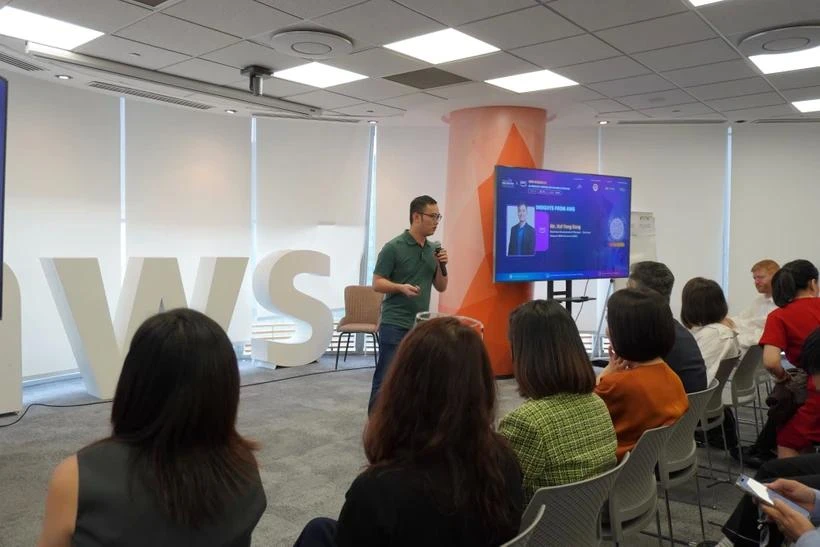
Sharing insights into the future of AI, Kai Yong Kang, Business Development Manager - Startups at Amazon Web Services (AWS) said that 2024 is referred to as the "year of products."

He said that within the vast scope of AI, Generative AI (GenAI) has been the hottest topic recently. This represents a significant advancement where technology can mimic human intelligence by generating new content (such as text, image, music, video) from the data it has been trained on. GenAI is fundamentally changing human behaviour and approaches to work, learning, entertainment, artistic creativity, and deeply impacting all aspects of life.

AI2.webp
Vietnam’s startup ecosystem has recorded remarkable strides in recent years. (Photo: VietnamPlus)

Regarding this, Le Vy, CEO of Do Ventures Fund, noted that technology companies are heavily investing in GenAI.

According to Vy, the most important factor for startup development is to create favourable infrastructure.

Vietnam boasts a stable economy, rapidly developing ecosystem, conducive startup environment, low costs, and support from government policies and large enterprises. All of these have provided great conditions for AI startups to flourish, Vy said.

Many GenAI founders benefit from partnerships with large corporations, where vast systems and data are readily available, she noted, adding that this is particularly impressive as corporations in Vietnam all have policies to collaborate with startups.

Vy said a huge amount of capital is being directed to GenAI startups in leading technology centres such as Silicon Valley and Europe.

However, she also noted that the AI ​​market, although "fertile", is also changing rapidly, as applications are constantly updated, therefore, investors in the region need to consider carefully before deciding to cooperate with a GenAI startup.

The three key factors to evaluate an AI startup are competitive advantage, revenue model, and human resources, Vy said.

Meanwhile, Laura Nguyen, Partner at GenAI Fund, emphasised that the top concern of investment funds is ensuring the sustainability of startups' business models.

Laura said that GenAI startups need to focus on protecting their businesses against risks from the AI ​​market, while always innovating and creating.

According to Valerie Vu, Founder of Ansible Ventures, with their intelligence and abilities, Vietnamese engineers can take their AI applications to the world.

While Western countries focus on software development, Vietnam has the advantage of high-quality human resources, both in charge of software and hardware development, Valerie said.

With its role of coordinating, creating a legal corridor and supporting policy mechanisms, the MPI is making initial efforts in building the foundation for the startup ecosystem.

The VIC 2024, which is co-organised by the Ministry and US tech giant Meta Group is one of the key programmes.

With strong pushes from policies and support from programmes such as VIC, participants shared the view that AI has great potential to contribute to socioeconomic development, improving the quality of life and work efficiency in Vietnam./.
VNA

See more

Participants in the ASEAN Plus Photonics Symposium in Gia Lai province on April 8 (Photo: baogialai.com.vn/)

Gia Lai province hosts ASEAN Plus Photonics Symposium

Participants presented and discussed a wide range of advanced topics shaping the future of photonics, including nanophotonics and metasurfaces; topological and non-Hermitian photonics; photonic crystals and optical lattices; light–matter interactions and polariton systems.

Vietnamese Ambassador to Brazil Bui Van Nghi (right) and Professor and quantum physicist Olival Freire Juniorin, President of Brazil's National Council for Scientific and Technological Development, at their meeting on April 7. (Photo: Vietnamese Embassy in Brazil)

Vietnam, Brazil to strengthen cooperation in science, technology

Ambassador Bui Van Nghi expressed Vietnam’s interest in strengthening cooperation with Brazil in areas such as renewable energy and environmental technologies, as well as high-tech sectors including artificial intelligence (AI), quantum technology, and the semiconductor industry.

Teachers guide students in experiencing the application of science (Photo: VNA)

Results become benchmark for science-technology governance

The transition to facilitative governance marks not only an operational reform but also a shift in development thinking. With expanded autonomy and controlled risk acceptance, science, technology, innovation and digital transformation are expected to become key drivers of rapid and sustainable growth in the years ahead.

Students experience robotic products (Photo: VNA)

AI powers sweeping overhaul of Vietnam’s education system

Nguyen Son Hai, Deputy Director General of the Department of Information and Communication Technology under the Ministry of Education and Training (MoET), said the sector has made rapid strides in digital transformation, from online classes during the COVID-19 pandemic to nationwide platforms covering the national education database, registration for high school graduation exam, and online university admissions.

Voters can access essential information about candidates on the VNeID app, enabling them to proactively learn and enhance their awareness when participating in elections. (Photo: VNA)

Digital transformation gathers pace nationwide

Adopted by the Politburo in late 2024, Resolution 57 positions science – technology development, innovation, and digital transformation as a top important breakthrough and strategic pillar for Vietnam’s development in the new era. Early implementation shows a clear shift toward data-driven governance and technology-enabled public services.

Can Tho city pledges to allocate at least 1% of total budget spending to science, technology and innovation (Illustrative image. Source: VNA)

Plan issued to implement Vietnam–France agreement on science-technology cooperation

Under the plan, the Ministry of Science and Technology will take the lead, in coordination with relevant ministries and agencies, in directing, guiding, monitoring and inspecting the implementation of the agreement. The ministry will also prepare reports on the signing and implementation progress for submission to the Ministry of Foreign Affairs for consolidation and reporting to competent authorities as required.

An overview of the provincial steering committee of Tay Ninh on implementing Resolution 57 on April 2 (Photo: VNA)

Tay Ninh moves to accelerate digital transformation

In science, technology and innovation, Tay Ninh has identified six major priorities: development of the digital economy, a carbon credit market, a Halal ecosystem, renewable energy, enterprise innovation support, and applications of artificial intelligence and big data.

Vietnam successfully held its first auction of national “.vn” domain names from March 18 to 20. (Photo: VNA)

Sci-tech revenue up 17% in March

The sci-tech sector contributed 133.5 trillion VND to the country’s gross domestic product (GDP) in March, a 28% increase from the same period last year.

By 2030, Vietnam targets ranking among the world’s top 15 countries in the Global Cybersecurity Index (Source: baochinhphu.vn)

Project aims to enhance capacity of national cybersecurity protection force

The project aims to strengthen overall capabilities and develop an elite and modern cybersecurity force able to proactively prevent and effectively respond to all cyber risks and threats, safeguarding national security, social order and safety, and the rights and lawful interests of organisations and individuals in cyberspace.

Delegates at the meeting (Photo: VNA)

Da Nang boosts hi-tech partnership with Germany’s Chemnitz City

Authorities in Da Nang hope Chemnitz and German partners will continue to accompany and support the city in accessing advanced technologies, connecting experts, integrating into innovation ecosystems, and attracting high-tech enterprises and supporting industries to explore investment and long-term cooperation opportunities.