Ample room remains for ASEAN-Japan cooperation: researcher

President of the Economic Research Institute for ASEAN and East Asia (ERIA) Watanabe Tetsuya said on December 14 that there are many fields with good potential for cooperation between Japan and the Association of Southeast Asian Nations (ASEAN) and between Japan and Vietnam.
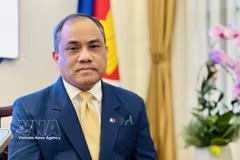
Ample room remains for ASEAN-Japan cooperation: researcher ảnh 1President of the Economic Research Institute for ASEAN and East Asia Watanabe Tetsuya (R) granting interview to Vietnam News Agency correspondent in Jakarta (Photo: VNA)
Jakarta (VNA) – President of the Economic Research Institute for ASEAN and East Asia (ERIA) Watanabe Tetsuya said on December 14 that there are many fields with good potential for cooperation between Japan and the Association of Southeast Asian Nations (ASEAN) and between Japan and Vietnam.

In an interview granted to Vietnam News Agency correspondents in Jakarta on threshold of the Commemorative Summit for the 50th Year of ASEAN-Japan Friendship and Cooperation to be held in Tokyo from December 16-18, Watanabe said that the summit not only marks the 50th anniversary of the two sides’ friendship and cooperation but is also a very important opportunity to "renew" their partnership for the next 50 years.

The leaders will discuss major areas of cooperation such as politics, economics, socio-culture, along with many new projects. However, the researcher said that one of the important topics of the summit is energy transition cooperation, which is very important for both Japan and ASEAN.
 
In the context that ASEAN and Japan are facing common challenges, including the transition to a more sustainable and carbon-free economy and society, Watanabe thought that the two sides should cooperate extensively in this "front", adding that innovating platforms and supply chains is very important.

According to the ERIA President, ASEAN is a very fast growing economic region, and has many opportunities to promote economic growth, business and investment with a relatively young population structure. Meanwhile, Japan is a mature economy with huge investment capital, many research & development activities, as well as advanced technology in the fields of digital technology, semiconductor, and artificial intelligence (AI). Therefore, the two sides can complement and take advantage of each other's strengths.

Regarding Vietnam's role in ASEAN-Japan cooperation as well as Vietnam's position in Tokyo's "Global South", Watanabe assessed Vietnam as an emerging economy with great importance for other countries around the world. Japan and Vietnam have maintained good friendship for decades, and promoting bilateral cooperation will be beneficial for both countries, for ASEAN and the whole world.

He also listed a series of potential fields of cooperation between Japan and Vietnam, such as energy transition, digital economy, decarbonisation, electric vehicles, supply chains, automobiles and electronics.

Especially, for a strongly growing economy like Vietnam, improving public transportation is an important agenda, which offers an opportunity for Japan and Vietnam to cooperate in high-speed trains, subways and inner-city transportation, said the researcher.

He noted that many Japanese companies are currently looking for opportunities in investment and establishing production facilities in Vietnam, and this trend will continue to increase in the near future.

In addition, in the face of current geopolitical tensions and fierce competition between major countries, many companies and investors are adopting more flexible supply chain strategies. In that context, Vietnam is in a very good position and is one of the most attractive alternative investment destinations for global entrepreneurs, he added./.
VNA


See more

An overview of the ASEAN Foreign Ministers’ Meeting on November 14, 2026 (Photo: VNA)

Vietnam backs ASEAN culture of consultation, dialogue, preventive diplomacy

Deputy Minister of Foreign Affairs Dang Hoang Giang stressed that amid conflicts and instability in various parts of the world, ASEAN should give top priority to strengthening the foundations of peace and stability, uphold the rule of law and promote the bloc’s principles and norms of conduct, particularly the Treaty of Amity and Cooperation in Southeast Asia (TAC).

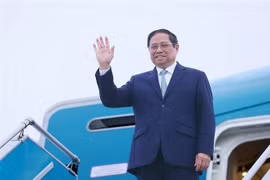
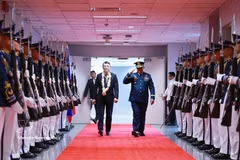
The welcome ceremony for Prime Minister Le Minh Hung at Ninoy Aquino International Airport on November 14 afternoon (Photo: VNA)

Vietnamese PM arrives in Philippines for 49th ASEAN Summit

PM Le Minh Hung’s attendance underscores Vietnam's sustained commitment to the bloc, which aligns consistently with the foreign policy set forth by the 14th National Party Congress, which defines ASEAN as a bloc of strategic importance and a top priority in Vietnam’s external relations.

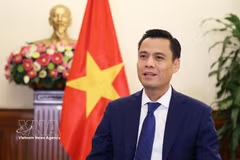
Deputy Minister of Foreign Affairs Dang Hoang Giang. Photo: VNA

Vietnam aims to promote ASEAN unity, resilience and practical cooperation: Deputy FM

Prime Minister Le Minh Hung's attendance at the 49th ASEAN Summit and related summits in Manila, the Philippines, from November 14-17 aims to concretise Vietnam's foreign policy of independence, self-reliance, resilience, multilateralisation and diversification, and reaffirm ASEAN's position as Vietnam's foremost strategic priority in its foreign policy.

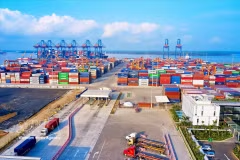
A road is under construction in Dong Nai city, Vietnam. (Photo: VNA)

ADB: Southeast Asia needs 7.1 trillion USD in infrastructure investment by 2040

ADB estimates that the region will need an average of 476 billion USD in infrastructure investment annually during 2026–2040, equivalent to 8.7% of GDP. However, at current investment levels, government budget resources would cover only around 45% of this demand, leaving an annual financing gap of 264 billion USD.

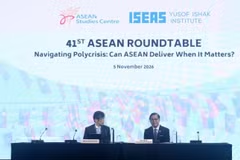
Thai Deputy Prime Minister and Minister of Foreign Affairs Sihasak Phuangketkeow (R) takes part in the Q&A session at the 41st ASEAN Roundtable. (Photo: VNA)

Thailand calls on ASEAN to proactively address polycrisis

Thai Deputy Prime Minister and Minister of Foreign Affairs Sihasak Phuangketkeow noted that no single member state could tackle challenges ranging from major-power competition and economic fragmentation to climate change and energy and food security on its own. Regional cooperation is therefore a strategic imperative, enabling ASEAN not only to overcome crises but also to sustain its development momentum.

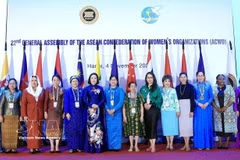
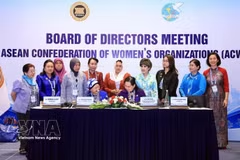
Participants in the 22nd General Assembly of the ASEAN Confederation of Women’s Organisations pose for a group photo. (Photo: VNA)

Women play key role in building united, resilient, sustainable ASEAN Community

Hosted by the Vietnam Women’s Union (VWU), the 22nd ACWO General Assembly marked another milestone in ACWO’s cooperation and development, allowing ASEAN women’s organisations to strengthen solidarity and mutual trust, share experience and identify cooperation priorities for the region’s next stage of development.

Delegates sign an agreement admitting the Timor-Leste Women’s Network Rede Feto as ACWO’s 11th member. (Photo: VNA)

ASEAN Confederation of Women’s Organisations holds Board of Directors meeting in Hanoi

Amid ongoing regional and global changes, which bring both new opportunities and challenges for women, the role of the ASEAN Confederation of Women’s Organisations in connecting organisations and promoting collective action has become increasingly important. This requires continued innovation in its operating methods, stronger ties among members and greater promotion of women's voices and roles in building a united, resilient, inclusive and sustainable ASEAN Community.

Haze in Kuala Lumpur Airport, Malaysia (Photo: VNA)

ASEAN countries step up efforts to combat transboundary haze

ASEAN already has the ASEAN Specialised Meteorological Centre (ASMC), based in Singapore since 1993. The establishment of the ASEAN Coordinating Centre for Transboundary Haze Pollution Control is expected to complement this mechanism by strengthening cooperation among member states and improving the region's response to transboundary haze pollution.

Japanese Minister of National Defence Koizumi Shinjiro (Photo: Xinhua/VNA)

Japan shores up defence ties with ASEAN

Japanese Minister of National Defence Koizumi Shinjiro said members must bridge differences to tackle shared challenges and proposed expanding Japan–ASEAN cooperation with outside partners into AI, unmanned systems and the protection of undersea critical infrastructure.

Speakers at the discussion (Photo: VNA)

ASEAN digital pact key to facilitating cross-border business

At a panel discussion on policy frameworks for the digital economy, held as part of the Autumn Economic Forum 2026 on October 27, speakers said ASEAN needed to ensure national systems could work together while protecting data and facilitating business, rather than impose uniform rules across the region.