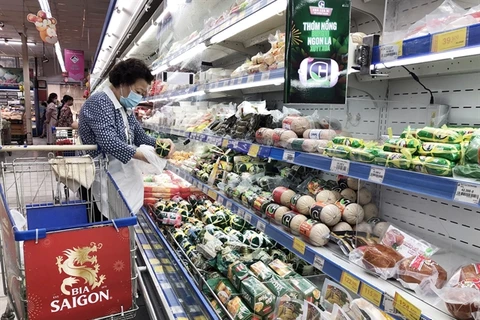
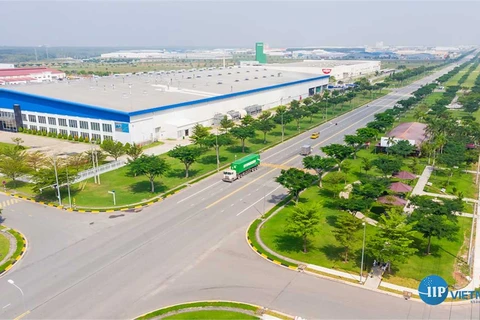
Many experts and businesses believe that the domestic cold storage market will have to encounter more challenges in order to advance to the next stage in the process of industrial logistics development. (Photo: VNA)
 According to Savills Vietnam, the first commercial cold storage in Vietnam was built in 1996 by Konoike VinaTrans, a logistics joint venture between Konoike Transport Co. Ltd of Japan and three Vietnamese companies.
However, Vietnam’s cold storage landscape is localised and highly fragmented, with over 40 projects providing a total of 460,000 sq.m of cold chain warehouse space in 2022, it said.
In fact, the country’s fresh food sales surged from 40.4 billion USD in 2020 to 45.7 billion USD last year, a compound annual growth rate (CAGR) of 6.3%.
Its e-commerce market also witnessed a remarkable annual growth rate of 21.5% from 2017 to 2022, fueling the expansion of all kinds of complimentary services.
Thomas Rooney, Senior Manager of Industrial Services at Savills Hanoi, said domestic companies provide the most new supply. At the end of 2022, An Viet, Phan Duy, Hung Vuong and ABA Cool Trans were the leading cold storage suppliers, however, foreign companies, such as Lineage Logistics, SK Logistics, and Lotte Logistics are also actively expanding their presence in the market.
Nonetheless, demand continues to outstrip supply in Vietnam, with the rise of e-commerce platforms placing immense pressure on cold storage capacity. The overall market occupancy rate stood at around 88% at the end of 2022, with major markets such as Ho Chi Minh City, Binh Duong, Long An, and Bac Ninh provinces hovering over 90%, Rooney pointed out.
Most existing stock is concentrated in Ho Chi Minh City and its surrounding provinces, such as Binh Duong, Long An, and Dong Nai, which together account for 87% of the total.
Rents for cold storage warehouses vary greatly across the submarkets, as the more developed facilities with better value-added services in HCM City command much higher rental levels, almost double those of other regions. On average, prime cold storage warehouse rents in Vietnam often fall in the range of 22 USD (Bac Ninh) to 50 USD (HCM City) per tonne.
Many experts and businesses believe that the domestic cold storage market will have to encounter more challenges in order to advance to the next stage in the process of industrial logistics development, requiring service providers to constantly take innovations and reforms in both operation and technology.
Rooney said that a well-located, well-designed automated warehouse will outperform conventional competitors from an operating cost perspective, and the market will see more transactions and greater institutional involvement ahead.
In fact, foreign investment funds are pouring much capital into cold storage construction in Vietnam due to its attractiveness and large potential. Along with cold storage, cold transport - refrigerated container – is also facing a lot of competition amid rising supplies. Businesses have switched from regular containers to investing in more than 500 refrigerated containers, mainly serving agriculture, fishery, health care and food.
Real estate services firm JLL believes that numerous factors will drive an investment recovery in cold storage assets by 2030, where volumes have contracted from a 2021 high.
Specifically, investors will be drawn to the greater stability of the sector compared to other asset classes, supported by evergreen demand for perishable goods like food and medicine housed in cold storage facilities. Additionally, attractive leasing covenants, whereby rents are typically higher than standard logistics and industrial facilities and lease terms are longer, will attract forward-thinking investors.
More recently, the higher barriers to entry into cold storage have influenced activity in the sector but will draw more specialised investors and operators to the sector. According to JLL analysis, there is a growing acceptance that cold storage investment requires a deep understanding of the unique complexities associated with temperature-controlled environments, logistics, and regulatory compliance. As a result, this operational reality can act as a competitive advantage for knowledgeable investors, while creating a deterrent to other investors.
Additionally, for the sector to meet consumer demand for both efficiency and to address global disruptions, investment in technology is an increasingly important consideration for investors eyeing cold storage facilities. Advancements in automation, robotics, and energy efficiency can significantly enhance the operational efficiency of cold storage facilities and help reduce operator/occupier costs as technology improves./.
VNA