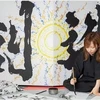
Nguyen Dang Hieu works on a painting. (Photo: VNA)
 Bac Ninh (VNS/VNA) - It's a bright sunny day in Ho Village in the northern province of Bac Ninh, and locals awake to the sound of machines printing votive money for the dead as they set about their daily routines.
In contrast, it's relatively quiet inside the Folklore Cultural Exchange Centre run by master artisan Nguyen Dang Che, who has ignored technical advancements and instead chooses to continue creating folk paintings by hand.
Pressing a woodblock with paint onto a piece of poonah paper, Che's 22-year-old grandson, Nguyen Dang Hieu, then carefully make a painting.
The result is vivid images of a mouse wedding with the bride and groom accompanied by a long procession.
He then puts the paper aside to let it dry and starts on another piece. Surrounding Hieu, his father, uncles are busy as well.
They are all descendants of artisan Che, who has been given credit for reviving this traditional form of printing in the early 1990s.
Che is 84, but he's still fairly agile and sharp, and wanders round the workshop giving advice to his sons, daughters and grandchildren.
Hieu said he has learnt every stage of creating a traditional Dong Ho painting, from drawing and mixing the colours, to carving the woodblocks and printing.
“None of it is simple, but I've been learning since I was six years old,” he tells Vietnam News. “I used to play in the workshop and I gradually absorbed the craft because it was like a game to me.”
“I’m proud to be part of a family with a traditional handicraft,” he said. “I know this career should be handed down to future generations.”
Hieu said it’s important to make people understand the art so they can help preserve it.
“I want to do more research into fine arts, colours, materials and methods to develop the folk painting further and to produce different designs that suit modern life,” he said.
Hieu is one of the few young people in the village to pursue the old-school methods in his career, despite all 250 households in the village being involved in the industry.
Together with Hieu, Nguyen Huu Dao, 29, son of artisan Nguyen Huu Qua, is another young man, who is keen on the traditional handicraft.
“I think I have the responsibility to take on the career,” he said. “I have grown up with the art and so are my children. I need more time to master it so I can make a living and teach my children.”
However, Dao is worried that the market for his products is waning.
“Providing I can live on the trade, I won’t have to switch to another career and I can follow my passion,” he said.
Deep roots
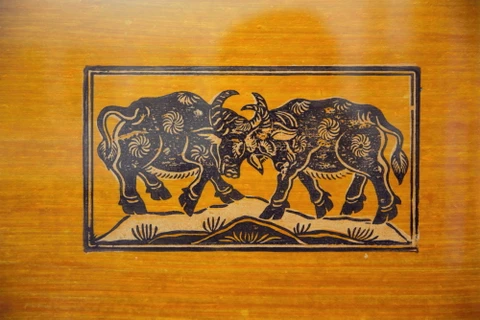
According to the history books, the craft of carving woodblocks for printing books first started in Vietnam in the 11th-12th century, while paintings created by the same method appeared later. The golden time of Dong Ho paintings was in the 17th-18th century.
According to 90-something-year-old Le Huy Hoan, one of the oldest men in the village, the art was still common in the early 1900s.
“I remember when I was small, people in the village made votive papers and paper offerings for the dead all year round,” he recalled. “But in the seventh lunar month of the year, they would start making paintings for Tet (Lunar New Year). The market in the twelfth lunar month would gather locals selling and buying paintings on the terrace of the village’s communal house.”
Hoan said at that time, each of the 17 families in the village had a painting workshop. The market would open on the 6th, 11th, 16th, 21st and 26th of the last lunar month before Tet for people to buy paintings to decorate their homes.
He said he felt a little regret as there are now only three families practising the traditional craft.
Master artisan Che used to run a regular class for young people, but now he has no students.
“Dozens of young people in the village used to attend my class, but they stopped because they can make better money printing votive papers,” Che said. “I think the best methods of training will remain inside our family, where children play with the paintings, and grow up loving them naturally like their grandparents and parents.”
Tran Quang Nam, an official from Bac Ninh's Department of Culture, Sports and Tourism, said the province plans to implement policies to support artisans like social health services, financial aid and promoting the sale of the paintings next year.
“The policy is a part of a dossier we are compiling to seek UNESCO recognition for the craft as an intangible heritage that is in need of urgent safeguarding,” he said.
The dossier will be submitted to UNESCO next March.
Researcher Bui Hoai Son, Rector of the National Culture and Arts Institute, agreed with the move.
“Passion on its own is not enough,” he said. “That passion should be supported, facilitated and realised by economic profits.
“If we can do that, we can help preserve the handicraft in a sustainable way.”
Self support
While waiting for support, the three remaining families have found their own ways to revive the art.
Since his retirement in 1992, Che has concentrated on creating paintings using old woodblocks and making new ones.
“Now I have hundred of printing blocks for various subjects both traditional and modern that I have created,” he said.
His products now include the traditional paintings and woodblocks for decoration, and also calendars, postcards, and wedding invitation cards.
The poonah paper he uses comes exclusively from Yen Phong district in the same province, and all the paints are made from natural materials. White is made from grinding up oyster shells; red from mountain pebbles; yellow from hoa hoe, a local flower; green from the leaves of the cajuput tree; and black from bamboo ash.
“In order to convince my children to follow the art, I needed to think of a way to earn more money,” he said.
He established an enterprise in 2005 to produce and sell folk paintings at home and abroad.
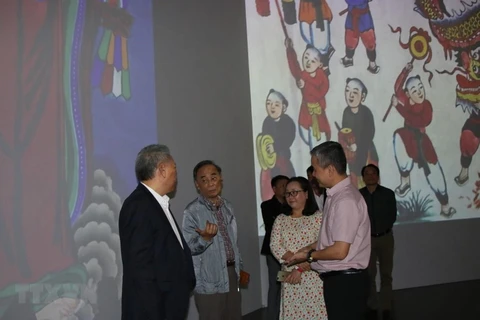
His workshop and museum have welcomed thousands of tours of both foreign and Vietnamese people, who want to find out more about the local culture.
The 6,000sq.m centre has also hosted children from all over the north who come to learn about the art.
“We are open throughout the year except for the first day of the lunar year,” he said. “Whenever visitors come, we are here to welcome them and show off our skills.”
Artisan Che said that he believes the art will return.
“I’m still here, and my children and grandchildren can still make a living from the art, so I think it is here to stay alive and will come back stronger than ever,” he said.
Artisan Qua, however, is worried there is no demand for the paintings.
“I'm also concerned about the next generation, who should get basic training and nurture a passion for the art,” he said.
“While we cannot train in large numbers, I think educating the family is important,” he said. “In my family, we sometimes use machines to print votive papers to make some money, but we still keep maintain the traditional craft.”
Both Che and Qua said more Vietnamese people are collecting Dong Ho paintings and woodblocks now.
“When people get richer, their intellect increases, and more people will return to their heritage,” Qua said.
“That is what we believe so we will continue our work,” he said./.
VNA