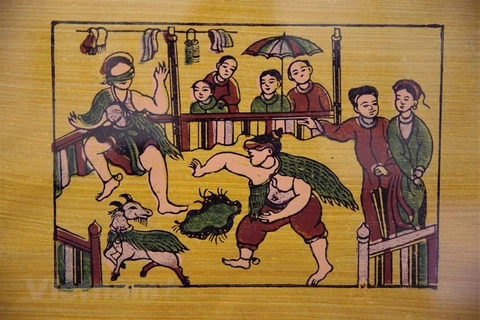
"Bit mat bat de” (Blind-man’s buff) (Photo: VietnamPlus)
 Hanoi (VNA) – Like many other traditional crafts, the change in people’s demand when the country switched to the market economy has caused numerous difficulties and challenges to the Dong Ho folk painting genre.
The appearance and competition of other forms of arts have exposed Dong Ho paintings to the risk of falling into oblivion.
Ups and downs in history
The elderly in Dong Ho village, located in Song Ho commune of Thuan Thanh district, the northern province of Bac Ninh, said the craft was in its prime between the late 19th century and 1944. At that time, the whole village engaged in producing votive papers from the 3rd to the 7th lunar month and then making paintings from the 8th to the 12th month in the lunar calendar to prepare for the Lunar New Year (Tet) festival.
All the 17 clans in the village did this craft, brightening the entire village with the colours of paintings. The busiest time was the market days on the 6th, 11th, 16th, 21st and 26th of the 12th lunar month.
On each market day, traders purchased thousands, even tens of thousands, of paintings, and locals also came to buy paintings to decorate their homes during Tet to wish for wealth and honour.
 “Le tri” (Civility and wisdom) (Photo: VietnamPlus)
 The market days of Dong Ho paintings were bustling also due to the exchange of other goods among residents of different villages and traders from far and wide. People brought scallop shell, tobacco, fish sauce and dried fish here to exchange for paintings or purchased paintings in bulk to re-sell them in other places.
After the last market day on the 26th of the 12th lunar month, the unsold paintings would be wrapped carefully to wait for the next “painting season”. In the festival of Dong Ho village on the 15th day of the 3rd lunar month, locals also organised various traditional rituals and competitions of votive papers and paintings.
After 1945, especially in the resistance war against the French colonialists, like other areas, the village suffered from the enemy’s bombings, a large number of woodblocks were burned down, locals were forced to evacuate. As a result, only few continued to produce paintings, and people also no longer bought the works. The craft was interrupted since then. When peace was restored in the northern region in 1954, villagers began to recover their traditional craft, but it was still unable to be as healthy as it used to be.
In 1967, realising the risk of the craft abandoned, local authorities entrusted artisan Nguyen Huu Sam with gathering 50 enthusiastic and skilled artisans in the village to set up a cooperative for producing Dong Ho folk paintings.
This was a period of the craft’s revival. From 1970 to 1985, many Dong Ho paintings were exported to some socialist countries.
 "Choi trau” (Buffalo fighting) (Photo: VietnamPlus)
 In the late 1980s and early 1990s, under the impact of the market economy and the change of political regime in Eastern European nations, the export faced numerous difficulties, and the painting production cooperative was dissolved because it was unable to sell the products.
When the country entered the reform period and began to develop a market economy, people ignored Tet paintings of Dong Ho village, leading to the disintegration of this craft. More than 90 percent of the local households abandoned woodblocks and switched to other means of livelihood to earn higher income like producing votive papers or other goods.
Determination to keep the craft alive
Artisan Nguyen Huu Hoa said: “In the 1990s, realising the risk that this craft could disappear, my father – artisan Nguyen Huu Sam, who used to be head of the Dong Ho painting production group – encouraged children to sustain the craft. My family sought and collected more than 600 precious old woodblocks from other families in Dong Ho village with the hope that one day, the craft will revive. Every day, my father devoted himself to both passing down the craft to descendants and patiently continuing to create and inherit ancestors’ heritage by printing the works with traditional themes and creating new ones that matched the market’s demand.”
In 2016, Sam passed away, but thanks to his training, his descendants have become young artisans who have a good grasp of all the secrets of each step to make Dong Ho paintings.
Hoa, the eldest son of Sam, and his wife, artisan Nguyen Thi Oanh, have inherited his father’s career to maintain the craft.
Artisan Nguyen Huu Qua, another son of Sam, also received training from his father and has now become the owner of a famous painting production establishment that attracts a large number of Vietnamese and foreign visitors every day.
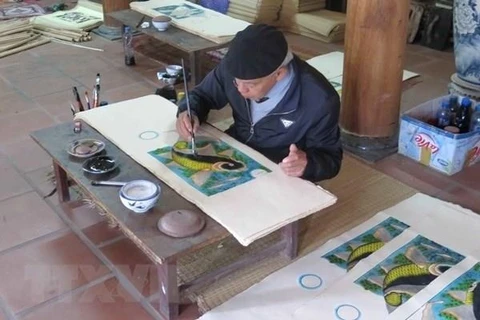
 Tools for making Dong Ho paintings (Photo: VietnamPlus)
 Concerned about the disintegration of the traditional craft, artisan Nguyen Dang Che has also dedicated his efforts to preserving the making of Dong Ho paintings. He said he was born and grew up amid the paintings, and he also luckily used to study in an artistic environment. Therefore, he felt regretful when witnessing the gradual disappearance of the traditional craft.
When retiring in 1991, he discussed with his family, and they decided to stop producing votive papers but return to making paintings. Aside from the woodblocks inherited from ancestors, he bought others from households in the villages and also created new woodblocks by himself.
In 2006, with the aspiration to keep the cultural heritage alive, Che and his children built a cultural exchange centre for Dong Ho folk paintings that covers 5,000 square metres right in their village.
The centre includes an area for making papers, areas for printing paintings and crushing scallop shell, and another for exhibiting and selling works to visitors. Managed by his son, artisan Nguyen Dang Tam, the centre is a place for storing and displaying thousands of woodblocks, many of which date back almost 200 years.
Tam recalled that initially, his family produced paintings and votive papers at the same time to use the money from selling votive papers to nurture the painting making. Thanks to that, his family gradually managed to recover the craft. They made paintings and sought selling places far and wide.
In 1995, Tam brought the paintings to Hanoi to sell them to foreign tourists. After that, he rented a store at No. 16 Chan Cam street to sell Dong Ho paintings and asked his friends in the fine arts sector to help introduce the genre in Vietnam and other countries. As a result, Dong Ho paintings have become more popular, and more and more people, especially foreigners, have come to buy the works.
Apart from traditional works, artisans have also actively reformed their products that meet the market’s demand but still embody the soul of Dong Ho folk paintings.
Previously, the paintings were only printed on small-sized papers, but now they are shown in various forms. Basing on traditional patterns, artisans also create calendars, stamps, painting books for children and postcards for tourists.
Thanks to the endeavour by committed artisans, despite countless ups and downs, the making of Dong Ho paintings is still preserved nowadays./.
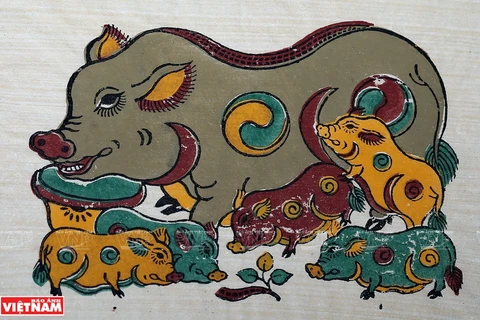
 “Lon am duong” (A pig of yin and yang) (Photo: VietnamPlus)
  “Nhan nghia (Benevolence and righteousness) (Photo: VietnamPlus)
  “Ca chep” (Carps) (Photo: VietnamPlus)
  From left: “Hung dua” (Catching coconuts) and “Danh ghen” (Jealousy) (Photo: VietnamPlus)
  “Dan ga” (Chickens) (Photo: VietnamPlus)