Ao Dai – a cultural symbol associated with Vietnamese women

Ao Dai (traditional long dress) has established itself as a cultural symbol connected with the image of Vietnamese women. The dress has seen significant changes through the years but its traditional characteristics have still been preserved, contributing to enhancing the charming beauty of Vietnamese women.
Ao Dai – a cultural symbol associated with Vietnamese women ảnh 1An Ao Dai show during the 2018 Hue Festival (Photo: VNA)

Hanoi (VNA ) – Ao Dai (traditional long dress) has established itself as a cultural symbol connected with the image of Vietnamese women. The dress has seen significant changes through the years but its traditional characteristics have still been preserved, contributing to enhancing the charming beauty of Vietnamese women.

Vietnamese soul and culture

Over the past hundreds of years, Ao Dai has been an endless source of inspiration for movies, music and fine art, and part of the soul of Vietnamese people at home and abroad.

The word “Ao Dai” has been included in the Oxford dictionary that explains Ao Dai is a Vietnamese woman’s long-sleeved tunic with ankle-length panels at front and back, worn over trousers.

In the mind of Vietnamese people and the eyes of international friends, Ao Dai is a symbol of Vietnamese culture and quintessence.

The dress is worn on various occasions, from family gatherings to diplomatic events, art performances, festivals, especially the traditional Tet (Lunar New Year) holiday, fashion shows and beauty contests, both at home and abroad.

Unlike traditional dresses of many other countries worldwide, it is not complicated to put on the Ao Dai. While it is simple to wear, the dress highlights the beauty of women. Ao Dai, therefore, has become a popular attire of Vietnamese women.

The traditional dress has played an important role in promoting Vietnam’s tourism. Tourists to the country, especially women, often brought home Ao Dai as a special souvenir.

Over the past years, many designers have breathed a new life into Ao Dai with new designs. Such designers as Minh Hanh, Vo Viet Chung and Si Hoang have contributed to promoting Ao Dai in the regional and international fashion industry.

Ao Dai’s history

The exact origin of Ao Dai is unknown though researchers concluded that its history dates back to thousands of years ago with different designs.

The oldest image preserved so far of Ao Dai was “Ao Giao Linh” (cross-collared robe) in about 1744 when Southern Vietnam was ruled by Lord Nguyen Phuc Khoat while the North was under the control of Trinh Lords. It was then worn with black skirts and a cloth belt.

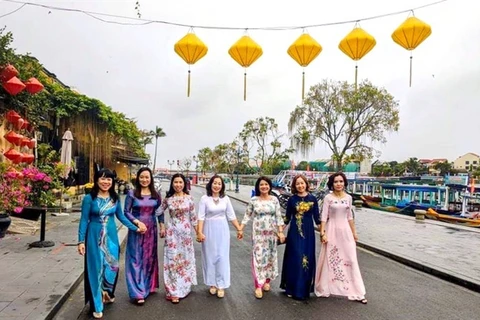
Ao Dai – a cultural symbol associated with Vietnamese women ảnh 2Ao Dai Festival in Ho Chi Minh City (Photo: VNA)

Phan Thanh Hai, Director of the Department of Culture, Sports and Tourism of the central province of Thua Thien-Hue province, said Lord Nguyen Phuc Khoat deserved great merit in making Ao Dai the official costume at that time.

During the 19th century, the outfit evolved into the “Ao Ngu Than” (five-panel gown). It then has two flaps sewn together in the back, two flaps in the front, and a flap hidden underneath the main front flap. The outfit had slits on both sides, features preserved in the later Ao Dai. However, Ao Ngu Than is shorter and not so tight as the modern Ao Dai.

In the 1930s, Vietnam was a French colony and influenced by Western culture. The artist Cat Tuong (or Le Mur) took Ao Dai to new advanced level when she combined Western dress style with traditional Ao Dai. The new outfit was resized to fit perfectly women’s body with a floor-length and curved flap, a pinched waist, along with a Western-style heart-shaped collar, and puffed sleeves.

However, this design was not welcomed by the public who said it did not match Vietnamese traditions.

After only four years of popularity, the “Ao Dai Le Mur” was temporarily put to rest as painter Le Pho removed all western influence from its design, and replaced it with several renditions of the four-panel gown. From this point on until the 1950s, his style of Vietnamese Ao Dai remained popular as it stood well with traditional ideology.

In the 1960s, the popularity of the Ao Dai reached its pinnacle, especially in the south. Dung Dakao, a Saigon-based designer altered the traditional costume, adding raglan sleeves and connected the front panel of the Ao Dai to the back, with the ingenious use of buttons that went from the collar to the armpit and all the way down to the hip. This created a comfortable dress that was snug on the female body while showing fewer wrinkles and giving more ease to movement.

Honouring Ao Dai

Ao Dai festival has formed part of the Hue Festival that gathers various collections of the dress by famous designers.

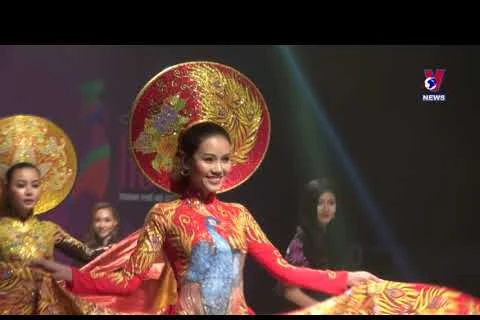
Ao Dai – a cultural symbol associated with Vietnamese women ảnh 3An Ao Dai design by Viet Bao at 2019 Hue Festival (Photo: baothuathienhue.vn)

In 2016, 10 well-known designers, including Hoai Sang, Anh Vu, Viet Ha, Hong Dung and Thuong Huyen, presented more than 300 sets of Ao Dai of different themes and patterns based on images of the Hue ancient capital city.

Currently, “Ao Dai Hue” has become a special tourism product that has left a good impression on domestic and foreign visitors, contributing to preserving and promoting the nation’s traditional cultural values.

Through the dress, the traditional culture of the ancient capital city has been promoted to domestic and international tourists.

The 2020 Hue Festival, slated for August 28 to September 2, will feature a special art performance dedicated to Lord Nguyen Phuc Khoat and King Minh Mang in recognition of their contributions to building and reforming the dress./.
VNA

See more

Le Y Linh, a music researcher living and working in France (Photo: VNA)

14th National Party Congress expected to continue affirming culture as pillar of Vietnam’s soft power

Talking to a Vietnam News Agency correspondent in Paris, Le Y Linh, a music researcher living and working in France, said culture should be placed on an equal footing with other sectors in the country’s development strategy. According to her, investment in culture should go beyond preservation and be closely linked with creativity, so that cultural values are not only safeguarded but also continue to evolve in contemporary life.

A view of the international conference in Ninh Binh province, which sets course for UNESCO nomination of the Tam Chuc Pagoda Complex and the Van Long Wetland Nature Reserve. (Photo courtesy of Ninh Bình Provincial People’s Committee)

Vietnam advances UNESCO nomination of Tam Chuc – Van Long Complex

During the conference, delegates examined a wide range of themes, including geology, geomorphology and biodiversity; cultural values such as history, archaeology and intangible heritage; human adaptation; site integrity, boundaries and management challenges; and a roadmap for nominating the Van Long – Tam Chuc wetland karst area as a World Heritage Site.

The feature film “Red Rain”* directed by Meritorious Artist Dang Thai Huyen and produced by the People’s Army Cinema (Vietnam Cinema Association). (Photo: VNA)

“Red Rain” wins Golden Kite Award 2025

"Mua Do" (Red Rain), directed by Meritorious Artist Dang Thai Huyen and produced by the People’s Army Cinema also earned its director the Best Director Award in the feature film category, marking a double win and making Red Rain the most honoured work of the night in the cinema section.

The pho museum provides a spot for domestic and foreign visitors to learn more about Vietnam's renowned dish, Pho, and experience its flavour. (Photo: VNA)

First-ever pho museum opens in HCM City

Located in an 800-square-metre area in Ben Thanh ward, the museum is the first private culinary museum in Vietnam licensed by the HCM City Department of Culture and Sports. The museum features three floors offering visitors a journey through pho's 100-year history via a souvenir area, show kitchen, cinema room and cultural exhibition space.

Cover page of Viet Nam hanh phuc (Happy Vietnam) book (Photo: VNA)

VNA publishing house launches books to mark 14th National Party Congress

The three books published by the VNA Publishing House contribute to promoting Vietnam’s image at home and abroad. They also serve as valuable external information products, helping nurture confidence, aspiration and determination to build and safeguard a socialist Vietnam as it advances firmly into a new era of prosperity, strength, civilisation and happiness.

A ceremony to see off the Vietnamese sport delegation to compete at the 13th ASEAN Para Games in Thailand is held at Noi Bai International Airport on January 15, 2025. (Photo: VNA)

Vietnamese delegation sets off for 13th ASEAN Para Games

Vietnam sends 185 members, including 140 athletes, competing in 11 sports including athletics, swimming, weightlifting, badminton, table tennis, chess, judo, boccia, archery, tennis, and fencing. The country aims to win 40–50 gold medals and strives to rank among the top 4–5 countries.

Nguyen Van Than, Chairman of the Vietnam Classical Music Association (VCMA), speaks at a press briefing in Hanoi on January 13. (Photo: The organisers of the concert)

Concert to be held to celebrate 14th National Party Congress

The programme, jointly organised by the VCMA and the Vietnam Association of Small and Medium Enterprises, will feature nearly 150 artists, performers and musicians, representing the finest of Vietnam’s and the international classical music scene.

Visitors to Vietnam's booth at International Cultural Festival 2026 (Photo: VNA)

Vietnamese image introduced at International Cultural Festival 2026 in Greece

The Vietnamese Embassy in Greece took part in the International Cultural Festival 2026, organised by the UNESCO Club of Piraeus and Islands in Greece, marking the embassy’s first activity of the new year and highlighting its efforts to bring the image of Vietnam closer to the Greek public and international friends through traditional Vietnamese cuisine.

A dish of Vietnamese fried spring rolls (Photo: VNA)

Vietnamese rice paper makes way into European kitchens

Vietnamese rice paper is increasingly winning the hearts of European diners thanks to its versatility, easy preparation and ability to pair well with a wide range of Western ingredients. This culinary exchange not only broadens the reach of Vietnamese cuisine but also enriches the multicultural culinary landscape of Belgium and many other countries.

A visitor to the exhibition (Photo: VNA)

Colours of Friendship: Hanoi welcomes Vietnam-RoK artistic encounter

The harmonious mingling of works by artists from both nations conjures a multi-layered, dynamic space where distinct visual languages intersect with shared emotional depth, aesthetic thinking and creative spirit. The result is a rich and refreshing visual experience.