APEC economies share experience in engaging in RTAs/FTAs

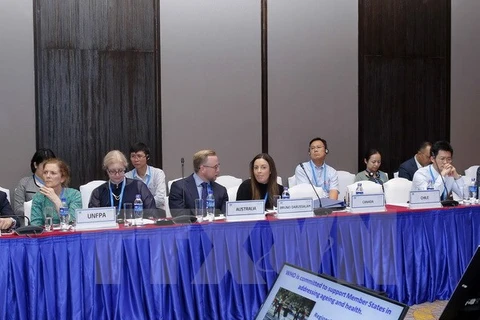
APEC officials shared views and experience in negotiating, concluding and implementing regional trade agreements (RTAs) and free trade agreements (FTAs) at a dialogue in Ho Chi Minh City on August 27.
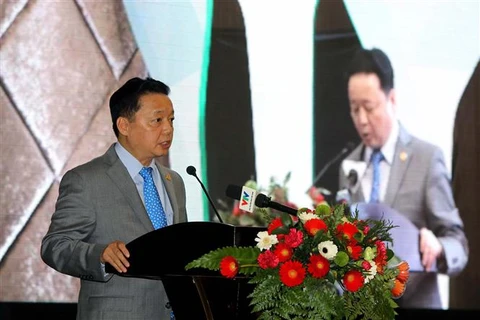
APEC economies share experience in engaging in RTAs/FTAs ảnh 1Deputy Minister of Foreign Affairs of Vietnam Bui Thanh Son (Source: VNA)
HCM City (VNA) –APEC officials shared views and experience in negotiating, concluding andimplementing regional trade agreements (RTAs) and free trade agreements (FTAs)at a dialogue in Ho Chi Minh City on August 27.
The APEC Senior Officials Meeting(SOM) Dialogue on RTAs/FTAs brought together APEC senior officials, officialobservers, speakers, and representatives from the businesses community.
According to statisticsreleased by the APEC Secretariat, as of December 2016, more than 150 RTAs/FTAssigned by at least one APEC member economy has gone into effect with nearly 60intra-APEC agreements.
Thanks to theirimpacts, intra-APEC trade has increased by 174 percent, from 2.3 trillion USDto 6.3 trillion USD during the 2000 – 2016 period.
In his opening remarks,Deputy Minister of Foreign Affairs of Vietnam Bui Thanh Son, who is also APEC2017 SOM Chair, said over half of the world’s FTAs originates from theAsia-Pacific region.
APEC is naturally the best platform todiscuss FTAs/RTAs, he said,noting that for the past 30 years, RTAs/FTAs in theAPEC region have flourished in number, scope of work and sophistication.
Increasingly sophisticated,next-generation regional FTAs, addressing next-generation trade and investment,behind-the-border and non-tariff measures issues are being developed with majorimplications, he said.
Regional economicintegration will continue to be one of APEC’s core cooperation pillars,including fostering RTAs/FTAs and with a view to the realisation of the Free Trade Area of the Asia-Pacific (FTAAP), Sonsaid.
In the context ofpositive signs of regional and global economic recovery, making the most ofbenefits from RTAs/FTAs is important to create new dynamism for economicgrowth, as well as trade and investment in the region, he noted.
Sonhighlighted the enormous static and dynamic benefits of FTAs on economicgrowth, market access, FDI attraction or domestic institutional reforms.
However,he said, in the current regional and global economic context and under theimpacts of the fourth industrial revolution, the question is how to make themost of the socio-economic benefits that FTAs bring about, concurrently withmitigating adverse impacts arising from adjustment costs, and increasing incomedisparity.
Additionally,given the economical, political and developmental diversities in the APEC,sharing of information, experiences and engaging in negotiations and conclusionof RTAs/FTAs is useful, practical and necessary for mutual economicdevelopment, social stability and shared prosperity for the whole of the Asia -Pacific region, he said.
Thedelegates mulled over the engagement of stakeholders in RTA/FTAs, lessonslearnt from RTAs/FTAs and impact assessments, and continued work for the APEC,including the work programme to implement the Lima Declaration on the FTAAP.
TheAPEC is in the process of realising the Bogor Goals of trade and investmentliberalization and facilitation by 2020 as well as shaping an APEC vision forthe realisation of a FTAAP.-VNA
VNA

See more

Chili peppers are on the list of essential goods in Indonesia (Photo: VNA)

Indonesia reduces imports of strategic food commodities

In 2026, Indonesia is expected to have approximately 12 million tonnes of rice carried over from the previous year, supported by annual production of around 34.7 million tonnes. With projected consumption of 31.1 million tonnes, national rice reserves could reach approximately 16 million tonnes by the end of the year.

Hanoi’s roadmap to implement low-emission zones from July is providing a strong boost to the electric two-wheeler market (Photo: VNA)

Low-emission zone roadmap drives electric two-wheeler boom in Hanoi

From July 1, Hanoi will introduce time-based or area-based restrictions on petrol-powered motorcycles within Ring Road 1, with plans to expand coverage across the entire zone by 2028 and extend to areas within Ring Road 3 by 2030. The policy is expected to reshape travel habits for millions of urban residents.

Delegates at the opening ceremony of the Made in Da Nang Expo 2026 (Photo: VNA)

Nearly 300 firms join Made in Da Nang Expo 2026

Speaking at the opening ceremony, Vice Chairman of the Da Nang People’s Committee Tran Chi Cuong said the exhibition is a large-scale trade promotion event aimed at showcasing products, connecting markets, and helping businesses enhance competitiveness while expanding domestic and export markets.

 Green production, standardised value chains key to fruit, vegetable sector growth

Green production, standardised value chains key to fruit, vegetable sector growth

Facing mounting pressure from increasingly stringent domestic and international standards, Vietnam’s fruit and vegetable sector is accelerating its shift toward green, safe, and sustainable production models. Beyond changing farming practices, localities and businesses are stepping up efforts to standardise value chains and build brands to achieve growth targets for 2026.

Hiep Phuoc Industrial Park in Ho Chi Minh City. (Photo: VNA)

Southern industrial real estate enters strategic growth phase

Key industrial hubs in the south, including Ho Chi Minh City, Dong Nai and Tay Ninh, are transitioning from a period driven largely by supply expansion and rising land prices to a more refined growth model. This new phase is shaped by infrastructure upgrades, supply chain restructuring, product improvement and greater emphasis on operational performance.

The launch of the Vietnam National Brand Week 2026 on April 16 (Photo: VNA)

Vietnam National Brand Week 2026 opens

Running from April 16 to 23 nationwide, the Vietnam National Brand Week 2026 marks the 18th anniversary of Vietnam Brand Day (April 20, 2008 – 2026).