As highlands pepper prices fall, farmers hold out

Over the last ten days, pepper prices have fallen from an already low 82,000 VND (3.65 USD) to 72,000 VND per kilogramme, but pepper farmers in the Central Highlands continue to hold out for higher prices.
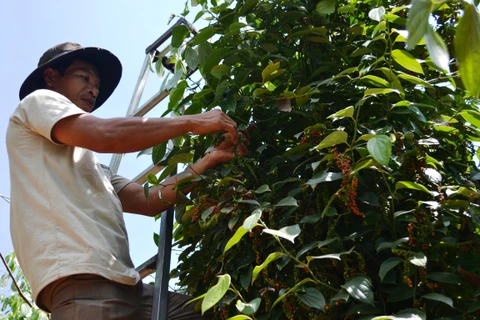
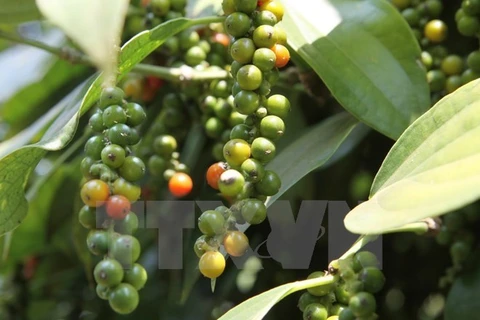
As highlands pepper prices fall, farmers hold out ảnh 1Farmer harvests pepper in Dong Nai Province. (Photo: VNA)

Hanoi (VNA) - Over the last ten days, pepper prices have fallen from analready low 82,000 VND (3.65 USD) to 72,000 VND (3.21 USD) per kilogramme, butpepper farmers in the Central Highlands continue to hold out for higher prices.

According to the Vietnam Pepper Association (VPA), domesticpepper prices started to decline back in 2016 when pepper farms over-expandeddue to farmers’ anticipation.

Pepper importing countries have receded their pepper demandsto create further downward pressure on prices. 

In 2015 to 2016, pepper prices in the Central Highlandsreached a record high of 230,000 VND (10.2 USD) per kilogramme, making farmersincrease the size of their farms despite warnings from local authorities.

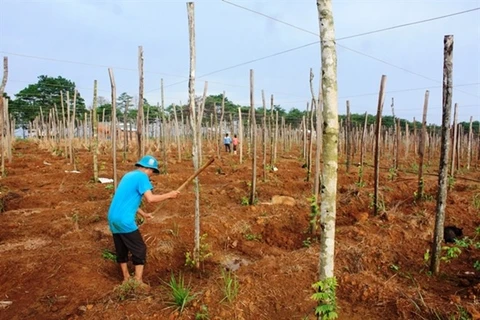
Le Nguyen, a pepper farmer in Thanh Binh commune of Dong Naiprovince, said that his two hectare pepper farm yielded 5.5 tonnes of driedpepper in March this year, but instead of selling immediately, he decided towait for higher price than the 117,000 VND (5.22 USD) per kilogramme back then.As such, after three months, the severe drop in pepper prices trouble himgreatly. “If I sell now, best I can do is break even,” said Nguyen.

Le Van, another farmer from the same commune, said that inaddition to the three tonnes of pepper that he harvested from his own farm, hehad purchased an additional two tonnes at 110,000 VND (4.9 USD) per kilogramme.By his own calculation, the current price will bring him a loss of nearly 90million VND (4,016 USD) on the other additional tonnes alone.

Vo Van Thanh, a farmer in Dong Nai province, said that hewill continue to refrain from selling no matter what, as the price is alreadytoo low to make a profit. He had already sold five tonnes at the beginning ofMarch this year at 120,000 (5.35 USD) per kilogramme, and still has two tonnesin storage.

In general, farmers still have faith that the pepper pricewill rise, in spite of the current lowest price in six years. Many farmersreport that they will continue to stock up on pepper instead of selling to makeeven.

The VPA advised farmers to remain calm and refrain from masssales that would drag prices down. They also advised farmers to sellimmediately when prices show signs of recovery instead of waiting for the 200,000VND (8.9 USD) per kilogramme mark they had hoped for.

Huynh Thanh Vinh, Director of the Agriculture and Rural DevelopmentDepartment of Dong Nai province, said that his department has persuaded farmersto reduce pepper farming areas and connected directly to manufacturers,bypassing middlemen.

Nguyen Huu Phuoc, Vice Chairman of the People’s Committee ofHung Loc commune, Nghe An province, said that in his locality, while onlyseveral merchants are losing big due to wrong predictions of rising pepperprice when it was still at a high from 110,000 to 130,000 VND back (4.9 to 5.8USD) per kilogramme in March 2017, most farmers refuse to sell as they wait forthe price to rebound. At this point they are neither making a profit nor aloss.

According to the Ministry of Agricultural and RuralDevelopment, Vietnam exported about 75,000 tonnes of pepper worth 456 millionUSD in the first four months of 2017. The national total output is about150,000ha, set to produce about 300,000 tonnes of pepper in the next two tothree years.-VNA
VNA

See more

Part of the Vung Ang II Thermal Power Plant. (Photo: VNA)

Vung Ang II thermal power plant inaugurated in Ha Tinh

With a total investment of 2.2 billion USD, the Vung Ang II Thermal Power Plant is developed under a build-operate-transfer (BOT) model and has a designed capacity of 1,200 MW, comprising two turbines. The plant is expected to play a key role in ensuring stable electricity supply for the central region and neighbouring areas, thereby facilitating the development of industries, agriculture and services.

Aircraft at the Noi Bai International Airport in Hanoi. (Photo: VNA)

Vietnam seeks stable jet fuel supplies from China amid Middle East disruptions

On the basis of the long-standing friendship and cooperation between Vietnam and China, as well as close ties between their aviation authorities, the Civil Aviation Authority of Vietnam has asked the Civil Aviation Administration of China to direct relevant fuel suppliers to ensure sufficient and stable supplies for Vietnam.

Illustrative photo (Photo: Xinua/VNA)

Remittances to Ho Chi Minh City decline in Q1 amid global headwinds

Data from the State Bank of Vietnam (SBV)'s Region 2 branch showed that remittances transferred through credit institutions and economic organisations in Ho Chi Minh City exceeded 2 billion USD in the January–March period, down 15.6% from the previous quarter and 16.9% year-on-year.

The shipments are unloaded at the airport. (Photo: VNA broadcasts)

Nearly 100 tonnes of Vietnamese fruits, vegetables airlifted to UAE

Vietnamese fresh produce and processed foods are increasingly recognised for their quality, with items such as cashew nuts, coffee and spices gaining popularity among Middle East consumers. In 2025, Vietnam’s farm produce exports to the UAE exceeded 445 million USD, up nearly 24% year-on-year.

The World Coffee Heritage Forum officially opens at the World Coffee Museum in Dak Lak province, with eyes on UNESCO recognition for Vietnamese coffee culture. (Photo: VNA)

World Coffee Heritage Forum opens in Dak Lak

Dak Lak is known as the 'capital' of Vietnamese coffee, with rich, fertile basalt red soil ideal for agriculture. The coffee provides livelihoods for thousands of locals and has developed a unique cultural space, closely tied to the socioeconomic life, customs and identity of local communities.

Chili peppers are on the list of essential goods in Indonesia (Photo: VNA)

Indonesia reduces imports of strategic food commodities

In 2026, Indonesia is expected to have approximately 12 million tonnes of rice carried over from the previous year, supported by annual production of around 34.7 million tonnes. With projected consumption of 31.1 million tonnes, national rice reserves could reach approximately 16 million tonnes by the end of the year.

Hanoi’s roadmap to implement low-emission zones from July is providing a strong boost to the electric two-wheeler market (Photo: VNA)

Low-emission zone roadmap drives electric two-wheeler boom in Hanoi

From July 1, Hanoi will introduce time-based or area-based restrictions on petrol-powered motorcycles within Ring Road 1, with plans to expand coverage across the entire zone by 2028 and extend to areas within Ring Road 3 by 2030. The policy is expected to reshape travel habits for millions of urban residents.

Delegates at the opening ceremony of the Made in Da Nang Expo 2026 (Photo: VNA)

Nearly 300 firms join Made in Da Nang Expo 2026

Speaking at the opening ceremony, Vice Chairman of the Da Nang People’s Committee Tran Chi Cuong said the exhibition is a large-scale trade promotion event aimed at showcasing products, connecting markets, and helping businesses enhance competitiveness while expanding domestic and export markets.

 Green production, standardised value chains key to fruit, vegetable sector growth

Green production, standardised value chains key to fruit, vegetable sector growth

Facing mounting pressure from increasingly stringent domestic and international standards, Vietnam’s fruit and vegetable sector is accelerating its shift toward green, safe, and sustainable production models. Beyond changing farming practices, localities and businesses are stepping up efforts to standardise value chains and build brands to achieve growth targets for 2026.

Hiep Phuoc Industrial Park in Ho Chi Minh City. (Photo: VNA)

Southern industrial real estate enters strategic growth phase

Key industrial hubs in the south, including Ho Chi Minh City, Dong Nai and Tay Ninh, are transitioning from a period driven largely by supply expansion and rising land prices to a more refined growth model. This new phase is shaped by infrastructure upgrades, supply chain restructuring, product improvement and greater emphasis on operational performance.