ASEAN culture, cuisine introduced in Venezuela

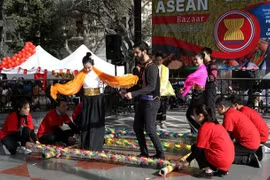
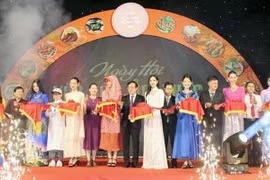
The diplomatic corps of ASEAN member countries in Venezuela jointly held an ASEAN Day and an ASEAN food fair in Caracas on December 7, aiming to introduce the cultural identity and people of ASEAN to local friends.
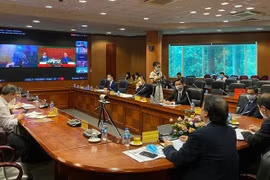
ASEAN culture, cuisine introduced in Venezuela ảnh 1Venezuelan Deputy Minister of Foreign Affairs Tatiana Pugh Moreno and officials of the Vietnamese Embassy in Venezuela pose for a photo at the event. (Photo: VNA)
Buenos Aires (VNA) – The diplomatic corps of ASEAN member countries in Venezuela jointly held an ASEAN Day and an ASEAN food fair in Caracas on December 7, aiming to introduce the cultural identity and peopleof ASEAN to local friends.

The event drew the participation of Venezuelan Deputy Ministers of ForeignAffairs Yuri Pimentel and Tatiana Pugh Moreno, and Deputy Minister of CultureMary Pemjean, among others.

Addressing the event, Venezuelan Deputy Minister of ForeignAffairs Tatiana Pugh Moreno said that the ASEAN Day and ASEAN food fair will help strengthen the relations and mutual understand between Venezuela andASEAN, thus opening up new cooperation opportunities between the two sides inmany areas.

Moreno expressed her impression at the increasing role andposition of the Association of Southeast Asian Nations (ASEAN) in the world as an international economic hub, as well as theassociation’s achievements in building a community of solidarity, unity andcooperation.

She said that ASEAN will become a model for regionalcooperation that the international community can learn from.

Vietnamese Ambassador to Venezuela Vu Trung My, who is also Chair of theASEAN Committee in Caracas, introduced the process of forming and developingASEAN into a community with unity and harmony in diversity. He highlightedASEAN’s achievements over the years to become the fifth largest economy in theworld and the third in Asia.

The diplomat said that the achievements have affirmed therole of the group towards the international community as a leading partner intrade and investment. ASEAN will continue to foster cooperation to anticipatebreakthrough changes such as circular economy, digital transformation, energy transition, climate change adaptation towards a thriving and sustainable communityfollowing the ASEAN Vision 2045, he said.

The Vietnamese ambassador also introduced the economic growth of Vietnam over theyears, as well as its competitive advantages and strengths in international economiccooperation and foreign direct investment attraction.

Within the event’s framework, many cultural programmes ofASEAN and Venezuela were held. Participants also enjoyed specialties of ASEANcountries and Venezuela. Vietnam brought a number of agricultural products tothe event, including coffee and tea./.
VNA
See more

An overview of the ASEAN Foreign Ministers’ Meeting on November 14, 2026 (Photo: VNA)

Vietnam backs ASEAN culture of consultation, dialogue, preventive diplomacy

Deputy Minister of Foreign Affairs Dang Hoang Giang stressed that amid conflicts and instability in various parts of the world, ASEAN should give top priority to strengthening the foundations of peace and stability, uphold the rule of law and promote the bloc’s principles and norms of conduct, particularly the Treaty of Amity and Cooperation in Southeast Asia (TAC).

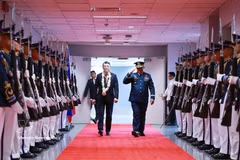
The welcome ceremony for Prime Minister Le Minh Hung at Ninoy Aquino International Airport on November 14 afternoon (Photo: VNA)

Vietnamese PM arrives in Philippines for 49th ASEAN Summit

PM Le Minh Hung’s attendance underscores Vietnam's sustained commitment to the bloc, which aligns consistently with the foreign policy set forth by the 14th National Party Congress, which defines ASEAN as a bloc of strategic importance and a top priority in Vietnam’s external relations.

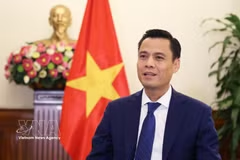
Deputy Minister of Foreign Affairs Dang Hoang Giang. Photo: VNA

Vietnam aims to promote ASEAN unity, resilience and practical cooperation: Deputy FM

Prime Minister Le Minh Hung's attendance at the 49th ASEAN Summit and related summits in Manila, the Philippines, from November 14-17 aims to concretise Vietnam's foreign policy of independence, self-reliance, resilience, multilateralisation and diversification, and reaffirm ASEAN's position as Vietnam's foremost strategic priority in its foreign policy.

A road is under construction in Dong Nai city, Vietnam. (Photo: VNA)

ADB: Southeast Asia needs 7.1 trillion USD in infrastructure investment by 2040

ADB estimates that the region will need an average of 476 billion USD in infrastructure investment annually during 2026–2040, equivalent to 8.7% of GDP. However, at current investment levels, government budget resources would cover only around 45% of this demand, leaving an annual financing gap of 264 billion USD.

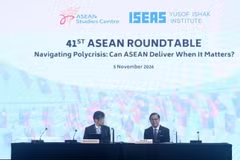
Thai Deputy Prime Minister and Minister of Foreign Affairs Sihasak Phuangketkeow (R) takes part in the Q&A session at the 41st ASEAN Roundtable. (Photo: VNA)

Thailand calls on ASEAN to proactively address polycrisis

Thai Deputy Prime Minister and Minister of Foreign Affairs Sihasak Phuangketkeow noted that no single member state could tackle challenges ranging from major-power competition and economic fragmentation to climate change and energy and food security on its own. Regional cooperation is therefore a strategic imperative, enabling ASEAN not only to overcome crises but also to sustain its development momentum.

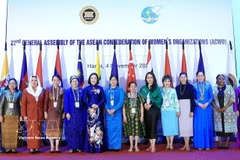
Participants in the 22nd General Assembly of the ASEAN Confederation of Women’s Organisations pose for a group photo. (Photo: VNA)

Women play key role in building united, resilient, sustainable ASEAN Community

Hosted by the Vietnam Women’s Union (VWU), the 22nd ACWO General Assembly marked another milestone in ACWO’s cooperation and development, allowing ASEAN women’s organisations to strengthen solidarity and mutual trust, share experience and identify cooperation priorities for the region’s next stage of development.

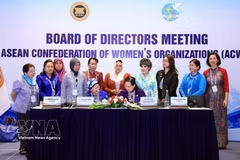
Delegates sign an agreement admitting the Timor-Leste Women’s Network Rede Feto as ACWO’s 11th member. (Photo: VNA)

ASEAN Confederation of Women’s Organisations holds Board of Directors meeting in Hanoi

Amid ongoing regional and global changes, which bring both new opportunities and challenges for women, the role of the ASEAN Confederation of Women’s Organisations in connecting organisations and promoting collective action has become increasingly important. This requires continued innovation in its operating methods, stronger ties among members and greater promotion of women's voices and roles in building a united, resilient, inclusive and sustainable ASEAN Community.

Haze in Kuala Lumpur Airport, Malaysia (Photo: VNA)

ASEAN countries step up efforts to combat transboundary haze

ASEAN already has the ASEAN Specialised Meteorological Centre (ASMC), based in Singapore since 1993. The establishment of the ASEAN Coordinating Centre for Transboundary Haze Pollution Control is expected to complement this mechanism by strengthening cooperation among member states and improving the region's response to transboundary haze pollution.

Japanese Minister of National Defence Koizumi Shinjiro (Photo: Xinhua/VNA)

Japan shores up defence ties with ASEAN

Japanese Minister of National Defence Koizumi Shinjiro said members must bridge differences to tackle shared challenges and proposed expanding Japan–ASEAN cooperation with outside partners into AI, unmanned systems and the protection of undersea critical infrastructure.

Speakers at the discussion (Photo: VNA)

ASEAN digital pact key to facilitating cross-border business

At a panel discussion on policy frameworks for the digital economy, held as part of the Autumn Economic Forum 2026 on October 27, speakers said ASEAN needed to ensure national systems could work together while protecting data and facilitating business, rather than impose uniform rules across the region.