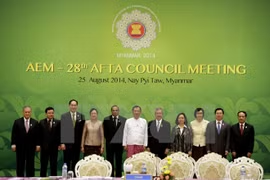
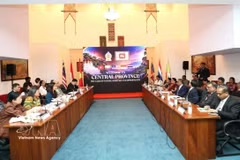
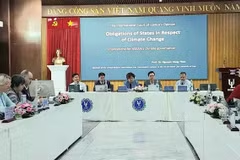
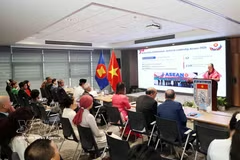
Officials at the AEM-China consultation (Photo: VNA)
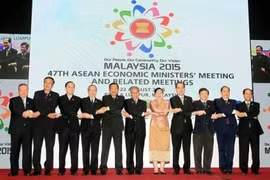
The ASEAN Economic Ministers (AEMs) convened consultations with the bloc’s dialogue partners in Kuala Lumpur, Malaysia, on August 23, agreeing to reinforce economic connectivity between the two sides.
The Vietnamese delegation to the functions, which were part of the 47th ASEAN Economic Ministers’ Meeting and related events, was led by Deputy Minister of Industry and Trade Nguyen Cam Tu.
At the 14th consultation with the Chinese Ministry of Commerce, the ASEAN side noted that China is currently the largest trading partner of the bloc with total trade turnover rising threefold from 113.3 billion USD in 2005 to 366.5 billion USD last year.
Malaysian Minister of International Trade and Industry Mustapa Mohamed asked China to facilitate ASEAN goods’ access to its market and support small- and medium-sized enterprises (SMEs) in entering the market.
Both sides hailed the finalisation of the chapter on Customs Procedures and Trade Facilitation (CPTF) in the ASEAN-China Free Trade Area Agreement (ACFTA), which will help simplify and harmonise customs procedures and clear goods faster while ensuring the transparency and stability in processing customs procedures between ASEAN and China.
The ASEAN officials suggested China consider tariff cut on a list of 307 products compiled by the grouping.
At the 12th consultation between the AEMs and the Republic of Korea (RoK)’s Ministry of Trade, Industry and Energy, the two sides welcomed the finalisation and signing of the third protocol amending the ASEAN-RoK Trade in Goods Agreement (AKFTA). They applauded the reaching of agreement on improving market access for sensitive commodities listed in the AKFTA.
They also lauded the implementation of more than 50 economic cooperation projects since 2009 which has helped enhance the ASEAN countries’ capacity in trade, services, investment, ship building, customs procedures, energy, agriculture, environment and SMEs.
Meanwhile, the ASEAN officials and their counterparts from the Japanese Ministry of Economy, Trade and Industry voiced pleasure over the finalisation of all chapters on trade in services and investment of the ASEAN-Japan Comprehensive Economic Partnership (AJCEP) Agreement.
They concurred to reach conclusion on difficult matters in the next several months and issue a minister-level statement on the full realisation of the AJCEP at the end of 2015.
The officials recognised the progress made in the implementation of the ASEAN-Japan 10-year Strategic Economic Cooperation Roadmap, especially in the promotion of SME development, new industries, technological cooperation and research on reducing non-tariff barriers in bilateral trade.
They also hailed Japan’s suggestions regarding the post-2015 action plan of the ASEAN Economic Community.
At the AEMs’ 18th consultation with their counterparts from China, the RoK and Japan (AEM+3), the ministers recognised strides made in the realisation of recommendations of the East Asian Vision Group II about economic pillars and coordination among the ASEAN-China, ASEAN-the RoK and ASEAN-Japan centres.
They were unanimous in fostering exchanges and coordination among the centres to facilitate and strengthen trade and investment connectivity between ASEAN and the three countries as well as between the bloc and other dialogue partners.
At the dialogue with the East Asia Business Council (EABC), the regional officials applauded the council’s proposals, especially those on assisting micro companies and SMEs’ access to non-mortgage loans.
They said work is well underway to establish a strong e-commerce framework in the region as suggested by the EABC. They also welcomed the EABC’s support of negotiations on the Regional Comprehensive Economic Partnership (RCEP).
At the 20th consultation between the AEMs and Australia and New Zealand, the officials rejoiced at the smooth implementation of the agreement on setting up the ASEAN-Australia-New Zealand Free Trade Area (AANZFTA), which took effect on January 2010, and noted that the realisation of the AANZFTA has helped consolidate the close economic partnership between the bloc and the two countries.
They highlighted that thanks to the AANZFTA, trade between ASEAN and Australia and New Zealand increased from 75.7 billion USD in 2012 to 82 billion USD in 2014.
The ASEAN ministers also welcomed strong assistance of Australia and New Zealand through the AANZFTA economic cooperation support programme, which has organised a number of capacity building programmes.
At the 12th AEM-India consultation, the ministers hailed the enforcement of the ASEAN-India Trade in Services and Investment Agreements in Brunei, Malaysia, Myanmar, Singapore, Thailand, Vietnam and India. They called on the expeditious ratification of the agreements in the other ASEAN member nations.
As part of the consultation, the officials also had discussions with the ASEAN-India Business Council (AIBC), calling upon the AIBC and the two sides’ business councils to make use of the ASEAN-India agreements while agreeing to facilitate and consolidate the AIBC.-VNA