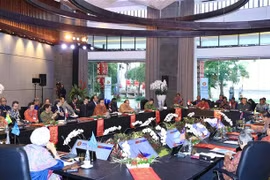
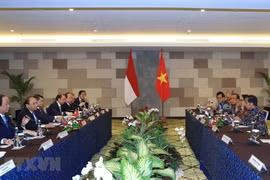
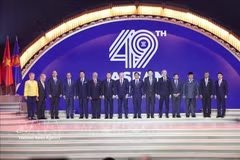
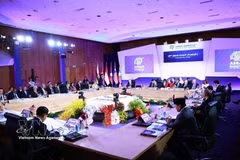
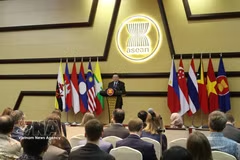
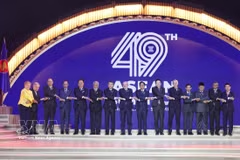
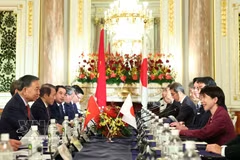
Signing ceremony of MoU on agricultural and food cooperation between ASEAN countries and China (Source: VNA)
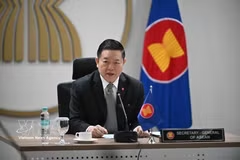
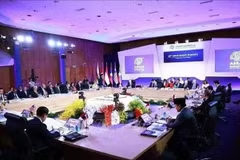
Hanoi (VNA) – The 18th Meeting of the ASEAN Ministers onAgriculture and Forestry and the Ministers on Agriculture of China, Japan andthe Republic of Korea (18th AMAF+3) took place in Hanoi on October12.
In his opening remarks, Vietnamese Minister of Agriculture and RuralDevelopment Nguyen Xuan Cuong, as Chair of the meeting, said the event takes placeamid challenges to food security, fierce competition in agricultural productionand trade, and more severe impacts of climate change.
Over the past years, the regional countries have seen great progress in agricultureand forestry derived from changes in household income, consumer taste and fooddistribution system as a result of urbanisation and industrialisation, he said.
This poses both opportunities and challenges to ASEAN and its three partnercountries in ensuring food security and safety, narrowing development gap,building rural areas in combination with sustainable and inclusive agriculturaldevelopment, he noted.
Cuong spoke highly of the agricultural cooperation of ASEAN and the three partnercountries over the past time and thanked the assistance of the three countriesthrough activities within the framework of the ASEAN Plus Three Cooperation Strategy on Food, Agriculture and Forestry (APTCS) for 2016-2025.
To promote the implementation of this strategy, he suggested the ASEAN+3Ministers on Agriculture and Forestry focus more on stepping up collaborationin food and nutrition security as well as mutual support in building and developingsustainable and environmentally friendly agriculture.
At the same time, they should study and transfer advanced technologies in agro-forestry-fishery production and processing in order toincrease productivity and product quality, he added.
It is also necessary to mobilise resources to invest in agriculture, especiallythose of enterprises via public-private partnership in the field; and boostcooperation in scientific and technological research and application inagro-forestry-fishery production through the transfer of production, management,operation and supervision technologies in line with farm produce supply chains.
The countries need to develop hi-tech and organic agriculture, and promotethe application of information technology in agricultural management.
According to the Vietnamese official, the sides should work together to boosttrade of food and farm produce between ASEAN and its three partner countriesthrough the harmonisation of standards and processes regarding food safety andplant and animal quarantine toward building safe production areas, and regionalcooperation in preventing cross-border animal disease transmission.
They need to share agriculture, farmer and rural development modelsof ASEAN+3 countries, thus improving farmers’ adaptation and competitiveness,he said.
At the meeting, the ministers appreciated the implementation of the APTCS for 2016-2025 and some importantactivities to enhance food security, manage forests sustainably, mitigate andadapt to climate change, strengthen plant and animal health and diseasecontrol, develop human resources, and improve productivity, quality and capacityto promote agricultural products.
They also spoke highly of progress in realising the ASEAN Plus Three EmergencyRice Reserve (APTERR) and reaffirmed their commitment to continued support forthe implementation of APTERR. They also recognised the implementation of theagreement’s Tier+3, especially a programme in particular for APTERR stockpiled rice from Japan and the Republic of Korea that is stored in Cambodia, Lao PDR, the Philippines and Myanmar.
Theministers applauded activities within the framework of the Tier+1 conductedbetween Japan and the Philippines, which is considered the first trial run forAPTERR. The meeting encouraged APTERR members to continue engaging in the Tier+3 programmes.
They also acknowledged the progress of the ASEAN+3 food security informationsystem, particularly developing food security information in the region and improving the data on ASEAN food and farm produce processing and distribution.
On the basis of results achieved in the cooperation process, a number ofagreements were signed at the meeting, including a memorandum of understanding(MoU) between the Governments of ASEAN countries and China on agricultural andfood cooperation, and another between ASEAN and the UN Food and Agriculture Organisation (FAO) on strengtheningcooperation in agriculture and forestry, along with a protocol amending the ASEANPlus Three Emergency Rice Reserve (APTERR).
The 19th AMAF+3 is scheduled to take place in Brunei next year.-VNA
VNA