Authorities work to resolve trade bottlenecks

As China continues to stick to its zero-COVID policy and impose strict measures on people and goods entering the country, Vietnamese authorities are putting forward solutions to ease trade bottlenecks at border gates.
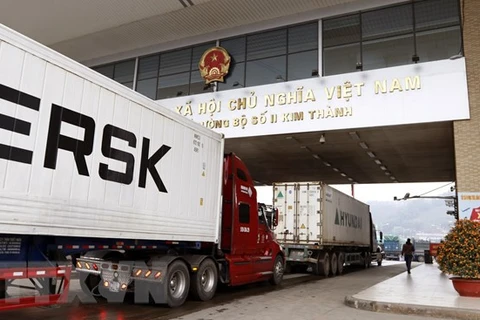
Authorities work to resolve trade bottlenecks ảnh 1Trucks carrying Vietnamese goods lay stranded at the border due to China's strict COVID-19 preventive measures and sluggish customs clearance. (Photo: laodong.vn)
Hanoi (VNS/VNA) - As China continues to stick to its zero-COVIDpolicy and impose strict measures on people and goods entering thecountry, Vietnamese authorities are putting forward solutions to ease tradebottlenecks at border gates.

Accordingto the General Department of Customs, the country's agricultural product exportsby road to China reached up to 1.58 billion USD in the first eight-monthsof 2021. The ongoing congestion has caused losses of nearly 2trillion VND (87.5 million USD) to export firms so far.

Somefirms have had to turn to air freight to maintain trade flow but itis not cost-effective, costing up to 76 percent more than roadhaulage.

TheMinistry of Industry and Trade (MOIT) thus urged firms to consider switchingfrom road to maritime transportation and redirect trade routes to otherprovinces to relieve ongoing congestion.

“Wewill opt for maritime transportation in the near future because roadtransportation is too risky. Road congestion every couple of yearshas really put us off,” said Tran Ngoc Hiep, Director of Thanh Long Hoang Hau Co.,Ltd. 

NguyenThi Diem Hang, vice chairman of VinaNutri Food, noted gridlock at Lang Sonas a sign that firms were relying too much on unofficial channels.Trade via these channels might incur lower costs but carry higher risks as unofficialexports could face suspension anytime China tightens their regulations.

Therefore,firms are recommended to do business with China more formally toavoid any risk from informal business practices. For instance, trade withChinese partners should be bound by written contracts with a clear clause ofdelivery and be conducted via official channels.

“Tosustain exports to China, firms need to scrap unofficial trade practices andshift their focus from quantity to quality and value,” Hang added.

MOITalso urged local authorities to keep a close watch on trade activities atborder gates and post the latest news on provincial web portals tokeep firms well-informed about any changes.

Anothersolution is to extend the domestic market and diversify foreign markets throughtrade promotion, supply-demand connection and application of e-commerce inagricultural trade to reduce the dependence on the Chinese market.

Infact, many firms have begun to find customers elsewhere since China raised thebar on fruits and vegetables exported to the country in 2019.

However,China still remained Vietnam’s second-largest export market foragricultural-forestry-fishery products in 2021, with an export revenue of 8.4billion USD in the first eleven months.

Bilateralnegotiations to increase the working time and efficiency of customs officers atborder gates have also been discussed to avert any future congestion.Currently, a number of border gates are processing customs proceduresat a rate much below normal.

ByDecember 27, more than 4,000 vehicles, mostly loaded with perishableagricultural produce, are still stuck in Lang Son. Regardless, only Huu Nghiand Chi Ma border gates are processing customs clearance with a sluggishaverage rate of eight vehicles per hour. 

AsTan Thanh continues to be temporarily closed, truck drivers stranded atthis border gate would need food and shelter to live for many days to come. Inorder to help these drivers out, Lang Son authorities have granted themfinancial support to cover part of their parking and livingcosts.   

Meanwhile,the Private Sector Development Committee (Committee IV) has come up withdifferent solutions to the problem.

Fortrucks lying stranded at border gates, notably those loaded with agri-fisheryexports and raw materials, Committee IV proposes higher-level meetings betweenthe two countries to look at ways to help the trucks move on.

Foragricultural produce ready for delivery prior to the Tet holiday, Committee IV urges thegovernment to work with local authorities to put thetransport such produce on hold until the situation at the bordergates improves.

Farmersare also called on to delay harvesting and put crops in storage tostem new commodity flows to the border.

Communicationchannels should be used to better regulate the trade flowat border gates, the committee added.

Inthe long-term, it is necessary to invest more in logistic infrastructure andimprove the capacities of warehouses and car parks in border provinces.

Asof January 1, 2022, foreign firms producing food exported to China are requiredto print codes granted by Chinese customs authorities or Vietnamese authorisedagencies on both sides of their product packages.

AnyVietnamese food exporter that has yet to apply for the codes can submitapplications to relevant agencies or online.

ByDecember 24, Chinese customs authorities had granted 31,988 codes toforeign export firms, of which 1,045 were Vietnamese./.


VNA
See more

The dialogue and business networking forum between CPTPP senior officials and business leaders is held in Ho Chi Minh City on July 22, as part of the 2026 CPTPP Senior Officials' Meeting (SOM3) hosted by Vietnam. (Photo: VNA)

Public-private dialogue unlocks CPTPP potential

The CPTPP has evolved beyond tariff reductions into a broad framework covering goods, services, investment and digital trade. Its success, however, ultimately depends on businesses' ability to turn commitments into new investment, stronger supply chains and innovative business models.

Tourists on Nha Trang beach in Khanh Hoa province (Photo: VNA)

Promoting integrated governance to advance sea-based economy

Khanh Hoa has positioned itself as the renewable energy industrial and service hub for the south-central and southern regions. Its economic development strategy identifies four key growth drivers, all built on the foundation of the marine economy.

An overview of the seminar entitled "Opportunities and challenges for market development in Turkish market" (Photo: Ministry of Industry and Trade)

Türkiye offers export potential for Vietnamese food producers: seminar

Türkiye’s target of lifting total exports of goods and services to more than 400 billion USD in 2026 could create additional opportunities for Vietnamese agricultural products, food and beverages, said Ta Manh Cuong, director of the Trade and Investment Promotion Support Centre.

SSC Vice Chairman Bui Hoang Hai speaks at the opening of the programme on July 21. (Photo: VNA)

Vietnam boosts crypto market oversight capabilities

Diederik Van Wersch, Chainalysis' ASEAN Regional Director, noted that Vietnam has a high level of crypto asset adoption, offering significant opportunities for innovation while creating greater demands for oversight and risk management.

Vietnam Railways has introduced a range of tourism, heritage and dedicated train services, attracting growing numbers of passengers. (Photo: VNA)

Railways reinvent themselves with tourism, heritage trains

One of the most notable successes is the premium Hoa Phuong Do (Flamboyant Flower) train operating between Hanoi and Hai Phong city. Since entering service in May 2025, the train has completed nearly 3,000 trips and carried around 1.33 million passengers.

Representatives of relevant parties witness the arrival of the shipment. (Photo: VNA)

First Czech pork shipment officially enters Vietnamese market

A Czech diplomat described the arrival of the first container as the successful outcome of a long and complex market-opening process involving years of negotiations, regulatory approvals and close cooperation between Czech and Vietnamese authorities.

A view of financial buildings in downtown Ho Chi Minh City along the Saigon River. (Photo: VNA)

HSBC: Vietnam’s growth, macroeconomic stability to face tougher test in H2

In a recently released report, Vu Binh Minh, CFA, Associate Director, FX Trading, Markets and Securities Services at HSBC Vietnam, said Vietnam’s economy has built a relatively favourable position in the first six months of the year with GDP expanding 8.18% – the highest first-half growth rate in recent years – as key growth drivers have operated in tandem.

Ha Tay Shoes has secured numerous export orders from the US and European markets. (Photo: VNA)

CPTPP strengthens free trade, expands global economic connectivity

Since taking effect, the CPTPP has significantly expanded Vietnam's access to major markets across North America, the EU, and the Asia-Pacific, contributing to strong export growth in key sectors such as textiles and garments, footwear, and agricultural, forestry and fishery products. The agreement has also encouraged greater investment into Vietnam by promoting regional production networks and clearer rules of origin.

Tan Mingming, Deputy Director of the Foreign Affairs Office of the Dezhou Municipal People’s Government. (Photo: VNA)

Chinese firms put Vietnam on expansion radar

Tan Mingming, Deputy Director of the Foreign Affairs Office of the Dezhou Municipal People’s Government, told Vietnam News Agency reporters that the city has spent years deliberately tightening its links with the Association of Southeast Asian Nations (ASEAN), with Vietnam seen as a key partner.

A perspective of the Viettel Military Industry and Telecoms Group's high-tech semiconductor chip manufacturing plant at Hoa Lac Hi-Tech Park. (Photo: Viettel)

Hanoi builds momentum as Vietnam's semiconductor hub

As Hanoi continues to strengthen its semiconductor ecosystem, the city is creating a new growth driver for both the capital and the country, enhancing Vietnam's technological capabilities and paving the way for deeper integration into the global semiconductor value chain.

Clams are processed for export at the factory of Thanh Hoa Seafood Import-Export JSC in Thanh Hoa province. (Photo: VNA)

Vietnam steps up export to achieve 550-billion-USD target

Against a backdrop of persistent uncertainty in global commerce, the Government is implementing a broad range of measures to strengthen export growth during the remainder of the year. These include expanding overseas markets through economic diplomacy, maximising the benefits of free trade agreements (FTAs), streamlining administrative procedures, reducing logistics costs, improving access to credit and helping businesses overcome trade barriers. Authorities are also encouraging deeper processing, official cross-border exports and greater market diversification to improve the competitiveness of Vietnamese products.