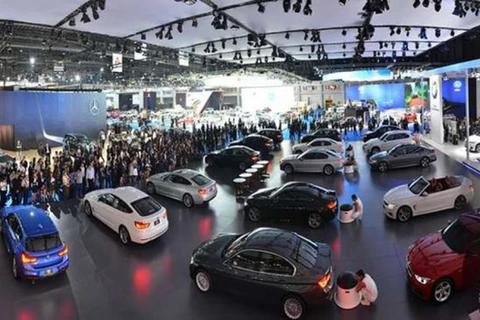
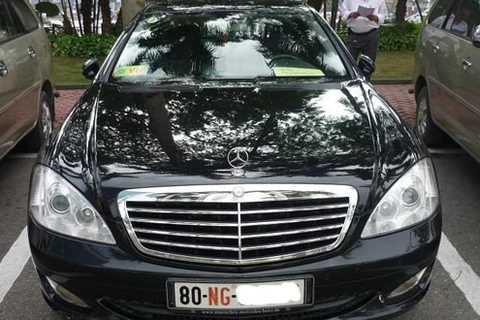
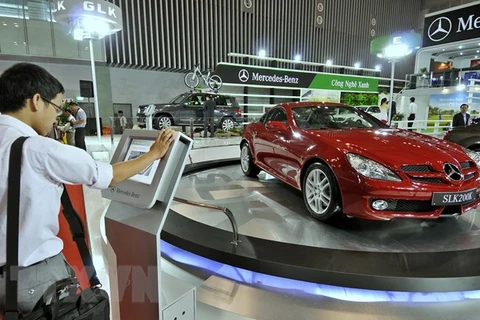
Illustrative image (Source: VNA)
 Hanoi (VNA) - Automobile imports in Vietnam plummeted in the first month of 2018, also the time before Tết (Lunar New Year) holiday.
Only 337 cars of all kinds were shipped to the country, according to data of the General Department of Customs.
Of the imports, there were only 17 passenger cars with nine seats or less, amounting to 567,000 USD. Notably, no cars were imported from Indonesia and India.
In 2017, Indonesia was among the top countries after Thailand with the highest number of exported cars to Vietnam. India too had a relatively large number of exported vehicles in 2016. However, in January this year, both the countries did not export any car to Vietnam. Meanwhile, Thailand lost its recognition as the largest import car market in Vietnam, with only 36 vehicles exported to the country since the beginning of the year.
Among the automobile export markets to Vietnam in January 2018, Russia suddenly rose to the top, with 159 vehicles being exported, worth 274 billion VND (12.03 million USD), equivalent to 1.7 billion VND each.
Under a deal on autos signed between Minister of Industry and Trade Tran Tuan Anh and Russian Ambassador to Vietnam Konstantin V.Vnukov in Hanoi in December last year, Russia’s joint ventures in Vietnam are allowed to import duty-free 2,550 complete built-up units and 13,500 sets of automobile parts from 2018 to 2022 as a way of exploring the capacity and tastes of the market.
China (65 cars) and the United States (42 cars) ranked second and third in exports, respectively.
According to The Jakarta Post, Indonesia’s four-wheel car manufacturers face a bleak future in exports following a new regulation of Vietnam, which is poised to build its own automotive industry.
The Vietnamese Government in November issued Decree No. 116/2017/ND-CP on car manufacturing, assembly, importation and warranty offering, a move that came into effect from January 1, 2018, and tightened car imports.
According to the Vietnamese Ministry of Industry and Trade (MoIT), Decree 116 is a supportive measure for domestic companies as it sets up a number of technical barriers to limit the import of cars. The decree comes at a time when the import tax of automobiles from within the ASEAN bloc is zero percent, which also became effective from January 1, 2018.
Under the decree, car importers in Vietnam are required to obtain a Vehicle Type Approval (VTA) certification, which details the imported vehicles’ quality, safety and environmental protection. The VTA must be issued by authorities in exporting countries. In addition to this, one sample will be selected from every batch of imported cars for emission, quality and technical safety tests. The inspection will be repeated in the next shipment, even on the same car models.
“The new rule creates additional costs; a complete inspection may take one to two months, while other cars from the shipment will have to stay at the port and be charged daily for storage,” Kukuh Kumara, Indonesian Automotive Manufacturers Association (Gaikindo) secretary-general, told The Jakarta Post.
The new rule prompted Gaikindo to send a letter to the MoIT on January 27. The letter claimed that four automakers - Toyota, Suzuki, Daihatsu and Hino - had stopped the planned production of 9,337 vehicles bound for Vietnam. The units were supposed to be manufactured in the December-March period.
The Jakarta Post quoted Kukuh as saying that Indonesia sent some 30,000 cars to Vietnam annually, with the four automakers being the biggest exporters.
According to data of the Central Statistics Agency, Indonesian passenger car exports to Vietnam from January to November last year was valued at 241.2 million USD, up significantly from 17.78 million USD in 2016. Indonesia is also ranked among the top three passenger car exporters to Vietnam, along with Thailand and China, with a market share of 13.12 percent.
Oke Nurwan, international trade director general at Indonesia’s Trade Ministry, said if manufacturers were reluctant to export their cars to Vietnam, Indonesia could lose some 85 million USD between December and March.
He said the Indonesian government had decided to take a soft approach on the matter by sending on February 26 a delegation to lobby with its Vietnamese counterpart.-VNA
Only 337 cars of all kinds were shipped to the country, according to data of the General Department of Customs.
Of the imports, there were only 17 passenger cars with nine seats or less, amounting to 567,000 USD. Notably, no cars were imported from Indonesia and India.
In 2017, Indonesia was among the top countries after Thailand with the highest number of exported cars to Vietnam. India too had a relatively large number of exported vehicles in 2016. However, in January this year, both the countries did not export any car to Vietnam. Meanwhile, Thailand lost its recognition as the largest import car market in Vietnam, with only 36 vehicles exported to the country since the beginning of the year.
Among the automobile export markets to Vietnam in January 2018, Russia suddenly rose to the top, with 159 vehicles being exported, worth 274 billion VND (12.03 million USD), equivalent to 1.7 billion VND each.
Under a deal on autos signed between Minister of Industry and Trade Tran Tuan Anh and Russian Ambassador to Vietnam Konstantin V.Vnukov in Hanoi in December last year, Russia’s joint ventures in Vietnam are allowed to import duty-free 2,550 complete built-up units and 13,500 sets of automobile parts from 2018 to 2022 as a way of exploring the capacity and tastes of the market.
China (65 cars) and the United States (42 cars) ranked second and third in exports, respectively.
According to The Jakarta Post, Indonesia’s four-wheel car manufacturers face a bleak future in exports following a new regulation of Vietnam, which is poised to build its own automotive industry.
The Vietnamese Government in November issued Decree No. 116/2017/ND-CP on car manufacturing, assembly, importation and warranty offering, a move that came into effect from January 1, 2018, and tightened car imports.
According to the Vietnamese Ministry of Industry and Trade (MoIT), Decree 116 is a supportive measure for domestic companies as it sets up a number of technical barriers to limit the import of cars. The decree comes at a time when the import tax of automobiles from within the ASEAN bloc is zero percent, which also became effective from January 1, 2018.
Under the decree, car importers in Vietnam are required to obtain a Vehicle Type Approval (VTA) certification, which details the imported vehicles’ quality, safety and environmental protection. The VTA must be issued by authorities in exporting countries. In addition to this, one sample will be selected from every batch of imported cars for emission, quality and technical safety tests. The inspection will be repeated in the next shipment, even on the same car models.
“The new rule creates additional costs; a complete inspection may take one to two months, while other cars from the shipment will have to stay at the port and be charged daily for storage,” Kukuh Kumara, Indonesian Automotive Manufacturers Association (Gaikindo) secretary-general, told The Jakarta Post.
The new rule prompted Gaikindo to send a letter to the MoIT on January 27. The letter claimed that four automakers - Toyota, Suzuki, Daihatsu and Hino - had stopped the planned production of 9,337 vehicles bound for Vietnam. The units were supposed to be manufactured in the December-March period.
The Jakarta Post quoted Kukuh as saying that Indonesia sent some 30,000 cars to Vietnam annually, with the four automakers being the biggest exporters.
According to data of the Central Statistics Agency, Indonesian passenger car exports to Vietnam from January to November last year was valued at 241.2 million USD, up significantly from 17.78 million USD in 2016. Indonesia is also ranked among the top three passenger car exporters to Vietnam, along with Thailand and China, with a market share of 13.12 percent.
Oke Nurwan, international trade director general at Indonesia’s Trade Ministry, said if manufacturers were reluctant to export their cars to Vietnam, Indonesia could lose some 85 million USD between December and March.
He said the Indonesian government had decided to take a soft approach on the matter by sending on February 26 a delegation to lobby with its Vietnamese counterpart.-VNA
VNA