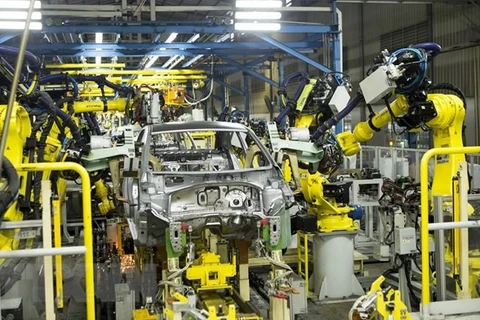
An automobile manufacturing line of Vinfast in the northern city of Hai Phong (Source: VNA)
 Hanoi (VNS/VNA) - The automobile industry of Vietnam has witnessed progress in the last two years, but the localisation rate (local part supply) still remains low, not meeting the set target, according to a Ministry of Industry and Trade (MoIT) report sent to the National Assembly for discussion and direction.
The report shows that the volume of domestically-assembled cars was 250,000-260,000 units in 2017 and 2018, of which several types have been exported to foreign countries including, Laos, Cambodia, Myanmar and Central America. The industry has contributed billions of US dollars to the State budget, contributing to reducing the trade deficit and creating jobs for more than 120,000 workers.
However, the localisation rate for cars with nine seats and fewer has reached about 7-10 percent, concentrating on tyres, seats, mirrors, glass, electrics, batteries and plastic products. Meanwhile, the Government’s target was set at 40 percent in 2005 and 60 percent in 2010.
MoIT said that up to 80-90 percent of the main raw materials for components production such as alloy steel, aluminium alloy, plastic beads and hi-tech rubber are currently imported. Every year, businesses have to import about 2-3.5 billion USD worth of parts and spare parts for production, assembly and repair of vehicles. Meanwhile, the localisation rate of regional countries has averaged 65-70 percent. Thailand alone hits 80 percent.
“If domestic automakers do not soon put in place effective solutions to improve localisation rates, it will be difficult to compete in the regional market,” said the report.
“The domestic market is small, with consumption of more than 300,000 vehicles [including imported ones] per year, while the number of manufacturing and assembling enterprises is high with 56 units so it has not been attractive for businesses to invest in the support industry.”
In the report, the ministry also emphasised the need to promote the development of the automobile and support industry, in which enterprises can make use of its solutions and policies offered by the automobile industry projects of domestic automakers such as Truong Hai Automobile Company (Thaco), Thanh Cong Group, VinFast and others.
The ministry said it was planning to submit to the National Assembly amendments to the application of special consumption tax on cars with a high localisation rate (no tax on locally-manufactured parts).
The ministry has built a pilot part supply chain for automobile manufacturers and assemblers at home and abroad, and studied mechanisms and policies to attract investment from multinational corporations investing in large-scale projects in Vietnam, especially those focused on the brands and models not existing in ASEAN, in order to create conditions for local enterprises to participate deeply in multinational automobile production chains.
According to a ministry report, there are more than 300 enterprises of the country’s total 1,800 parts and spare parts manufacturing enterprises participating in the production network of multinational corporations, of which automobile manufacturing and assembly industry reached 7-10 percent, the remainder being the textile and footwear industry with 40-45 percent, electronics and telecommunications with 15 percent and specialised electronics and high-tech industries with 5 percent.
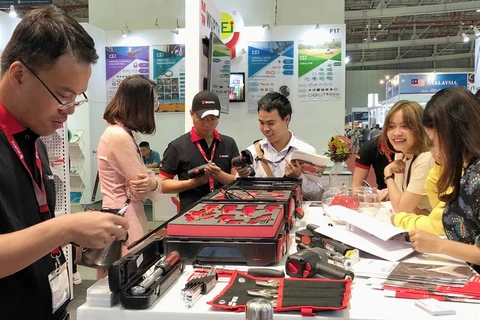
Chief Representative of Japan External Trade Organisation (JETRO) Hironobu Kitagawa said at a signing ceremony of co-operation between Reed Tradex Vietnam and Jetro held in Hanoi recently that in 2018, the number of investment projects from Japan into Vietnam reached the highest level of 630 projects with total investment of about 8 billion USD.
He said nearly 70 percent of Japanese enterprises had invested in Vietnam, responding that "They want to expand their business, however, one of the difficulties is the low localisation rate of materials and parts.”
“The localisation rate of Japanese enterprise in Vietnam is 36.3 percent, lower than China's rate of 66 percent and Thailand's rate of 57 percent. Therefore, our enterprises are forced to import from other countries like Thailand and China," Kitagawa said.
“This is the main cause of increased costs and great risks for Japanese enterprises operating in the manufacturing sector in Vietnam, and also the cause of difficulties in maintaining middle and long-term investments in the country," he added.
The JETRO representative also said that restrictions on mechanisms and policies to support the development of small and medium enterprises were one of the existing problems in Vietnam. – VNS/VNA
VNA