Farmers harvest lychee in Luc Nhan district, Bac Giang province. (Photo: VNA)
 Bac Giang (VNA) – The northern province of Bac Giang is set to push ahead with building brands, trademarks, and expanding the market for local agricultural products, said the provincial Department of Agriculture and Rural Development.
In particular, trade promotion and e-commerce use will be supported to advertise products in domestic and foreign markets.
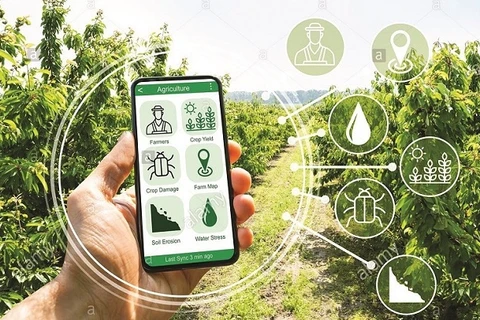
Authorities will effectively carry out the plan on supporting farming households to sell produce on e-commerce platforms, facilitate the development of the digital agricultural economy. Their aim is to effectively implement the issued regulations and policies on trade promotion to help cooperatives and businesses to expand export markets, improve product value, and tap into the Vietnamese market with a population of nearly 100 million.
Bac Giang will continue diversifying distribution channels for key products while helping farmers connect with processing and distributing businesses to gradually form a production network and supply chain linking production, processing, distribution, purchasing, and selling so that local clean produce can enter supermarkets in the province and other localities, the department said.
It noted that in the time ahead, the province will also step up communications to introduce its key and typical products as well as local potential, further commercialise products, and attach local agricultural products with the brands of the firms in partnership with farmers.
In addition, authorities will encourage enterprises, cooperatives, and farmers to apply e-commerce to advertise and sell products online; assist them to build geographical indications, trademarks, brands, and origin tracing labels; and improve the capacity of collecting, analysing, forecasting, and providing market information to issue orientations for production, trade promotion, and sale plans.
Bac Giang will develop more sale channels, connect supply and demand between local farming zones and domestic and foreign distribution systems, help put agricultural products up for sale on e-marketplaces, and develop online sale channels. The department will review the planning on showrooms and wholesale markets for farm produce in some localities in the province.
The province will also boost the official export of its strong products such as lychee, orange, pomelo, processed vegetables, pork, chicken, and processed timber to China, and continue expanding shipments to new markets like the EU, the US, Australia, Japan, the Republic of Korea, ASEAN, and the Middle East, according to the department.
In the first quarter of 2023, Bac Giang recorded an increase of 1.8% in agro-forestry-fishery production value.
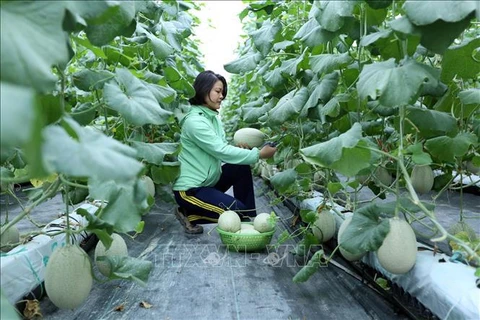
Renowned for lychee cultivation, the province is forecast to reap a bumper harvest this year. Specialised agencies are guiding farmers in complying with VietGAP and GlobalGAP standards to improve fruit value and meet export standards.
Notably, authorities have examined and monitored the 178 production unit codes for the 16,695ha of lychee qualified for export while maintaining 215 establishments eligible to export the fruit to China and one packaging establishment eligible to export to Japan. They have also proposed the Plant Protection Department under the Ministry of Agriculture and Rural Development grant four production unit codes for the 43.06ha in Tan Yen district qualified for exporting lychee to Australia and the US.
In 2022, it reformed the farm produce distribution network; connected specialised farming zones, the processing and distribution system, and retailers; and cooperated with relevant parties to put agricultural products up for sale at supermarkets, markets, and trade centres.
Bac Giang currently has 52 provincial products, comprising eight key products (lychee, chicken, pork, citrus fruits, quality rice, vegetables, peanuts, and fish), 14 typical products, and 30 potential products. Some have been entitled to protection abroad, including “My Chu” (Chu noodles), “My Ke” (Ke noodles), “Vai thieu Luc Ngan” (Luc Ngan lychee) with geographical certification protected in Japan, the Republic of Korea, and Thailand; “Ga doi Yen The” (Yen The hill chicken) protected in Singapore, China, and Laos; and “Vai thieu Luc Ngan” protected in the US, Australia, and Singapore./.