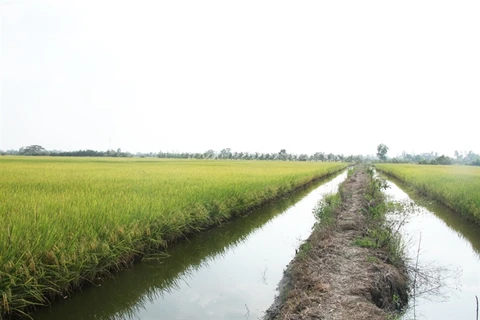
Artemia breeding ponds in Bac Lieu province’s Hoa Binh district. (Photo: VNA)
 It will focus on agriculture, seafood, salt production, industry including small businesses, construction, transport, trading, and services.
It plans to establish 140 new cooperatives, 105 in agriculture, by 2025.
It will encourage cooperative groups that operate efficiently to develop into cooperatives. Under the 2012 Cooperative Law, a cooperative group has at least three members and a cooperative, at least seven.
To achieve the targets, the province will take measures like boosting advocacy about the law and implementing it, improving the operations of collective economy units and mobilising investments from various sources to enhance their efficiency.
It will have preferential policies to get outstanding university graduates and young scientists to manage cooperatives, encourage research into advanced techniques for developing the collective economy and prioritise soft loans for cooperatives to acquire them.
It will focus on developing brand names for cooperatives to increase their competitiveness, and organise trade promotion activities at home and abroad to popularise them.
It will create conditions for cooperatives and cooperative groups to exchange experiences and link up with companies to develop value chains.
It will prioritise creation of infrastructure for transport, power and water and irrigation to enable development of the collective economy.
The province has 170 cooperatives, but a majority have little capacity in terms of finance, competitiveness and management, and face difficulties in adopting advanced techniques and seeking outlets for their products, according to its Cooperative Alliance.
It said co-operation between members of a cooperative, between cooperatives and between cooperatives and companies have not been implemented efficiently.
With the number of cooperative managers who have a college or university degree only meeting 79 per cent of target, most lack the skills needed for managing and organising the operation of cooperatives, it added.
Nguyen Van Vu, its chairman, said the alliance would work with local authorities to improve the quality of management and instruct cooperatives in linking up with companies.
Under the national target programme for building new-style rural areas, the province’s cooperatives, especially agricultural cooperatives, have got more support in recent years.
“Cooperatives can easily access loans from the province’s Cooperative Development Fund,” Vu said.
The fund provided loans worth a total of 6.3 billion VND (273,000 USD) to nine cooperatives last year and would provide 19 billion VND (821,000 USD) to 26 others this year, he said.
The alliance has identified some efficient cooperatives for further development, and they will get priority in promoting their products, building brands and getting soft loans.
The Vinh Chau Artemia Cooperative in Bac Lieu city’s Vinh Trach Dong commune is one of those selected.
With support from the alliance and local authorities, it breeds artemia, also known as brine shrimp, for harvesting its eggs.
When artemia eggs are harvested and processed, they can be stored for a very long time. When the eggs are provided sufficient conditions, they will hatch into nauplii, which are used as food for fish and shrimp larvae and have high nutritional value.
The cooperative exports its artemia eggs to many markets, including the US and the EU, and has annual revenues of 20 billion VND (865,000 USD)./.
VNA