Bac Ninh province strives to preserve folk painting genre

The Department of Culture, Sports and Tourism of the Red River Delta province of Bac Ninh on February 24 inaugurated an exhibition house to introduce Dong Ho, an outstanding folk painting genre which is on the verge of oblivion.
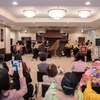
Bac Ninh province strives to preserve folk painting genre ảnh 1Visitors at the exhibition house (Photo: VNA)
Bac Ninh (VNA) – The Department of Culture,Sports and Tourism of the Red River Delta province of Bac Ninh on February 24 inauguratedan exhibition house to introduce Dong Ho, an outstanding folk painting genrewhich is on the verge of oblivion.  

Deputy director of the department Nguyen Van Dap said theprovincial People’s Committee approved a project on preserving and promotingheritage values of Dong Ho in Thuan Thanh district for 2014-2020, with a visiontowards 2030.

Accordingly, Bac Ninh will pay more attention to promotingthe paintings, build a dossier seeking UNESCO’s recognition of the Dong Ho folk painting genre as part of thehumanity’s intangible cultural heritage in need of urgent safeguarding,and build a preservation centre.

As the highlight of the preservation centre, theexhibition house covers over 500 sq.m with more than 1,000 documents andobjects reflecting the history of the painting genre, its values and thepreservation work.

This genre had been in its prime before 1944. At thattime, local residents mainly earned their living by making paintings to sell inthe Lunar New Year (Tet) festival and producing votive papers. The village wasbusy all year round, and there were up to 17 clans involved in makingpaintings. Usually, the whole village made votive papers from the first lunarmonth to the 15th day of the 7th lunar month. From the 8th to the 12th month inthe lunar calendar, they turned to producing paintings for Tet.

Over hundreds of years of development, Dong Ho folkpaintings have become an indispensable “spiritual food” for a large number ofpeople from all social strata in the country for many centuries.

Each painting has its own meaning, reflectingaspirations of the working class, from simple to sacred and noble things. Suchpaintings as “Vinh hoa” (Honour), “Phu quy” (Wealth), “Tien tai” (Richness),“Ga dai cat” (The rooster of good fortune), “Phuc” (Happiness) and “Tho”(Longevity) show the wishes for a new year.

Meanwhile, to commemorate national heroes, artisanscreated “Hai Ba Trung tru giac Han” (Trung Sisters defeat the Han enemy), “BaTrieu danh quan Ngo” (Lady Trieu fights against the Wu troops), and “Ngo VuongQuyen danh Nam Han” (King Ngo Quyen fights against the Southern Han troops),among others. To inspire the traditional fondness for learning and the respectfor teachers, there are such works as “Hieu hoc” (Fond of learning), “Vinh quybai to” (Returning home to pay tribute to ancestors after achieving academichonours), “Muc dong doc sach” (Herdsman reads book), and “Thay do coc” (Toadteacher).

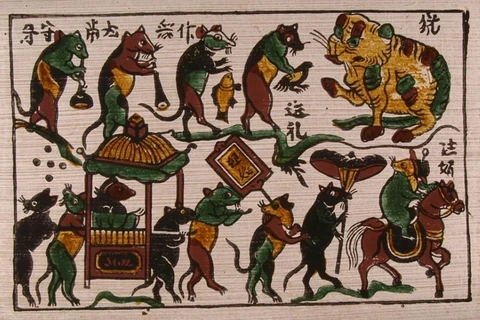
Dong Ho paintings also criticise bad habits, vices, aswell as injustice in society. Among them, “Dam cuoi chuot” (Mice’s wedding) isa profound satirical implication. The cat represents the ruling class that isgreedy and eager for bribery while the mice, representing peasants, are wise andalways stay alert to the cat. Meanwhile, “Danh ghen” (Jealousy) criticisesmen’s womanising while secretly giving advice to them to help prevent a familytragedy.

“Tu quy” (The four seasons), “Tung hac” (The pine andthe crane), “Ke cuc” (The rooster and the chrysanthemum), “Lien ap” (The lotusand the duck) imply the virtues of honourable persons. There are also paintingsdepicting traditional cultural activities of the daily life or festivals in thenorthern region like “Danh du” (Swinging), “Danh vat” (Wrestling), “Ruoc trong”(Drum procession), “Mua rong” (Dragon dancing), “Mua lan” (Kylin dancing), and“Choi trau” (Buffalo fighting)./.
VNA
See more

Visitors to the booth of the Vietnamese Embassy at the Embassies Food and Culture Festival held in Prague, the Czech Republic, on June 6 (Photo: VNA)

Vietnamese culture, cuisine leave lasting impression in Czech Republic

Featuring more than 100 booths representing diverse cultures from around the world, the festival transformed the heart of Prague into a vibrant multicultural space where visitors could sample traditional dishes, enjoy folk performances, listen to traditional music and experience unique cultural showcases from different continents.

Vietnamese artists play traditional musical instruments at the festival held in Karlovy Vary city, the Czech Republic, on June 5. (Photo: VNA)

Vietnam culture, cuisine showcased in Czech Republic

The festival featured more than 20 booths offering traditional Vietnamese dishes, including "pho" and spring rolls, alongside activities promoting Ao Dai (Vietnamese traditonal long dress). One of the highlights was the presentation of complimentary Ao Dai to Czech residents and international visitors.

The Nguyen Dynasty (1802-1945) imperial throne, a recognised national treasure of Vietnam, officially returns to public display at Thai Hoa Palace in Hue Imperial Citadel on June 4 (Photo: VNA)

Nguyen Dynasty throne returns to Hue Imperial Citadel after restoration

The throne has been reinstated at its original central position inside Thai Hoa Palace, the ceremonial heart of the former imperial court. Its return has attracted significant interest from visitors and heritage enthusiasts eager to see one of Vietnam’s most important royal artefacts back on display.

People join the “Ho Van Lantern Festival Night” programme at the special national relic site of the Van Mieu–Quoc Tu Giam (Temple of Literature) in Hanoi. (Photo: VNA)

Night-time economy drives growth of Hanoi’s cultural industries

Under the Politburo’s Resolution No. 80-NQ/TW on the development of Vietnamese culture, Hanoi has been given fresh opportunities to leverage its cultural, historical, tourism and creative assets. The city’s recently approved project on developing the night-time economy for 2026–2030, with a vision to 2045, is expected to create momentum for cultural industry growth while enhancing Hanoi’s standing as a creative and modern city with a distinctive identity.

Efforts made to preserve, promote values of Non Nuoc Cao Bang Global Geopark

Efforts made to preserve, promote values of Non Nuoc Cao Bang Global Geopark

First recognised by UNESCO on April 12, 2018, the Non Nuoc Cao Bang Global Geopark in the northern province of Cao Bang is a land shaped by more than 500 million years of geological history. Covering over 3,683 sq.km and encompassing all or part of 36 communes and wards, the geopark is home to numerous scenic landscapes, as well as historical and cultural sites of exceptional value.

Scenic views of Da Nang featured in the film "Love in Vietnam" (Photo: VNA)

Da Nang Asian Film Festival 2026 set to launch with expanded international focus

Through this coordinated effort, Da Nang aims to establish DANAFF not only as an annual film event but also as a distinctive cultural landmark, helping position the city as a reputable destination for regional film and cultural events and enhancing its international profile, Vice Chairwoman of the municipal People’s Committee Nguyen Thi Anh Thi, said.

Co Bo Temple in Thanh Hoa province (Photo: nhandan.vn)

Thanh Hoa taps spiritual heritage to boost cultural tourism

Experts have called for stronger implementation of heritage management regulations under the Cultural Heritage Law, clearer responsibilities for site management boards and stricter action against activities that distort cultural traditions.

Ambassador Do Hung Viet, Vietnam's Permanent Representative to the United Nations, and his spouse introduce Vietnamese dishes to visitors at the 2026 UN International Bazaar in New York on June 3. (Photo: VNA)

Vietnam leaves strong impression at 2026 UN International Bazaar

A wide range of traditional handicrafts reflecting Vietnam’s rich cultural heritage, including ceramics, lacquerware, silk products, brocade textiles and other items, attracted considerable attention from visitors. Many products sold out early in the day.