Dong Ho paintings - unique folk culture in Red River Delta

As part of the national intangible cultural heritage, Dong Ho painting or Dong Ho folk woodcut painting is a genre of Vietnamese folk painting, stemming from Dong Ho village in the northern province of Bac Ninh in the 17th century.
Dong Ho paintings - unique folk culture in Red River Delta ảnh 1Rats' Wedding, a famous painting of the Dong Ho folk woodcut painting genre (File photo)

Bac Ninh (VNA) – As part of the national intangible cultural heritage, Dong Ho painting or Dong Ho folk woodcut painting is a genre of Vietnamese folk painting, stemming from Dong Ho village in the northern province of Bac Ninh in the 17th century.

In the past, Dong Ho paintings were used as decorations at homes in the Red River Delta during the Lunar New Year festival (Tet). Hanging a Dong Ho painting in the house at the beginning of a new year was believed to bring happiness and prosperity for the family. The folk paintings have become part of Vietnamese life through generations and are now used in the modern arts, including painting, sculpture, fashion, and pottery.

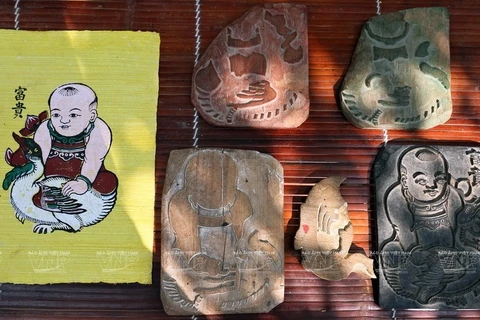
Dong Ho painting is special because it is printed by hand entirely from woodblocks. Each painting has one woodblock for the outline and several others for printing colours. The number of the woodcuts corresponds to the number of colours a painting has. The colours of paint are processed from natural materials Vietnam. The woodblocks are engraved by hand and can be kept for many years.

Dong Ho paintings are printed on do paper made from do tree bark and covered with a layer of scallop shell powder mixed with sticky rice paste. The scallop seashell gives a sparkling white background while the rice paste makes the paper more supple and able to maintain colours for a long time. To print a painting, the woodblock is applied with paint and pressed on a sheet of paper. The process is repeated for each colour and the finished picture is the result of joining different colours in a certain order.

Dong Ho paintings feature the life of northern delta inhabitants. The themes vary, from familiar livestock such as buffaloes, pigs and chickens, to daily activities, historical figures, cultural values, folk allegories and social commentaries. Typical Dong Ho paintings include Vinh Hoa and Phu Quy (Eminence and Prosperity), Corpulent Pig with Piglets, Hen Surrounded by Chicks, Rat’s Wedding, Scene of Jealousy, Scene of Wrestling, Scene of Catching Coconuts, Saint Giong, Ngo Quyen, and Trung Ladies.

In 1945, Dong Ho village had 17 families making Dong Ho paintings. Now, only two families of artisans Nguyen Huu Sam and Nguyen Dang Che still do the craft. The two families have conserved over 1,000 woodblocks and restored 500 ancient woodcuts.

In recent years, Dong Ho paintings have regained popularity due to a rising demand from foreign tourists. This has largely encouraged local artisans to revive and develop the craft.

In Song Ho commune, there is a centre for Dong Ho painting conservation located inside the workshop of Nguyen Dang Che’s family. The centre has a showroom displaying thousands of paintings and a workshop where artisans show visitors how the paintings are made./.
VNA

See more

Deputy Minister of Foreign Affairs Ngo Le Van, Chairman of the Vietnam National Commission for UNESCO, speaks at plenary session of the 48th session of the UNESCO World Heritage Committee in Busan on July 20, 2026. (Photo: VNA)

Vietnam proposes priorities to strengthen international cooperation on world heritage conservation

On behalf of Vietnam, the deputy minister proposed three priorities of strengthening international cooperation and capacity-building for member states, particularly developing countries; promoting science-based conservation that strikes a balance between preservation and development while placing local communities at the centre; and enhancing coordination among relevant conventions and programmes, alongside the responsible application of digital technologies and artificial intelligence in heritage conservation.

Claudia Roth, a member of the German Bundestag, visits the Vietnamese booth at the festival. (Photo: VNA)

Vietnam attends multicultural festival in Germany as guest of honour

The Vietnamese booth attracted a large number of visitors with traditional dishes such as "nem cuon" (fresh spring rolls) and "bun cha" (grilled pork with vermicelli), along with displays of ao dai (traditional long dress), conical hats and cultural performances imbued with Vietnamese identity. These activities helped spread Vietnamese culture and foster understanding and closer ties between the Vietnamese community, German residents and international friends.

Representatives of countries and territories participating in the Asian Pencak Silat Championship. Photo: VNA)

10th Asian Pencak Silat Championship opens in Dong Nai

Speaking at the opening ceremony, Director of the municipal Department of Culture, Sports and Tourism Le Thi Ngoc Loan said the championship offers athletes an opportunity to compete in a spirit of fairness and sportsmanship while promoting exchanges, mutual understanding and friendship among participating countries.

A special art performance at the Khanh Hoa Sea Festival 2026 (Photo: VNA)

Khanh Hoa Sea Festival 2026 opens, promoting sustainable marine development

Having been held 10 times, the Khanh Hoa Sea Festival has evolved beyond a local celebration into an event of national significance in culture, economy and external relations. This year's edition continues to honour Vietnam's maritime cultural heritage while promoting tourism, the marine economy and international integration.

The golf course at NovaWorld Phan Thiet will host international tournaments during Sports Festival 2026. (Photo: VNA)

Around 7,000 athletes to compete at Sports Festival 2026

This year's festival will feature 12 sports, introducing several new events such as national youth triathlon and beach tennis championship, while expanding its international scope by bringing together clubs, athletes, and police forces from ASEAN countries for events such as the ASEAN Police Open Golf Tournament 2026.

A performance of Cheo Tau folk singing, a distinctive cultural tradition of O Dien commune in Hanoi. (Photo: VNA)

Beyond preservation: Unlocking the value of Vietnam's heritage

Dr. Nguyen Thu Hanh, Director of the Centre for Research and Development of Vietnam Cultural Industry (SDCI), said Vietnam has traditionally focused on preserving heritage rather than creating new value from it. The key obstacle, she noted, is the weak connection between heritage and science, technology, education, design, communications and the marketplace, limiting its economic, educational and social impact despite the country's abundant cultural resources.

Vietnamese Ambassador to Laos Nguyen Minh Tam speaks at the event. (Photo: VNA)

Film screening in Vientiane highlights Vietnam-Laos strategic cohesion

A screening of the special Vietnamese feature film Mua Do (Red Rain) was held in Vientiane on July 16 to mark the 49th anniversary of the signing of the Vietnam-Laos Treaty of Amity and Cooperation (July 18, 1977–2026), reaffirming the two countries' strategic cohesion through cultural exchange.

Artists from the Vietnam National Puppetry Theatre deliver emotionally compelling performances that recreate the rich historical legacy of Thang Long–Hanoi. (Photo: VNA)

Top leader's directives chart new course for culture-led development: experts

Artists and cultural experts shared the view that the top leader's guidance at the second meeting of the Central Steering Committee for the Development of Vietnamese Culture not only reviewed the initial implementation of the Politburo's Resolution No. 80-NQ/TW but also identified four major gaps requiring urgent action and three strategic shifts to unlock the full potential of culture.

Digital transformation in heritage should adopt people-centred approach: UNESCO

Digital transformation in heritage should adopt people-centred approach: UNESCO

Digital transformation in the heritage sector should adopt a people-centred approach, ensuring the meaningful participation of communities at every stage-from documentation and preservation to the management, use and dissemination of cultural data. Jonathan Baker, Representative of the United Nations Educational, Scientific and Cultural Organization (UNESCO) told the Vietnam News Agency during an interview on July 8.

After covering more than 4,000 km across Europe, the Pho Cultural Roadshow Europe 2026 makes its final stop at Viet Pho Restaurant in Berlin. (Photo: VNA)

Pho roadshow ends European journey with Berlin finale

The initiative brought together eight leading Vietnamese chefs and culinary experts, who introduced pho and other traditional dishes at eight destinations – Prague, Warsaw, Trnava, Bratislava, Vienna, Budapest, Bochum and Berlin. Each stop celebrated a different facet of Vietnam's culinary heritage while fostering professional exchanges and discussions on the future of Vietnamese cuisine.

The Vietnamese Consulate General's booth at the Hong Kong Book Fair (Photo: VNA)

Vietnamese cultural heritage promoted at Hong Kong Book Fair

The booth of the Vietnamese Consulate General in Hong Kong has attracted considerable attention with a vibrant display featuring traditional conical hats painted with Vietnamese landscapes, red lanterns and large images of popular destinations such as Ha Long Bay, Sa Pa, Hue and Da Nang.