Banh chung gu – Ha Giang’s must-try specialty

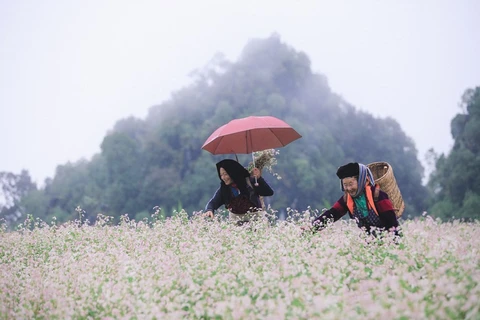
The name of the cake reflects the image of a woman carrying a basket on her back, bending to the hard work in her field.
Banh chung gu – Ha Giang’s must-try specialty ảnh 1"Banh chung gu" is part of the celebration of the Lunar New Year (Tet) festival of  the Red Dao ethnic group in Ha Giang. (Photo: VietnamPlus)

Ha Giang (VNA) – Visiting the northern mountainous province of Ha Giang, tourists are encouraged to try “banh chung gu” ((hunchback glutinous rice cake). 

As ‘banh chung’ (square glutinous rice cake) is an indispensable part of the celebration of the Lunar New Year (Tet) festival of the ethnic majority Kinh, the Red Dao ethnic group in Ha Giang have their own version. The Red Dao cake is known as ‘banh chung gu”.

The name of the cake reflects the image of a woman carrying a basket on her back, bending to the hard work in her field.

In this way, the Red Dao praise the hard work of the people there, particularly local women.

Banh chung gu – Ha Giang’s must-try specialty ảnh 2The cake is wrapped with forest dong leaf, sticky rice is spread evenly on the leaf, then beans, bacon, and spices are added sufficiently. (Photo: VietnamPlus)

Unlike the square glutinous rice of the Kinh, which often includes a frame made of six wild dong (phrynium placentarium) leaves cut in the forest to wrap the cake, the Red Dao uses only one leaf because each cake is the size of a fist, weighing from 100 to 150 grams only.

The cake is made of sticky rice, green beans, pork from local black pigs wrapped in dong leaves. The glutinous rice should be soaked in water overnight and the bacon, with fish sauce, salt, and pepper for several hours to ensure the cake is sticky and delicious. To make the cake green, the leaves should be fresh and washed clean.

The cake is wrapped with forest dong leaf, sticky rice is spread evenly on the leaf, then beans, bacon, and spices are added sufficiently. 

After folding the two edges of the leaf to create the shape of the cake, housewives tie it with bamboo strings and then cook it for about eight to ten hours.

Local people boil cakes with traditional wood stoves, not electric ones. After being boiled for hours, the meat turns soft while the rice is sticky. It is said to carry the flavour of the mountains.

According to local people, delicious chung cake must be boiled very well. When grabbing a bite, people can feel all the flavor of fragrant marinated pork, green beans mixed with sticky glutinous rice grown in mountainous areas.

Banh chung gu – Ha Giang’s must-try specialty ảnh 3The name of the cake reflects the image of a woman carrying a basket on her back, bending to the hard work in her field. (Photo: VietnamPlus)

In the past, the cake was only cooked for the Lunar New Year festival but now locals make the cake for sale year-round.

Many households have expanded the production of chung cake, creating a stable source of income for local people and contributing to promoting Ha Giang tourism.

In addition to the chung cake, other specialties of the province are steamed rice rolls with egg and Thang Co which is made from pork (beef or horsemeat is an alternative), its organs, some herbs, and seeds.

Besides, five-corlour sticky rice and rice cooked in bamboo pipes are also must-try local specialties. The five-colour glutinous rice is special in that it contains the culinary hues of white, purple, green, yellow, and red, and used on special occasions in Vietnam, such as Lunar New Year, weddings, and death anniversaries. The dish is usually presented in the shape of a flower with five petals, as a way to show affection and respect for parents, grandparents, and ancestors./. 
VNA

See more

A ritual at Hue Nam Temple Festival (Photo: VNA)

Hue Nam Temple Festival: From imperial relic to distinctive cultural celebration in Hue

Historically known as Ngoc Tran Son Tu, the temple was renamed Hue Nam during the reign of King Dong Khanh in the late 19th century, symbolising royal gratitude to the Mother Goddess. It is also the only temple in Hue that harmoniously combines royal ceremonial elements with folk religious practices, creating a distinctive blend of court ritual and popular belief.

Participants in the 20th Cong hien (Devotion) Awards presentation ceremony in Hanoi on April 15 (Photo: VNA)

Devotion Awards mark two decades of honouring excellence in music, sports

Nguyen Thien Thuat, Editor-in-Chief of the The Thao & Van Hoa newspaper and Head of the organising board of the awards, said, noting that their achievements reflect the spirit of the Politburo’s Resolution No. 80, which emphasises preserving national cultural values while selectively absorbing the essence of world culture.

Artisans and students take part in cultural activities and exchanges in the Xoan singing performance space at Hung Lo ancient communal house in Phu Tho province (Photo: VNA)

Ancestral legends revived through contemporary performance

Beyond cultural value, well-organised festival programmes linked with tourism and media can contribute to the development of cultural industries and enhance Vietnam’s cultural soft power, positioning heritage-based events as distinctive national cultural brands in the international arena.

Khue Van Cac (Khue Van Pavilion) stands as a defining cultural symbol of Hanoi, closely associated with Vietnam’s long-standing tradition of valuing education and honouring knowledge. (Photo: VNA)

Greater efforts needed for heritage to shape Hanoi’s identity

As suggested by UNESCO experts, heritage should be approached as an integrated system encompassing space, people and everyday life. This perspective can inform urban planning, cultural tourism development and the creation of clear economic drivers.

Participants at the gathering (Photo: VNA)

Lao, Cambodian students welcome traditional New Year in Ho Chi Minh City

In his speech, Vice Chairman of the municipal People’s Committee Nguyen Manh Cuong said the municipal Party organisation, authorities and people always value the close ties and solidarity among Vietnam, Laos and Cambodia. He described the three nations’ longstanding ties, forged through shared hardships, as an invaluable spiritual asset and a bedrock for sustainable development.

Vietnamese kickboxers win 32 gold medals at the Kickboxing World Cup 2026. (Photo: Vietnam Kickboxing Federation)

Vietnam finish third at Kickboxing World Cup 2026

According to Vu Duc Thinh, President of the Vietnam Kickboxing Federation, the strong results reflected careful preparation by local training centres and the determination of Vietnamese fighters. The team’s participation, funded largely through socialised and local resources, also demonstrated growing support for the development of kickboxing in Vietnam.

Politburo member, Secretary of the Party Central Committee and Head of the Party Central Committee’s Commission for Information, Education and Mass Mobilisation Trinh Van Quyet speaks at the event (Photo: VNA)

National Radio Festival opens in Quang Ninh

The opening night was combined with an artistic programme titled “sounds of the new era,” drawing around 50,000 spectators. The programme was structured in three chapters: Origins of Sound, Heritage Sound, and Sound of the New Era.

Vietnamese puppetry faces pressure to adapt to modern lifestyles, particularly amid growing competition from diverse entertainment forms (Photo: VNA)

Vietnamese puppetry seeks renewal amid preservation challenges

People’s Artist Nguyen Hoang Tuan, Chairman of the Hanoi Theatre Association, noted that while northern Vietnam had 27 puppetry guilds in 1986, only 14 remain today. Many traditional plays and original scripts have been lost, hurting restoration and preservation efforts.