Banking system’s bad debt ratio surges to 3.56%

The bad debt ratio of the banking system skyrocketed from 2% at the beginning of this year to 3.56%, or more than 440 trillion VND, at the end of July 2023, according to the latest data from the State Bank of Vietnam (SBV).
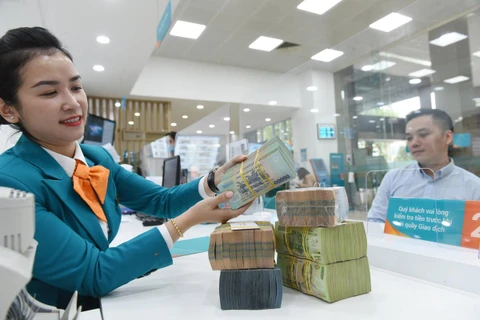
Banking system’s bad debt ratio surges to 3.56% ảnh 1Illustrative photo (Photo: VNA)
Hanoi (VNS/VNA) - The bad debt ratio of the bankingsystem skyrocketed from 2% at the beginning of this year to 3.56%, or more than440 trillion VND, at the end of July 2023, according to the latest data fromthe State Bank of Vietnam (SBV).

Including bad debts that commercial banks sold to the Vietnam Asset ManagementCompany (VAMC) and have not yet been recovered, the bad debt ratio rose to 6.16%.

This bad debt ratio includes the debts of five banks: SCB, Dong A Bank, CBBank,OceanBank, and GPBank, which are under the SBV’s special control. Excludingthese five banks, the bad debt ratio stood at 1.92%.

SBV Governor Nguyen Thi Hong stated that as of September 21, 2023, theoutstanding loans of the banking system totalled more than 12.62 quadrillionVND, an increase of 5.91% compared to the end of 2022. Notably, the bad debtratio in the real estate sector rose from 1.8% in July 2022 to 2.58% in July2023.

The credit quality of many banks has shown signs of deterioration. Some bankslisted on the stock exchange, such as NCB, ABBank, BVBank, VPBank, VietBank,OCB, and PGBank, had bad debt ratios exceeding 3% by the end of June 2023.

Experts predict that the credit quality of the banking system may continue toface pressure. Some bank leaders believe the bad debt ratio will peak in thethird quarter of this year and start to gradually decrease from the beginningof the next year.

The SBV has highlighted that the domestic and international economic situationsare highly volatile due to the escalating Russia-Ukraine conflict, whichdisrupts the global supply chain. This leads to a rising risk of inflation andimpacts the consumer spending of many economies. Vietnam’s major tradingpartners also face potential recession risks, especially following incidentsinvolving several US banks.

At present, banks' management of bad debts encounters numerous challenges,especially with the rise in overdue debts and a sluggish real estate market,making the handling of real estate collateral even more challenging.

Furthermore, the SBV has noted that the debt trading market still presents manylimitations. The legal framework related to restructuring credit institutionsand managing bad debts remains incomplete, and there is a lack of favourablepolicies to encourage both domestic and foreign investors to participate inhandling collateral and trading bad debt.

Specifically, the infrastructure of underperforming banks still lacks theresources and specific mechanisms for thorough management. Some State-ownedgroups and corporations do not have the resources required to manage losses andrestructure non-bank credit institutions where they hold ownership orsignificant shares./.
VNA

See more

Vietnam shows strong FDI performance in the first 11 months of 2025 (Source: vtv.vn)

Vietnam shifting FDI attraction focus from volume to quality

As production relocation to Southeast Asia accelerates and competition for FDI intensifies, Vietnam faces increasing pressure from regional rivals such as India, Malaysia and Indonesia, which are offering bold tax incentives and developing specialised industrial parks. This reality requires Vietnam to shift its focus from attracting large volumes of capital to drawing high-quality investment, prioritising core technologies, innovation, value chain linkages and higher localisation rates.

Vice Chairman of the Ho Chi Minh City People’s Committee Hoang Nguyen Dinh inspects IUU fishing prevention efforts at Hung Thai Port in Long Hai commune. (Photo: VNA)

Ho Chi Minh City steps up oversight of unqualified fishing vessels

HCM City currently has 4,475 fishing vessels, all of which have been registered and updated on the VNFishbase system. Among them, 4,268 vessels, or 95.37%, have been granted fishing licences, while 207 unqualified vessels are being strictly managed and kept ashore.

Airlangga Hartarto (fifth from right), Indonesian Coordinating Minister for Economic Affairs, and CEO of VinFast Asia Pham Sanh Chau (sixth from right) at the plant opening ceremony on December 15. (Photo: VinFast)

VinFast inaugurates EV plant in Indonesia

The VinFast Subang plant was completed and put into operation just 17 months after groundbreaking, demonstrating the company's rapid execution capability and strong implementation capacity. This is VinFast's fourth operational facility worldwide, and its first plant in Indonesia and Southeast Asia outside of Vietnam.

From early December, major retail chains in Ho Chi Minh City have recorded a noticeable increase in shoppers seeking Tet products. (Photo: VNA)

HCM City businesses ramp up production to meet Lunar New Year demand

From early December, major retail chains in the city have recorded a noticeable increase in shoppers seeking Tet products. Many consumers are taking advantage of promotional programmes to purchase gift items with long shelf lives, such as confectionery, soft drinks and processed foods, well ahead of the holiday peak.

Workers process fish to be tinned for export at KTC Canned Food Factory under Kien Giang Trading JSC. (Photo: VNA)

Vietnam to host seminar on export growth strategies

Vietnam's exports rose 16.1% to 430.2 billion USD in the first 11 months of 2025, while total trade hit 839.8 billion USD during the same period. This strong performance shows that exports remain a key driver of economic growth, boosting Vietnam's standing on the world stage in recent years.

The vessel carrying the 2 millionth TEU arrives at Hai Phong Port. (Photo:VNA)

Hai Phong Port reaches 2-million-TEU milestone

Handling the 2 millionth TEU in 2025 not only demonstrates Hai Phong Port’s operational capacity and the collective efforts of its workforce, but also highlights its increasingly important role in regional and global supply chains, the confidence of shipping lines, logistics firms and the business community, and the effectiveness of policies to improve the investment climate and strengthen maritime infrastructure and services.

Melons labelled with traceability codes on display at the Song Van agricultural produce store in Ninh Binh city, Ninh Binh province. (Photo: VNA)

Tracing origins hindered by fragmented data systems

As the Government accelerates the digital economy, establishing a unified national traceability system has become a crucial move to end data fragmentation and disconnection among ministries, sectors and localities.

Hyundai unveils its new Avante Hybrid model in Seoul, the Republic of Korea, on August 13, 2020. (Photo: Yonhap/VNA)

Tax cuts poised to ignite Vietnam’s hybrid vehicle boom from 2026

Experts forecast that 2026-2030 will mark a period of strong growth for hybrid vehicles in Vietnam, a trend that will invigorate the automotive sector while supporting national objectives on emissions reduction, sustainable development and the broader transition to green mobility.