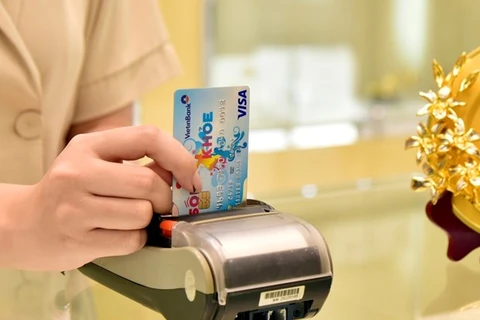
Banks to introduce domestic credit chip cards to promote cashless payments

The National Payment Corporation of Vietnam (Napas) last week said it will work with seven banks to introduce domestic credit chip cards with unified standards to limit cash payments and tackle black credit.
Banks to introduce domestic credit chip cards to promote cashless payments ảnh 1Domestic credit chip cards with unified standards were expected to be introduced this week. (Source: VNA File Photo)

Hanoi (VNS/VNA) - TheNational Payment Corporation of Vietnam (Napas) last week said it will work with seven banks tointroduce domestic credit chip cards with unified standards to limit cashpayments and tackle black credit.

The domestic credit chipcards are expected to be officially launched this week. The seven banks includeVietnam Joint Stock Commercial Bankfor Industry and Trade (Vietinbank), Ban Viet Joint Stock Commercial Bank (VCCB), AsiaCommercial Bank (ACB), HCM City Housing Development Commercial Joint Stock Bank(HDB), Bao Viet Bank (BVB), Sai Gon Thuong Tin (Sacombank) and Vietnam Thuong Tin (Vietbank).

Previously, fourState-owned commercial banks issued domestic credit cards but the issuance wastemporarily halted due to inefficient operation. Some joint-stock banks alreadyissued this type of card but without unified technical standards.

Nguyen Quang Minh, Napas’ deputy director, saidthe new domestic credit cards will beaccepted throughout the networks of all banks while the previously-issued oneshad limited acceptance.

“In developed countries,domestic credit cards are very common,” Minh said. “That banks will join withNapas to issue domestic credit cards will significantly contribute to limitingcash payments and provide more options for consumer credit to prevent blackcredit.”

The domestic credit chipcards has high security in accordancewith the State Bank of Vietnam’sstandards and EMV standards – a security technology used worldwide for chipcard payments and acceptance devices – originally developed by Europay,MasterCard and Visa, he said.

Cardholders will not have to pay fees for transactions withan interest-free period of up to 55 days compared to the typical 45 days. Theacceptance points will haveto pay fees of about 1.1-1.3 percent of the transaction values, lower thanother credit cards.

The fees for cashwithdrawal would be about 1-2 percent of the transaction value (a minimumof 10,000-20,000 VND pertransaction), also much lower than the feeof about 4 percent of other international credit cards.

Statistics from the Vietnam Bank Card Association showed thatoperating domestic credit cards saw a decrease of 10 percent in 2017-20 and newissuances fell by 36 percent.

However, the totaltransaction value of existing domestic cards increased by 25 percent in theperiod./.

VNA

See more

Delegates perform the opening ceremony. (Photo: VNA)

Thailand Week 2026 opens in Hanoi

The event brings together more than 100 companies, including Thai enterprises and Vietnamese importers, across about 120 booths. It features a wide range of Thai products aligned with consumer trends in Vietnam, including food and beverages, health and beauty, mother-and-baby and pet products, fashion and jewellery, household goods and tourism services.

Illustrative image (Photo: VNA)

Vietnam remains Singapore’s third-largest seafood supplier in 2025

Data released by the Accounting and Corporate Regulatory Authority of Singapore (ACRA) show that Singapore spent 125.5 million SGD (97.7 million USD) importing seafood from Vietnam last year, up 10.7% year on year, accounting for 10.3% of the city-state’s total seafood import market.

Workers assemble mobile phone components at Diem Thuy Industrial Park in the northern province of Thai Nguyen. (Photo: VNA)

Electronics exports surpass 107 billion USD in 2025

With an export turnover of 107.75 billion USD in 2025, computers, electronic products and components not only maintained their position as Vietnam’s largest export by value, but also contributed more than half of the overall increase in the country’s export turnover in 2025.

Experts said that Vietnam’s economic outlook continues to be underpinned by stable foreign direct investment inflows and public investment, which is playing an important role in driving growth. (Photo: thoibaotaichinh.vn)

Foreign investors maintain strong confidence in Vietnam’s market

Looking ahead to 2026, prospects remain bright as manufacturing, economic growth and foreign investment in Vietnam are expected to stay robust, with the country forecast to post the highest growth rate in the region this year, according to Adam Sitkoff, Executive Director of the American Chamber of Commerce (AmCham) in Vietnam.

Toy production at a Hong Kong-invested factory (Photo: VNA)

Vietnam targets deeper market penetration in Hong Kong in 2026

Vietnam-Hong Kong trade hit 62.3 billion USD in the first 11 months of 2025, soaring 73.1% annually. Vietnamese exports to Hong Kong amounted to 36.8 billion USD, a 90.6% hike, ranking fourth among Hong Kong’s import sources, while imports from Hong Kong stood at 25.5 billion USD, up 52.9% and ranking third.

Vietnam’s start-up market enters restructuring phase

Vietnam’s start-up market enters restructuring phase

In 2026, venture capital inflows into Vietnam’s start-up ecosystem are expected to recover gradually, though in a more selective manner. VinVentures forecasts that capital will focus on start-ups that have survived the rigorous screening of 2024–2025, possess clear business models, strong commercialisation capacity, and the ability to generate real cash flows.