Beverage sector contributes 1.3 billion USD to budget

The beverage industry contributed 30 trillion VND (1.3 billion USD) to the State budget last year, according to the Vietnam Beer, Alcohol and Beverage Association (VBA).
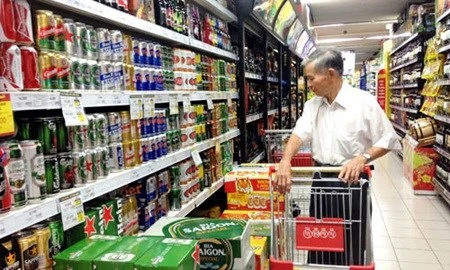
Beverage sector contributes 1.3 billion USD to budget ảnh 1Illustrative image (Source: VNA)

Hanoi (VNA) - The beverage industry contributed 30 trillion VND (1.3 billion USD) to the State budget last year, according to the Vietnam Beer, Alcohol and Beverage Association (VBA).

At a conference held in Hanoi on January 6, VBA Chairman Nguyen Van Viet said the beverage industry continued to grow over the past five years despite the difficult economic times that have resulted in many other kinds of companies struggling or shutting down.

Besides, the sector also created jobs for dozens of thousands of labourers as well as adequately met the domestic demand with high quality products, enhancing competitiveness amid anticipated rising competition pressure associated with intensive international integration, Viet said.

According to a VBA report, in 2015, the beverage industry produced over 3.4 billion litres of beer, an increase of 40 percent compared to 2010.

Vietnam currently has 129 beer establishments, most of which are concentrated in large cities such as Hanoi, Ho Chi Minh City, and Thua Thien Hue. The majority of the market share is still controlled by the Sai Gon Beer, Alcohol and Beverage Corporation (Sabeco), the Hanoi Beer, Alcohol and Beverage Corporation (Habeco) and the multinational breweries Heineken and Carlsberg.

In the reviewed period, non-alcoholic beverages also witnessed an impressive growth with a production capacity of five billion litres per year and more than 1,800 production facilities.

By 2020, the beverage industry is forecast to reach a higher capacity, with 4.25 billion litres of beer, 9.2 billion litres of non-alcohol and 360 million litres of alcohol expected to be produced per year.

While joining the Trans Pacific Partnership (TPP) agreement and other Free Trade Agreements (FTAs) would give Vietnam the chance to attract more investment, it would also pose a significant challenge, Viet said, adding that domestic beverage companies should enhance their production quality and improve their distribution system to protect their domestic market shares.-VNA
VNA

See more

UK Ambassador to Vietnam Iain Frew addresses the event (Photo: nhandan.vn)

Vietnam, UK step up cooperation in derivatives commodity market development

The British Embassy in Vietnam and the British Consulate-General in Vietnam, in coordination with Boston Consulting Group (BCG), held a capacity-building session under the UK–Vietnam Growth Gateway initiative in Hanoi on March 5 to discuss strategies for developing a transparent and globally connected commodity and derivatives market.

The Quang Tri coastal road project, spanning nearly 55km, is among key projects with regional connectivity that play an important role in promoting socio-economic development in the central province of Quang Tri. The project is expected to be completed by the end of 2026.(Photo: VNA)

Public investment disbursement slow despite record capital scale

As of February 28, total disbursed capital reached 55.74 trillion VND, equivalent to 5.6% of the plan assigned by the Prime Minister. Of the figure, disbursement of the central budget was estimated at 10.18 trillion VND, or 2.9% of the plan, while that of local budgets totalled 45.56 trillion VND, reaching 7% of the target.

Delegates taste UK food (Photo: VNA)

Taste of UK week promotes British foods in Vietnam

The “Taste of the UK” food week, held for the first time in Ho Chi Minh City from February 26 to March 11, is an opportunity to promote British food products and strengthen their presence in Vietnam, while giving local consumers a chance to experience the diversity of UK cuisine.

A customer purchases E5RON92 bioethanol fuel at a PVOIL gas station on Thai Thinh street, Hanoi (Photo: VNA)

Retail fuel prices rise sharply in March 5 adjustment

According to the Ministry of Industry and Trade, the global fuel market during the latest price adjustment period from February 26 to March 4, 2026 was influenced by several major factors, including the escalating military conflict between the US – Israel coalition and Iran.

Workers at a textile factory in Hanoi (Photo: VNA)

Supporting industries seek fresh growth momentum

Against a backdrop of global uncertainty and supply chain restructuring, the Government has introduced a range of measures aimed at injecting new momentum into domestic manufacturing. New provisions covering workforce training, testing and certification, trade promotion and technology upgrades have been implemented.

Workers package fruits at the factory of Vina T&T Group (Photo: nhandan.vn)

Vietnamese exporters adapt to escalating Middle East conflict

The Ministry of Industry and Trade’s Export-Import Department forecasts upward pressure on global prices for consumer goods, fuel, and crude oil in the coming time. Such hikes could exert indirect but broad negative effects on Vietnam’s overall production and trade, with particular exposure in exports destined for the Middle East.

The MoIT will closely monitor global oil prices, output, inventories and trade flows to adjust imports and domestic supply accordingly. - Illustrative image (Photo: VNA)

Vietnam triggers fuel contingency plan over Middle East crisis

The Ministry of Industry and Trade will closely monitor global oil prices, output, inventories and trade flows to adjust imports and domestic supply accordingly. It will also intensify oversight of key traders’ compliance with their 2026 minimum reserve obligations.

Workers process tra fish for export. (Photo: VNA)

Agro-forestry-fishery exports up over 17% in first two months

Of the total export value in the January–February period, agricultural products accounted for 6.09 billion USD, up 17.1% year-on-year. Seafood exports reached 1.76 billion USD, marking a sharp increase of 23.3%, while forestry products brought in 2.82 billion USD, up 7.4%.