Beverage sector needs to strategise

Local beverage enterprises should have reasonable strategies on production and consumption to gain growth in the situation of high inventory at present, said experts.
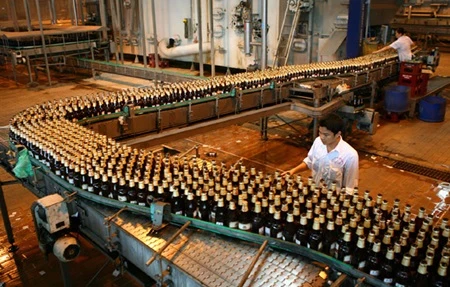
Beverage sector needs to strategise ảnh 1Last year, the beverage industry contributed more than 25.78 trillion VND (1.14 billion USD) to the State budget. (Source: VietQ.vn)

Hanoi (VNA) - Local beverage enterprises should have reasonable strategies on production and consumption to gain growth in the situation of high inventory at present, said experts.

According to the Ministry of Industry and Trade's report in October, the inventory index of the beverage industry in the first 10 months of this year increased by 97.4 percent compared with the same period last year. It was always among the top industries with the highest inventory index in the last two years.

Meanwhile, the beverage industry also had a high production index, even higher than the average production index for the processing industry.

The General Statistics Office reported that in the first 10 months of this year, the production index of the local beverage industry gained a year-on-year increase of 7.1 percent, including milk powder, which went up 17.9 percent, fresh milk, which rose 15.3 percent, and beer that rose 6.8 percent, in addition to commercial water, which increased 6.6 percent.

However, the consumption index of the beverage industry had a year-on-year surge of only 5 percent in this period.

The local beverage firms have faced difficulties in production and business as well as competition from rival foreign rival firms. In addition, slow growth of the local economy has been a reason for slow consumption of beverage products in the past.

Nguyen Van Viet, Chairman of Vietnam Beer, Alcohol and Beverage Association, said early this year that Vietnamese beverage firms must be ready to face strong competition from foreign rival because foreign enterprises have had strong investments in Vietnam.

The association said the growth rate of the beer industry has seen a downtrend since 2011. It is expected to reduce to 4.7 percent for this year from 8.5 percent in 2011. The HCM City Food and Foodstuff Association said the beverage industry has faced those difficulties due to the instability in purchasing material, high transport costs and property rents, and lower purchasing power in the local market.

However, experts said the local beverage industry will gain recovery in growth if it overcomes the existing difficulties.

Bui Truong Thang, Deputy Head of the Light Industry Department under the Ministry of Industry and Trade, said that in the future, those enterprises should focus on expanding the market and synchronising production equipment to improve capacity and quality and reduce production cost. These will lead to increased competitive ability of beverage products of local firms.

The SSI Research under the Saigon Securities Inc (SSI) said the consumption of beverage products has seen a saturation in cities in recent times, but the rural regions have become potential markets that the enterprises have not focussed on developing, Thoi bao Kinh doanh newspaper reported.-VNA

VNA

See more

Gemalink International Port in Ho Chi Minh City is one of the strategic seaports for industry, trade and global integration. (Photo: VNA)

Vietnam deepens global supply-chain integration

Deputy Minister of Industry and Trade Phan Thi Thang said Vietnam remains a top priority for international corporations and buyers seeking new sources of supply, thanks to its 17 FTAs, stable investment environment, improving production capacity and strategic location in Southeast Asia.

Illustrative image (Photo: VNA)

Vietravel Airlines resumes Hanoi – Da Lat route

Resuming the route is part of the carrier's year-end operating plan. It's a concrete step toward optimising the airline's domestic network, and a sign of its commitment to helping Lam Dong province revitalise tourism following the airport upgrades, its representative said.

Prof. Tan Jian Ping, Director of the Centre of Excellence for Sustainable Technologies for Agricultural Advancement and a Zero-Waste Economy (STARGAZE) at Xiamen University Malaysia (Photo published by VNA)

Vietnam, Malaysia see potential for smart agriculture cooperation

Prof. Tan Jian Ping, Director of the Centre of Excellence for Sustainable Technologies for Agricultural Advancement and a Zero-Waste Economy (STARGAZE) at Xiamen University Malaysia (XMUM), said NAP 2.0 focuses on applying Industry 4.0 technologies, including the Internet of Things (IoT), unmanned aerial vehicles, artificial intelligence (AI), automation and biotechnology.

The 30th Export Day draws representatives from various organisations and businesses in Argentina. (Photo: VNA)

Vietnam, Argentina eye broader Mercosur access amid free trade push

During the 30th Export Day, organised on September 15 in Buenos Aires by the Chamber of Exporters of the Argentine Republic (CERA) under the theme "New Export Frontier: The Transformation Underway," Vietnamese Ambassador to Argentina Ngo Minh Nguyet highlighted that Vietnam considers Argentina and Mercosur important partners in South America and sees broad potential to deepen trade and investment ties.

Drone is used in seeding, fertilising and pesticide spraying (Photo: VNA)

Greening agriculture through low-emission crop production

The scheme to sustainably develop 1 million ha of high-quality, low-emission rice in the Mekong Delta by 2030 is advancing, said Nguyen Quoc Manh, Deputy Director of the Department of Plant Production and Protection at the Ministry of Agriculture and Environment.

DACE launches organic spice processing, preservation and export plant in Cao Bang (Photo: VNA)

Cao Bang develops organic farming zones linked to European markets

Around 2,353ha of farmland in the province meets organic standards, including more than 2,332ha of spice-growing areas cultivating cinnamon, star anise and ginger that have obtained internationally recognised certifications such as USDA (US), EU and JAS (Japan).

Electronic components are produced at a factory in Hanoi. (Photo: VNA)

Hanoi's imports surge 41% in first eight months of 2026

Hanoi aims to achieve average annual export growth of at least 12% during 2026-30, with the city seeking to diversify export markets, boost high-tech and value-added products and reduce reliance on traditional markets.

Ben Thanh Market in Ho Chi Minh City attracts a large numbers of domestic and international visitor.( Photo: VNA)

Vietnam targets 50 million international visitors by 2030

The Ministry of Culture, Sports and Tourism has outlined three scenarios for 2027–2030. Under the high-growth scenario, international arrivals would rise 15–18 percent annually to reach 45–50 million, while domestic tourism would reach around 160 million trips. Total tourism revenue is projected at 80–90 billion USD.

Factories and production facilities in the Chu Lai Open Economic Zone, Da Nang city, are equipped with modern production lines. (Photo: VNA)

Ready-built factories gain from new manufacturing FDI wave

Ready-built factories attracted 73% of new manufacturing FDI in northern Vietnam over the past two quarters, as foreign investment continued to surge at the region's industrial hubs during the first eight months of 2026. The trend points to growing demand for premises that can be put into operation quickly.