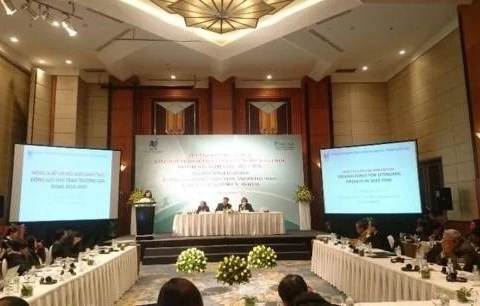
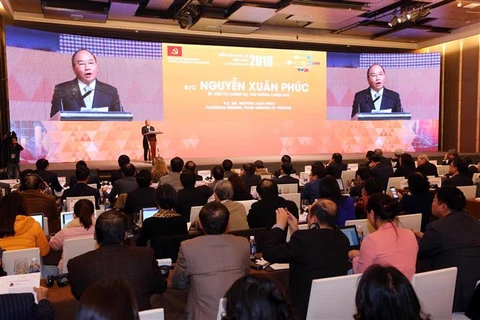
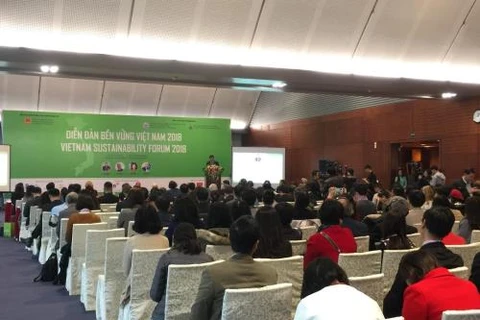
Deputy Prime Minister Vuong Dinh Hue is speaking (Source: VNA)
 Hanoi (VNA) – Deputy Prime Minister Vuong Dinh Hue has asked for a breakthrough in improving the health of businesses, especially State-owned enterprises (SOEs) in 2018.
Chairing a meeting of the Steering Committee for Business Reform and Development in Hanoi on January 31, Deputy PM Hue, who is head of the committee, noted that the health of businesses is better as 47.3 percent of firms enjoyed profit in 2017, while the figure in 2012 was only 30 percent.
Of the profitable firms, 83.5 percent are State-owned. However, the profit percentage on capital and turnover remains low, while business management of the firms is still weak, he noted, stressing the need to continue reducing cost for enterprises, including financial and operational cost, he said.
He pointed out that the current number of enterprises is far behind the target of 1 million in 2020, as in 2018, the country aims for only 135,000 new firms.
A report of the Steering Committee for Business Reform and Development showed that the number of SOEs has reduced sharply to over 500, including seven economic groups, 57 corporations, and 441 independent businesses run by ministries, sectors and localities.
Wholly state-owned firms are now present in 11 sectors instead of 60 in 2001.
Nguyen Hong Long, deputy head of the committee, said that in 2017, 69 State-owned enterprises were approved for equitisation, including large businesses worth over 1 trillion VND (44 million USD). State capital in equitised firms last year was 160.08 trillion VND, 6.34 times higher than that of 2016.
Long said that the State has so far withdrew 8.91 trillion VND in book value and gained 139.38 trillion VND from SOE divestment.
Last year, the country saw a record number of newly-established enterprises with 126,859 firms, up 15.2 percent compared to 2016, raising the total operating firms to over 561,000, he added.
Mentioning 2018 tasks, Deputy PM Hue urged ministries and sectors continue completing legal institution and framework in managing and operating SOEs as well as accelerate equitisation, re-organisation and capital divestment of the firms.
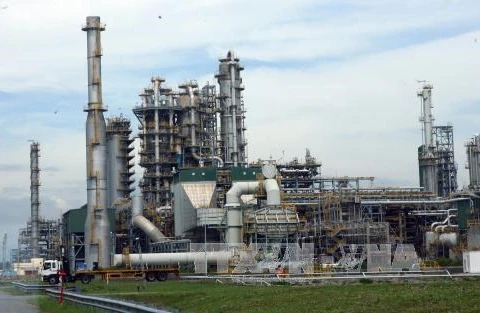
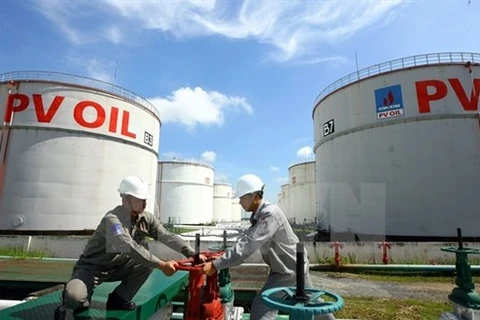
This year, four large enterprises with highest capital in the 69 equitised groups and corporations in 2017 will launch their initial public offering (IPO) on the stock market: the Vietnam Rubber Group, PetroVietnam Oil Corporation (PVOIL), the PetroVietnam Power Corporation, and Binh Don Oil Refinery.
The Deputy PM said equitisation targets the improvement of governance capacity and effectiveness of the firms.
Along with reviewing and handling State-owned enterprises with losses and ineffective operation, Hue asked for reshuffling of key leaders in equitised businesses. - VNA
Chairing a meeting of the Steering Committee for Business Reform and Development in Hanoi on January 31, Deputy PM Hue, who is head of the committee, noted that the health of businesses is better as 47.3 percent of firms enjoyed profit in 2017, while the figure in 2012 was only 30 percent.
Of the profitable firms, 83.5 percent are State-owned. However, the profit percentage on capital and turnover remains low, while business management of the firms is still weak, he noted, stressing the need to continue reducing cost for enterprises, including financial and operational cost, he said.
He pointed out that the current number of enterprises is far behind the target of 1 million in 2020, as in 2018, the country aims for only 135,000 new firms.
A report of the Steering Committee for Business Reform and Development showed that the number of SOEs has reduced sharply to over 500, including seven economic groups, 57 corporations, and 441 independent businesses run by ministries, sectors and localities.
Wholly state-owned firms are now present in 11 sectors instead of 60 in 2001.
Nguyen Hong Long, deputy head of the committee, said that in 2017, 69 State-owned enterprises were approved for equitisation, including large businesses worth over 1 trillion VND (44 million USD). State capital in equitised firms last year was 160.08 trillion VND, 6.34 times higher than that of 2016.
Long said that the State has so far withdrew 8.91 trillion VND in book value and gained 139.38 trillion VND from SOE divestment.
Last year, the country saw a record number of newly-established enterprises with 126,859 firms, up 15.2 percent compared to 2016, raising the total operating firms to over 561,000, he added.
Mentioning 2018 tasks, Deputy PM Hue urged ministries and sectors continue completing legal institution and framework in managing and operating SOEs as well as accelerate equitisation, re-organisation and capital divestment of the firms.
This year, four large enterprises with highest capital in the 69 equitised groups and corporations in 2017 will launch their initial public offering (IPO) on the stock market: the Vietnam Rubber Group, PetroVietnam Oil Corporation (PVOIL), the PetroVietnam Power Corporation, and Binh Don Oil Refinery.
The Deputy PM said equitisation targets the improvement of governance capacity and effectiveness of the firms.
Along with reviewing and handling State-owned enterprises with losses and ineffective operation, Hue asked for reshuffling of key leaders in equitised businesses. - VNA
VNA