Breakthrough policies needed to develop electronics industry

The electronics industry has seen good progress in recent years, accounting for about 18% of the total industrial production value and more than 30% of the total export revenue of the country.
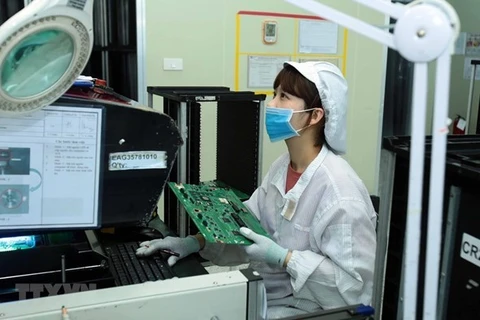
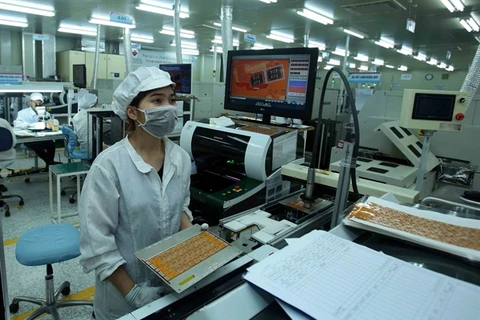
Breakthrough policies needed to develop electronics industry ảnh 1Manufacturing circuit boards at Vietnam Posts and Telecommunication Industry Technology Joint Stock Company at the Hoa Lac Hi-Tech Park. (Photo: en.nhandan.vn)
Hanoi (VNA) - The electronics industry has seen good progress in recent years, accounting for about18% of the total industrial production value and more than 30% of the totalexport revenue of the country.

However, about 95% of the export value of this industry stillbelongs to foreign-invested enterprises. Therefore, regulatory agencies need toresearch and issue breakthrough policies for the electronics industry todevelop more sustainably and strongly.

In the 2016-2020 period, exports of electronics, computers andcomponents in this period, grew by an average of 23.8% per year, according tothe General Statistics Office, bringing Vietnam from the 47th position in theworld in 2001 to the 12th position, and third in the ASEAN region in terms ofelectronics exports.

In 2022, the electronics industry earned an export revenue of114.4 billion USD, an increase of about 6% compared to 2021 and accounting formore than 30% of the total export revenue of the country.

The outstanding development of the electronics industry ismainly due to the attraction of large investments from multinationalcorporations, the Republic of Korea and Japan in the field of manufacturingelectronic components.

But the consequence is that the industry is also heavilydependent on foreign investors when up to 95% of export revenue belongs to FDIenterprises. The capacity of domestic enterprises remains limited, and thedomestic electrical-electronics market is dominated by foreign brands.

Besides, the localisation rate of the electronics industry isstill low. Most electronic products on the Vietnamese market are importedcomplete units or assembled domestically with foreign components. Although domesticsupporting enterprises have participated in the value chain of the industry,they can only provide simple products with low technological value. Vietnam'selectronics industry is still at the assembly stage in the electronicproduction chain.

Explaining the cause of this situation, Deputy Director of theIndustry Department Pham Tuan Anh said that electronic products often have arelatively short lifespan, with features and designs quickly changed, while domesticenterprises have limited capacity and lack resources to invest in the researchand development of products as well as brands.

Therefore, production stages with high value-added content stilldepend on foreign production chains. On the other hand, due to the lowproduction capacity of domestic enterprises, product quality has not yet metthe high requirements of FDI enterprises, leading to a lack of linkages betweensuppliers and multinational corporations.

After the COVID-19 pandemic and a series of socio-economic upheavalsin the world and the region, Vietnam's electronics industry is facing anopportunity to welcome a new wave of investment and to restructure the valuechain in the near future.

Many large corporations in the world such as Apple, Pegatron orIntel have expressed interest and plans to invest in or expand the productionof electronic products in Vietnam, including some products with high technologycontent. Samsung is looling for more domestic suppliers to increase the linkagein the value chain of the group in Vietnam.

However, to tackle the challenges facing the electronicsindustry, the State needs to promptly adjust its FDI attraction policy toeffectively take advantage of the wave of production shifting to Vietnam.Support policies are also needed to help support enterprises improve theircompetitiveness and promote digitalisation.

Deputy Director Pham Tuan Anh said that in the coming time, itis necessary to develop a long-term support strategy to help transform theindustry from simple assembly to manufacturing high-value-added products.First, it is necessary to promote the development of products such as displays,semiconductors and key electronic components.

Electronic businesses themselves should pay more attention toidentifying core and breakthrough products, as well as focus their resources onproducts with good competitiveness./.
VNA
See more

A booth at the trade promotion fair. (Photo: VNA)

Red River Delta trade promotion fair opens in Hung Yen

A trade promotion fair for localities in the Red River Delta opened on November 10 in the northern province of Hung Yen, aiming to foster regional connectivity, promote sustainable development and enhance brand of regional products.

Tan Thuan Export Processing Zone, Ho Chi Minh City (Photo: VNA)

Foreign investors ready to pour capital into HCM City

Administrative reform remains HCM City’s top priority. The city aims to cut at least 30% of procedures, reduce processing times and costs, and shift from a “management mindset” to a “service mindset” to better support the business community.

PM Pham Minh Chinh speaks at the event (Photo: VNA)

PM spotlights solidarity, cooperation, dialogue at annual business forum

Vietnam will maintain political stability and social order, push three strategic breakthroughs in institutional reform, hard and soft infrastructure, and quality human resources, while restructuring the economy and reforming the growth model, sustaining macroeconomic stability, and bolstering connectivity between domestic and FDI enterprises, said PM Pham Minh Chinh.

Officers of the Vam Lang border guard station in Dong Thap disseminate information on the prevention of illegal, unreported and unregulated (IUU) fishing and present a national flag to members of a local ship. (Photo: VNA)

Dong Thap province’s fishing cooperation models prove effective

According to Tran Thi Be Bay, Deputy Director of the provincial Department of Agriculture and Environment, the cooperative groups and cooperatives have members engaging in logistics services, such as purchasing seafood at sea and supplying fuel to fishing vessels, thereby helping fishermen stay longer at sea and increase productivity.

Vietnam’s pepper exports maintain strong growth momentum of over 25%, earning nearly 1.4 billion USD in the first ten months of 2025. (Photo: VNA)

Pepper exports maintains over 25% growth

According to the Vietnam Pepper and Spice Association (VPSA), the country exported 19,430 tonnes of pepper in October, including 16,464 tonnes of black and 2,966 tonnes of white pepper, with a total value of 129.5 million USD.

Vietnam's dragonfruits for export (Photo: VNA)

Tay Ninh expands middle East–Africa markets for farm produce

Leveraging its position as a gateway linking the Southeast and Mekong Delta regions, Tay Ninh province is asserting its role as a strategic hub in expanding agricultural supply chains to Muslim markets, especially the Middle East and Africa, which have emerged as promising destinations for Vietnamese agricultural exports, particularly Halal-certified products.

Vietnam’s Trade Counselor in India Bui Trung Thuong and Nguyen Phi Van, Chairwoman of Go Global Holdings, cut the ribbon at the opening ceremony of a Three O’Clock coffee shop at AIPL Joy Central. (Photo: tuoitre.vn)

Three O’Clock brings Vietnamese coffee to India’s billion-people market

This milestone on November 8 came 11 months after the signing of an international franchise agreement between Three O’Clock (a brand under the Teatime limited company) and its exclusive master franchise partner for the Indian subcontinent FranGlobal. Under the deal, FranGlobal will develop the brand in India, Nepal, Sri Lanka, and Bangladesh, committing to a minimum of 100 outlets within a decade.

A Vietjet flight attendant offers gifts to international passengers during a flight. (Photo: courtesy of Vietjet)

Vietjet reports strong growth in Q3, announces 20% stock dividend

In Q3, Vietjet's air transport revenue reached 16.728 trillion VND, with a pre-tax profit of 393 billion VND. Cumulatively, for the first nine months of the year, the company reported air transport revenue of 52.329 trillion VND and a pre-tax profit of 1.987 trillion VND, which increased by 28% year-on-year.

Nguyen Duc Thien, General Director of Vietnam Electricity (EVN)’s Northern Power Corporation (centre), chairs the working session with credit rating organisation Fitch Ratings (Photo: npc.com.vn)

Fitch Ratings affirms Northern Power Corporation at ‘BB+’ with stable outlook

The rating reflects EVNNPC’s standalone credit profile of ‘BB+’, which is on par with both parent company EVN and Vietnam’s sovereign rating of ‘BB+/Stable’. Fitch said the alignment of EVNNPC’s rating with EVN’s reflects the state-owned parent’s full ownership and the high likelihood of government support, consistent with Fitch’s Parent and Subsidiary Linkage Rating Criteria.

Vietnamese Ambassador to Brazil Bui Van Nghi (right) meets with President of the Brazilian Association of Soybean Producers (Aprosoja) Mauricio Buffon in Brasilia. (Photo: VNA)

Vietnam, Brazil boost agri-trade cooperation

The Vietnamese ambassador expressed the country’s desire to increase the export of aquatic products, cashews, wood items, processed farm produce, apparel, mobile phones, computers, and electronic components to Brazil.