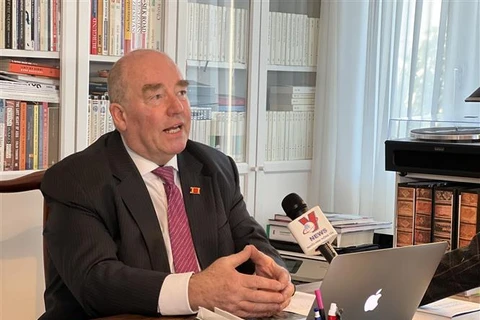
London (VNA) – President Ho Chi Minh’s Testament is one of the great political texts, not just of the Vietnamese people, but of the world, according to British historian John Callow.
In a recent interview granted to Vietnam News Agency correspondents in the UK on the occasion of the 55th anniversary of the implementation of President Ho Chi Minh’s Testament, Callow said the Testament is not a dogma, but a guide to action and political principle.
In this sense, it can be put alongside Machiavelli's The Prince or anything written by Jefferson at the founding of the United States of America, he said, adding these works survive and inform as foundational political documents because they contain eternal wisdoms, approaches, not blueprints, not mechanical guides, not things that must be followed according to these things in every circumstance, but broad guides to action that can be creatively applied in every situation.

According to the historian, the Testament is almost a second founding article of trust and faith between the rulers and the ruled. It is remarkable because it sets down very honestly President Ho Chi Minh’s hopes, his dreams and aspirations for posterity.
For the Vietnamese Communist Party and people, it provides almost a second constitution, one that is deeply moral, not in a dull or a lecturing way, but in its incredible humanity that it seeks to preserve the rights, the hopes, the dreams of the women, the men, the children of Vietnam and to go forward in the path that Ho Chi Minh led, Callow said, pointing out that key to this is national independence.
President Ho Chi Minh knew that all the sufferings of his fellow countrymen and women going through the spraying of Agent Orange, the defoliation of the forests, the use of napalm and the war crimes in his country had to be through something. It ripped at his soul, but he knew that the vision of the future had to be worth it. And that sense of the future, that sense of optimism for socialism is a young movement.
The Testament was not meant to be a dry blueprint, but be a living document that would give to the people the sense that, however hard the road, the end product would be a more equal, equitable society, where women were valued as well as men, where children could progress to their complete potential and where foreign influence would be used where it is good and ignored where it is not.
The historian believed Vietnam has walked a tightrope between this, taking those things just like President Ho Chi Minh did, that are good for Vietnam from the West and a world economy that is not always favourable, but balancing it always with independence, with what is right and what is noble for its people.
According to the historian, the Testament is also incredible because it blends together the vital elements of what that the Vietnamese would talk about as Ho Chi Minh Thought. The Testament was distilled into just a few pages with Ho Chi Minh’s sense of poetry, going back to traditional verses, but then taking it forward to greetings for Marx and Lenin. It has the sense of the very new and the ancient, the immutable, the eternal, but also the cutting edge of political thought, science and technology, all placed at the service of the people.
The Testament shows Ho Chi Minh’s cares, concerns and hopes, but above all his optimism. There is no sense that Vietnam was going to fail, that socialism was going to be watered down or forgotten, but it was a socialism that was creative, that the Party could develop and continue and build upon his legacy. And in so many aspects, though the world has changed and conditions have been very difficult from anything that he perhaps might have foreseen, that legacy has given sustenance, weight, power and legitimacy to today’s Vietnam, Callow believed, saying this remarkable document contains both power and inspiration for the Vietnamese people and all the progressive people of the world. The Testament remains vital, forceful, and capable of delivering on all those areas of promise that the Vietnamese people have triumphed with since the liberation movement and the passing of Ho Chi Minh.
John Callow is a historian, author and trade unionist. He is also the former Director of Archives at the Marx Memorial Library. He has written widely on Early Modern witchcraft, politics and popular culture. His books include Witchcraft & Magic in Sixteenth- and Seventeenth-Century Europe (co-authored with Professor Geoffrey Scarre); James II: King in Exile; Embracing the Darkness: A Cultural History of Witchcraft, and The Last Witches of England: A Tragedy of Sorcery and Superstition./.