Building of national dossiers for Mo Muong underway

The collection and recording videos of Mo Muong in the northern provinces of Ninh Binh, Son La, Phu Tho and Hoa Binh have been completed, Hoa Binh province’s Department of Culture, Sports and Tourism announced on December 20.
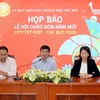
Building of national dossiers for Mo Muong underway ảnh 1An overview of the meeting. (Photo: VNA)

Hoa Binh (VNA) – The collection and recording videos of Mo Muong in the northern provinces of Ninh Binh, Son La, Phu Tho and Hoa Binh have been completed, Hoa Binh province’s Department of Culture, Sports and Tourism announced on December 20.

The studies of Mo Muong cultural heritage in Ninh Binh, Son La, Thanh Hoa, Phu Tho provinces and Hanoi have also been finished, it said.

Implementing the instructions of Deputy Prime Minister Vu Duc Dam, the People’s Committee of Hoa Binh province has worked the authorities of Hanoi, Son La, Phu Tho, Ninh Binh, Da Lak, Thanh Hoa and the Ministry of Culture, Sports and Tourism to prepare the national dossiers for Mo Muong which will be submitted to UNESCO to be named in the List of Intangible Cultural Heritage in Need of Urgent Safeguarding.

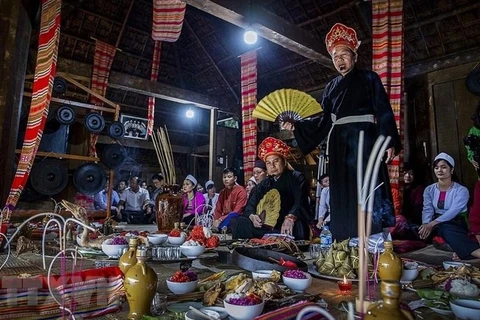
Mo Muong is a job and also a performance practiced at funerals, religious festivals, and life cycle rituals by the Muong ethnic minority group. Mo Muong has a long life, spanning centuries, as it has always helped to nurture the characteristics and the souls of the Muong people.

It is the essence of labour, production, cultural behaviour and the philosophy of the Muong people, reflecting their love of life and home villages.

Each Muong community has its own version of Mo, but they are all fairly similar. The existence of various versions of Mo has helped expand the heritage and spiritual life of the Muong people.

Regarding the preliminary results of archaeological excavations of two national relics sites, namely Stone Roof of Vanh village in Yen Phu commune and Xom Trai cave in Lac Son district’s Tan Lap commune, Dr Nguyen Viet, Director of the Centre for Southeast Asian Prehistory Studies, said that the excavations aimed to gather more scientific data to enrich the knowledge of Hoa Binh culture and to supplement to the records of local cultural history. They will also serve the education of traditions to younger generations, contributing to socio-economic development, he said.

The excavation of the Stone Roof of Vanh village revealed a number of vestiges of fire stoves and animal bones that may be related to the prehistoric people's seats for making tools or processing food.

The excavation of Xom Trai cave in Tan Lap commune also delivered similar results, Viet said./.
VNA

See more

The “Vietnam Pavilion” at Aldea Global 2026 (Photo: VNA)

World Cup 2026: Vietnam leaves distinct mark at global cultural showcase

The “Vietnam Pavilion” at Aldea Global 2026 offers Mexican visitors and international guests an opportunity to explore the country’s rich cultural heritage, history and people through exhibitions, tourism promotion activities, traditional arts presentations and displays of representative cultural products.

Michelin Guide Vietnam recognises 11 one-Michelin star restaurants (Photo: Michelin Guide Vietnam)

Local ingredients, cultural roots propel Vietnam’s Michelin journey

One of the clearest examples is Hieu Luc, a modest fish soup eatery on Hai Ba Trung Street in Hanoi, which has been included in the Michelin Selected category for the second consecutive year. Known for its clear, delicately sweet broth made from freshwater perch and mustard greens, the restaurant serves a traditional specialty from Hung Yen province.

Delegates attending the ASEAN City Leaders Conference 2026 visit the Imperial Citadel of Thang Long on June 9. (Photo: VNA)

ASEAN city leaders explore Hanoi’s heritage sites

At the Imperial Citadel of Thang Long, delegates visited the Doan Mon Gate and learnt about the formation and development of the ancient capital through different historical periods at display spaces. They also explored the Kinh Thien Palace’s Dragon Steps (large stone steps with dragon carvings), regarded as the political and ceremonial centre of the imperial citadel during successive Vietnamese dynasties.

Ly Hoang Nam is Asia's No. 1 pickleball player. (Photo: webthethao.vn)

Ly Hoang Nam tops Asian pickleball rankings

Vietnam boasts five players in the DUPR Asian top 10, with Nam leading the rankings on 6,267 points ahead of competitors from the Philippines, India, Hong Kong (China) and Chinese Taipei.

Visitors to the booth of the Vietnamese Embassy at the Embassies Food and Culture Festival held in Prague, the Czech Republic, on June 6 (Photo: VNA)

Vietnamese culture, cuisine leave lasting impression in Czech Republic

Featuring more than 100 booths representing diverse cultures from around the world, the festival transformed the heart of Prague into a vibrant multicultural space where visitors could sample traditional dishes, enjoy folk performances, listen to traditional music and experience unique cultural showcases from different continents.

Vietnamese artists play traditional musical instruments at the festival held in Karlovy Vary city, the Czech Republic, on June 5. (Photo: VNA)

Vietnam culture, cuisine showcased in Czech Republic

The festival featured more than 20 booths offering traditional Vietnamese dishes, including "pho" and spring rolls, alongside activities promoting Ao Dai (Vietnamese traditonal long dress). One of the highlights was the presentation of complimentary Ao Dai to Czech residents and international visitors.

The Nguyen Dynasty (1802-1945) imperial throne, a recognised national treasure of Vietnam, officially returns to public display at Thai Hoa Palace in Hue Imperial Citadel on June 4 (Photo: VNA)

Nguyen Dynasty throne returns to Hue Imperial Citadel after restoration

The throne has been reinstated at its original central position inside Thai Hoa Palace, the ceremonial heart of the former imperial court. Its return has attracted significant interest from visitors and heritage enthusiasts eager to see one of Vietnam’s most important royal artefacts back on display.

People join the “Ho Van Lantern Festival Night” programme at the special national relic site of the Van Mieu–Quoc Tu Giam (Temple of Literature) in Hanoi. (Photo: VNA)

Night-time economy drives growth of Hanoi’s cultural industries

Under the Politburo’s Resolution No. 80-NQ/TW on the development of Vietnamese culture, Hanoi has been given fresh opportunities to leverage its cultural, historical, tourism and creative assets. The city’s recently approved project on developing the night-time economy for 2026–2030, with a vision to 2045, is expected to create momentum for cultural industry growth while enhancing Hanoi’s standing as a creative and modern city with a distinctive identity.