Can Tho city puts focus on solar power

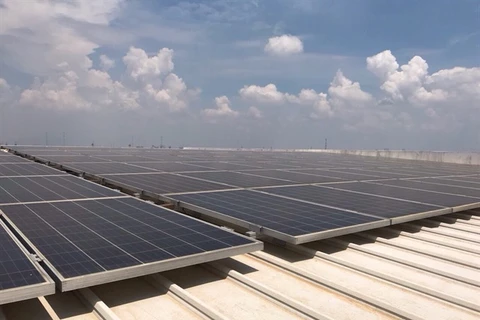
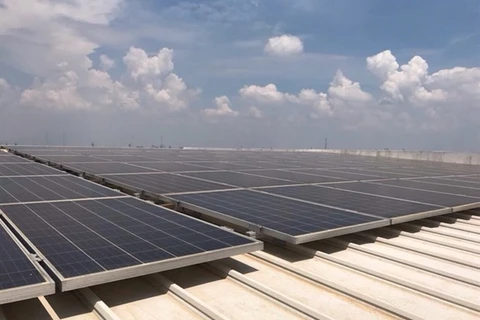
The Mekong Delta city of Can Tho is keen on exploiting its renewable energy potential and will provide investors with tax and credit incentives, especially for solar power projects.
Can Tho city puts focus on solar power ảnh 1Qu​ang Ng​ai Power Co. workers check the solar power system installed on An B​inh Island, L​y S​on district, Quang Ng​ai province (Photo: VNA)
Can Tho (VNA) - The Mekong Delta city of Can Tho is keen on exploiting its renewable energy potential and will provide investors with tax and credit incentives, especially for solar power projects.
Vo Thi Hong Anh, Vice Chairwoman of the Can Tho People’s Committee, told the Vietnam News Agency that the city has a lot of potential for developing solar energy.
She said the city has already factored solar energy into its long-term development plan as part of diversifying power sources, particularly for remote areas that still lack electricity supply.

The impacts of climate change over the last five years, like prolonged hot weather, has seen electricity consumption rise by 10-12 percent every year, said Nguyen Van Quang, Director of the Can Tho Power Company.

In 2017, Can Tho’s highest daily power consumption was 8.1 million kWh, while the corresponding figure in 2016 was 7.1 million kWh, Quang said.

Quang said that although the city’s power sector was trying to maintain safe and continuous power supply. The rapid development of hi-tech agriculture and aquaculture, accompanied by increasing demand for electricity, was worrying the people of Can Tho, adding urgency to the search for stable alternative power sources.

Duong Nghia Hiep, Deputy Director of the municipal Department of Industry and Trade, said that among the renewable energy solutions, solar power was the most suitable and gets highest priority because it is a very clean form of energy compared to other options.

Le Duong Cam Thuy, Deputy Director of Can Tho’s Department of Planning and Investment, said that the city was one of three localities absorbing the highest intensity of sunlight in Vietnam. As such, investing in solar power plants was a must for the city.

According to the the Ministry of Industry and Trade (MoIT), annual electricity supply in the 2020-2030 decade may fall short of demand, especially in the Mekong Delta.

The ministry expects Can Tho to spearhead the exploitation and development of solar power, becoming a power hub for the entire southern region.

At least three international corporations have proposed plans to set up solar power plants in Can Tho city.

By the end of 2015, Vetco Vina, a Korean invested firm specialising in renewable energy and hospital management, proposed a plan to build a 130MW solar power plant worth 1.2 trillion VND (53.6 million USD) in Can Tho. The project will use the latest technology available in the RoK, the investor committed.

Vetco Vina also revealed a plan to build a solar-powered international standard hospital in Can Tho to help the city’s medical sector be less dependent on expensive diesel and gasoline generators.

In early June this year, the multinational group ET Solar held a working session with Can Tho authorities, seeking business opportunities in solar energy supply.

ET Solar said it wanted to build a system of solar power plants which are capable of generating nearly 200MW of electricity in Can Tho.

ET Solar has been successful in 15 countries and become a prestigious stock on the US securities exchange. In Vietnam, ET Solar said it expects to build plants, sell products in the market and transfer technology to localities.

The US Dragon Capital Management Limited also discussed plans to build a solar energy plant with Can Tho authorities in late July.

The company’s investment director, Gavin Smith, said the city has favourable conditions for such a plant, adding that the company will begin feasibility studies in August, and construction could start in the first quarter of 2018.

Smith said the plant, with an initial investment of 1 trillion VND (44 million USD), will be built in two phases, with the first phase having a capacity of 29MW and the second 100MW.

Vice Chairwoman Anh said the city authorities highly appreciated the feasibility and economic significance of recent investment projects in Can Tho city.

She believes that once the projects begin operating, they will not only reduce reliance on fossil-fuel based power sources, buy also create jobs for local residents.

Under current regulations, investors have to obtain the MoIT’s approval for projects with capacities of less than 50 MW, and that of the Government for higher capacities.

“This absolutely discourages investors, that’s the reason why some projects have been planned for a long time but have not been implemented yet,” Anh said.

However, she added that local authorities are determined to realise the potential of solar power development in Can Tho, and will provide investors all support related to policies and provide relevant information.

Enterprises investing in renewable energy will also enjoy import tax incentives and preferential loans for scientific and technological development, Anh pledged.-VNA
VNA

See more

Customs officers inspect vehicles and imported goods at the Huu Nghi International Border Gate in Lang Son province. (Photo: VNA)

Customs intensify crackdown on counterfeit goods, trade fraud

The customs sector has identified the fight against smuggling, trade fraud, counterfeit goods and intellectual property violations as a key task. Customs units nationwide have stepped up inspections and supervision of import-export activities along major routes and at key checkpoints.

Workers process clams for export at the factory of Thanh Hoa Fishery Import-Export JSC in Thanh Hoa province. (Illustrative photo: VNA)

Vietnam notifies WTO committee of goods origin management reforms

The information presented by Vietnam attracted attention from others WTO members amid global efforts to accelerate the digital transformation of import – export procedures and improve the implementation of rules of origin to enhance supply chain adaptability.

A Petrolimex worker refuels a motorbike. (Photo: VNA)

Energy imports surge in first quarter of 2026

Data from Vietnam Customs shows that the country spent approximately 2.93 billion USD importing nearly 3.37 million tonnes of petroleum products in the first quarter of 2026, an increase of 77.8% in value and over 44% in volume compared to the same period last year.

A perspective of the Quang Ninh 1 Wind Power Plant project (Photo: Quang Ninh provincial Department of Construction)

Quang Ninh gives nod to first offshore wind power plant

The project is expected to have a designed capacity of 50 MW and will be implemented in nearshore waters of the Co To special zone. It will be the first offshore wind power project in the province, playing a pioneering role in tapping Quang Ninh’s abundant renewable energy potential.

Viettel launches the Unitel Logistics brand in Laos. (Photo: VNA)

Vietnamese firms expand global footprint

The Government recently approved the “Go Global” programme for 2026-2030, which identifies the private sector as a key driving force in Vietnam’s international expansion process. It aims to help Vietnamese private enterprises strengthen their overseas presence in a comprehensive, effective and sustainable manner through international investment, business activities and deeper integration into regional and global supply and value chains.

Vietnam and Cambodia are seeking to strengthen supply chain connectivity and promote sustainable border trade at a trade promotion conference in Vietnam's Mekong Delta province of Dong Thap on May 15. (Photo: https://thoibaonganhang.vn/)

Vietnam, Cambodia eye stronger border trade, supply chain connectivity

Vietnam–Cambodia trade ties have grown rapidly in recent years, becoming one of the major pillars of economic cooperation in the Mekong sub-region. The two countries share a 1,137-km border and an increasingly developed network of international and secondary border gates, facilitating cross-border trade, logistics and investment.

Illustrative image. (Photo: VNA)

Three proposals to connect overseas Vietnamese resources with private economy at home

There are currently many Vietnamese IT specialists working in technology corporations, banks, start-ups and innovation ecosystems across Canada. With appropriate mechanisms in place, this workforce could become a technology bridge, helping Vietnamese enterprises access management expertise, technical solutions, international standards and partnership networks in North America.

The Nguyen Van Linh–Nguyen Huu Tho intersection fully opens both underpasses to traffic, helping ease congestion in the area. (Photo: VNA)

Ho Chi Minh City pushes for full public investment disbursement

Ho Chi Minh City was allocated a record 147.599 trillion VND (5.6 billion USD) in public investment capital for 2026, up 22.6% from last year and accounting for nearly 14.6% of the nation’s total public investment budget. However, disbursement by the end of April remained below the national average.