An auto production line at Thanh Cong Huyndai Auto Plant in Ninh Binh province (Photo:VNA)
 Hanoi (VNA) – The price of domestic cars have soared since the beginning of this year due to the Government's adjustment of special consumption taxes on imported automobiles.
The move is a result of the new tax calculation, causing many car dealers to simultaneously increase their prices to the public for automobiles.
Under the new tax calculation, which will be changed beginning January 1, 2016, the special consumption tax for imported cars with 24 seats and below would be based on the importer's price, but the price must not be lower than 105 percent of the cost of an auto, which includes the car's import price, import tax and special consumption tax at the importing point. If it is lower than this level, the tax will be fixed by a tax agency following regulations on tax management.
As for 24-seater cars assembled and manufactured in Vietnam, the tax will be based on the carmakers' wholesale price, though this price must not be lower than 7 percent of the average prices of automobiles.
The new calculation method is expected to cause an estimated 5-percent increase in the price of imported cars.
At an automobile shop on HCM City's Cong Hoa street, the price of a Ford Ranger pick-up truck has increased by more than 22 million VND (1,004 USD) compared with the previous price. Also, a Camry 2.5, which previously cost 1.35 billion VND (61,618 USD), now costs over 1.4 billion VND (63,900 USD), an increase of 55 million VND (2,510 USD), the Phap luat TPHCM newspaper reported.
Linh, who intended to purchase a car, told the newspaper that some of his friends bought their cars last year, before the tax had changed, so they could pay a lower price. "Some cars now cost as much as 1 billion VND (45,643 USD) higher than last year," said Linh. Domestic auto importers and assemblers have also increased the selling prices of their cars. Mercedes-Benz, considered a pioneer, has seen some prices soaring.
Early this year, some Mercedes-Benz distributors announced that their selling prices on some vehicles had risen between 20 million VND (912 USD) and 1.8 billion VND (80,000 USD).
For example, an A200 now costs 30 million VND (1,300 USD) more, while the price of a CLA has increased by 20 million VND (890 USD). The highest increases are seen on imported vehicles, such as GL63 AMG 4Matic and G65 AMG, with prices surging by 1.28 billion VND (56,900 USD) and 1.8 billion VND (82,158 USD), respectively.
Truong Kim Phong, sales and marketing director of Ford Vietnam, said the selling prices of their pick-up trucks had increased by over 20 million VND (912 USD) since the beginning of this year.
The 16-seat passenger Ford Transit's price had also been increased by 35 million VND (1,597 USD), Phong told the newspaper, adding that the costs of locally-assembled cars would also rise in the near future.
"The new calculation method for the special consumption tax, along with high US dollar exchange rates, have affected the cost of imported cars and auto parts that can not be produced for vehicles assembled in the country, forcing auto makers and distributors to increase their prices," Phong said.
For the same reason, other auto importers have also increased prices.
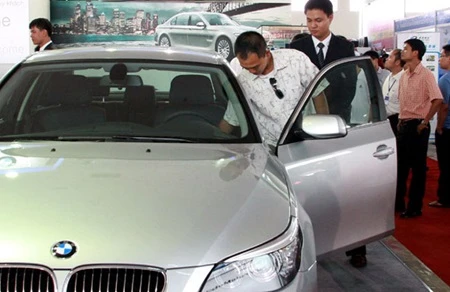
The importer and distributor of BMW cars in Vietnam has announced their latest list of car selling prices, with an increase in car prices fluctuating between 49 million VND (2,236 USD) and 650 million VND (29,668 USD). As for the Porsche Macan and Macan S, prices increased by 290 million VND (13,236 USD) and 250 million VND (11,410 USD), respectively.
Although the costs of popular inexpensive cars have not been affected, according to the prediction of local auto firms, the prices of these vehicles will also rise by 2 to 5 percent over current price levels, the newspaper said.
Suppose to fall
According to integration commitments in the free trade agreements that Vietnam has signed, the prices of cars would decrease. For example, since early 2016 the tax imposed on complete built up units imported from ASEAN countries to Vietnam would fall from 50 percent last year to 40 percent.
Under WTO commitments, beginning January 1 import taxes applied on automobiles would slightly decrease from 4 percent to 2 percent.
Therefore, auto prices should be reducing, rather than rising, the newspaper reported, adding that some businesses and experts said the tax reduction under these free trade agreements are nothing, compared to the newly-applied special consumption tax.
In addition, Vietnam mainly imports pick-up trucks from the ASEAN region, such as Chevrolet Colorado, Toyota Hilux and Nissan Navara, which are taxed at about 5 percent, while other types of car are taxed at about 50 percent. Therefore, the reduction of taxes on automobiles imported from ASEAN countries hardly affects the prices of these vehicles, the newspaper said.
Meanwhile, other luxury cars, such as Mercedes-Benz, BMW, Audi and Lexus, which are often sourced from Japan, the US and Europe, do not have the opportunity to enjoy the 40-percent tax level, as do those imported from the ASEAN region.
According to Huynh The Du, a lecturer at the Fulbright Economics Teaching Programme, the new tax on imported cars, which he calls rational, should even be increased further.
"The automobile market development must be consistent with transport infrastructure development. Without policies controlling the automobile market, the economy will suffer many consequences," Du said, adding that increasing taxes is one of the most effective solutions to limit the amount of vehicles on the road.
According to the General Statistics Office, the total import value of automobiles and automobile parts was estimated at nearly 6 billion USD in 2015, of which the import value of automobiles reached 3 billion USD.-VNA