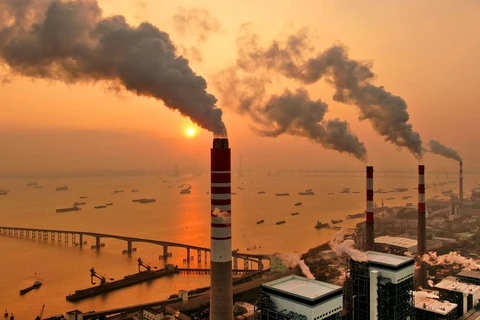
An emissions trading market was expected to contribute to achieving net zero. (Photo: baotainguyenmoitruong.vn)
 Greenhouse gas emissions in Vietnam increased rapidly over the past three decades in direct proportion to the economy’s growth.
According to the most recent report on greenhouse gas emissions by the Ministry of Natural Resources and Environment, total emissions would reach 928 million tonnes of CO2 equivalent by 2030 and 1.5 billion tonnes by 2050 in a moderate scenario.
Vietnam had quite a high emission intensity per GDP unit compared to other countries in the Southeast Asian region, at about 0.35 kg CO2 per 1 USD.
To realise the goal of becoming a high-income country in 2045 and achieving net zero emissions by 2050 as committed at COP26, Vietnam was facing challenges in creating a low-carbon but rapidly growing economy.
It was necessary for Vietnam to raise all resources and apply innovative solutions, among which, carbon pricing, including carbon tax and an emissions trading market, are regarded as an effective and feasible tool.
According to Vietnam Initiative for Energy Transition (VIETSE), currently, Vietnam indirectly imposes a tax on carbon through the environmental protection tax on fossil fuel producers and importers. However, this tax rate did not really reflect the nature of carbon pricing.
International experience showed that carbon tax and an emissions trading market could be flexibly applied in tandem to optimise emissions reductions. However, the emissions trading market was becoming more and more popular because it allowed businesses to be flexible and proactive in choosing measures to comply with emissions quotas and achieve cost-effectiveness.
The carbon market was first mentioned in the Prime Minister’s Decision 1775/QĐ-TTg in 2012, then the Party’s Resolution 24-NQ/TW in 2013 and Resolution 50-NQ/CP in 2021.
Accordingly, the Vietnamese Government recognised the development of a carbon market as a must-do to respond to climate change and protect the environment.
Wolfgang Mostert, an expert in energy and climate policies, said that carbon pricing was a policy toward efficiency to achieve emissions reduction goals at the lowest cost.
The carbon market played an important role in the process, however, it would take time and require a large investment to develop and operate this market, he said.
In the current context of deepening economic integration, many countries were striving to reduce greenhouse gas emissions which became a mandatory requirement for enterprises.
Emissions reduction was not only to reduce harm to the environment but also to move towards sustainable development and meet the green standards of importing markets.
Vietnam’s major export markets, including the EU and the US, were preparing to pilot the implementation of the Carbon Border Adjustment Mechanism (CBAM). Accordingly, technical barriers and regulations related to emissions reduction would be erected to force enterprises to follow and a carbon tax would be imposed if enterprises did not meet the requirements.
The pilot implementation was set to start in 2023 for sectors including cement, aluminium, power, steel and iron production. CBAM would officially be applied from 2026. The range of industries which must comply with CBAM would continue to expand in the future, posing significant challenges for Vietnamese export goods.
However, the operation of a carbon market would also create an advantage for Vietnam's domestically produced goods to increase competitiveness.
Truong An Ha, an export from VIETSE, said that the development and operation of a domestic carbon market would help Vietnam to take opportunities arising from carbon emissions efficiently, increase adaptability to international carbon pricing mechanisms and enhance the competitiveness of Vietnamese products.
Moreover, a carbon market was also a mechanism to create resources for the development and application of low-emission technologies toward a carbon-neutral economy, she said.
Experts said that it was necessary to develop a clear sanction mechanism for entities which did not comply with their given quotas. Emissions quotas should be set in a harmonious way between emission reduction targets and economic development goals and encourage enterprises to apply emission reduction technologies.
Emissions trading should be piloted first in sectors which were easy to measure such as electricity, industry and buildings before expanding to others, together with a clear mechanism for using revenue from the carbon market to ensure efficiency in promoting low-emission technologies./.
VNA