Cashew export revenue in 11 months surges over 19 percent

Vietnam earned 2.18 billion USD from shipping 300,000 tonnes of cashew abroad, rising 19.2 percent and 7.3 percent year-on-year respectively.
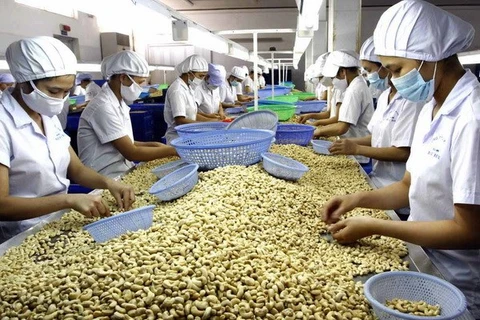
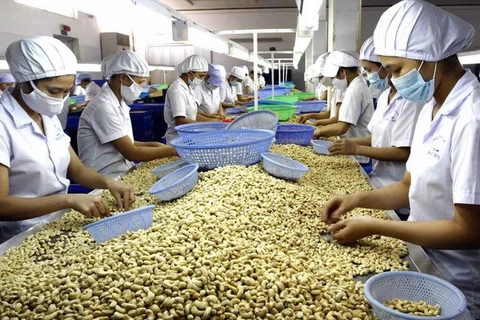
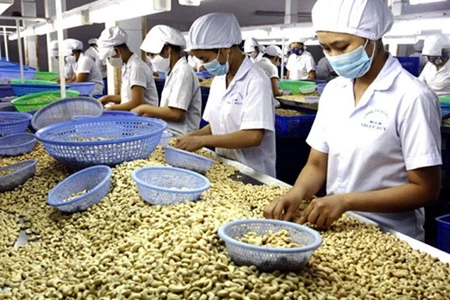
Cashew export revenue in 11 months surges over 19 percent ảnh 1Cashew processing for exports (Source: VNA)

Hanoi (VNA) - Vietnam earned 2.18 billion USD from shipping 300,000 tonnes of cashew abroad, rising 19.2 percent and 7.3 percent year-on-year respectively, according to the Ministry of Agriculture and Rural Development.

In November alone, the country exported 25,000 tonnes of processed cashew, pocketing 186 million USD, the ministry said.

The average export price was 7,269 USD per tonne, up 11.3 percent compared to the same period last year.

China, the Netherlands and the US remain three largest importers of Vietnamese cashew.

Among markets that recorded a strong increase in exports were Germany (63.18 percent), Thailand (40.12 percent), the UK (37.82 percent), the Netherlands (37.59 percent), and the US (28.92 percent).

The Vietnam Cashew Association (VINACAS) said the country targets 320,000 tonnes of cashew nut exports and 2.5 billion USD in revenue in 2015. Cashew nuts have become one of the key export staples of Vietnam’s farming sector, following rice, rubber and coffee.

Vietnam is now home to over 300,000 hectares of cashews in the southern provinces of Binh Phuoc, Ba Ria – Vung Tau and Dong Nai; Phu Yen and Binh Dinh provinces in the central region; and the Central Highlands province of Dak Lak.-VNA
VNA

See more

Downtown area in Ho Chi Minh City. (Photo: VNA)

Vietnam's golden gateway: FDI poised for gains in 2026

More than just volume, the quality of FDI entering Vietnam has improved. The nation is evolving from a base for basic assembly and processing into a genuine contributor to hi-tech manufacturing and R&D across global value chains.

Deputy Minister of Finance Do Thanh Trung speaks at the ceremony (Photo: VNA)

Project to advance growth, innovation, leadership for enterprises kicks off

AGILE is not only a testament to the long-standing and trusted strategic partnership between Vietnam and Canada, but also an important contribution to the Vietnamese Government’s efforts to promote innovation and sustainable growth within the private sector, thereby effectively mobilising private investment to realise inclusive and sustainable development goal.

At Regza Vietnam Electronics Co., Ltd. in Dong Nai province. (Photo: VNA)

FDI disbursement in January hits five-year high

Economists said that the continued growth in realised FDI reflects foreign investors’ sustained implementation and expansion of production and business activities in Vietnam. This is seen as an encouraging signal, underscoring investors’ confidence in Vietnam’s business environment and economic prospects.

In Q1 2026, Vietnam records 16 export commodities with turnover exceeding 1 billion USD. (Photo: VNA)

Exports face stiff test in bid to hit 550 billion USD

To achieve export growth of over 15% as directed by the Government, the MoIT said it will prioritise a set of core measures in 2026, including expanding production capacity, developing new export products, increasing domestic content and value added, accelerating the shift from processing to manufacturing, and proactively addressing trade barriers and defence measures.

Illustrative photo (Photo: VNA)

January CPI rises on stronger Tet holiday demand

CPI in January 2026 rose 0.05% month-on-month, with urban areas up 0.02% and rural areas up 0.09%. Of the 11 major commodity and service groups, nine recorded price hikes while two saw declines.

Vietnam is currently Cambodia’s third-largest trading partner worldwide, after China and the US, and its largest trading partner within ASEAN. (Photo: Ministry of Industry and Trade)

Party chief’s Cambodia visit to open up new phase of deeper, closer cooperation

To further unlock the potential of bilateral economic and trade cooperation, Vietnam and Cambodia should continue reviewing and effectively implementing signed agreements, facilitating trade and border connectivity, strengthening trade promotion in complementary sectors, reforming administrative procedures, upgrading border and logistics infrastructure, and enhancing coordination in combating smuggling and trade fraud.