Central Highlands provinces asked to not expand macadamia area

The Central Highlands provinces of Dak Lak, Lam Dong, Dak Nong, Gia Lai and Kon Tum have stopped expanding the area grown with macadamia trees, said the Tay Nguyen Agro-Forestry Science Technology Institute.
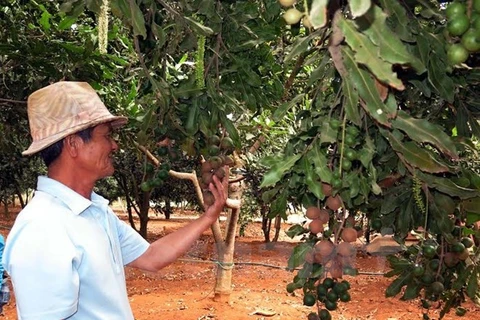
Central Highlands provinces asked to not expand macadamia area ảnh 1A macadamia grower in the Central Highlands(Photo: VNA)

Dak Lak (VNA) – The Central Highlandsprovinces of Dak Lak, Lam Dong, Dak Nong, Gia Lai and Kon Tum have stoppedexpanding the area grown with macadamia trees, said the Tay NguyenAgro-Forestry Science Technology Institute.

Meanwhile, local farm households and businesses areadvised to focus on the cultivation of planted trees.

Macadamia trees have recently been grown in theCentral Highlands on a pilot project and given yields after 5-7 years. Experts say further studies on land, climate, seedlings andcultivation techniques should be carried out before the tree is put intolarge-scale cultivation in the region.

Dak Lak province, which boasts the third largestmacadamia area after Lam Dong and Dak Nong, has stopped the cultivation of newmacadamia trees until 2020, with orientations to 2030.

Director of the Dak Lak Department of Planning andInvestment Dinh Xuan Ha said local farmers should grow macadamia trees alongwith industrial and perennial fruit trees such as coffee, avocado and durian tomaintain their income and avoid risks.

Macadamia trees made first appearance in Vietnam in the 1990s,but farmers in the Central Highlands only started cultivating them in 2000.

The region is currently home to more than 2,266ha ofmacadamia trees, or 64.01 percent of the country’s total crop area, mainly inLam Dong (44.04 percent) and Dak Nong (35.3 percent). The region produces 246tonnes of nuts per year, accounting for 91.45 percent of the country’s output.

Experts say since it is a relatively new species, furtherstudies should be conducted to ensure its efficiency and reduce risks forgrowers. - VNA

VNA

See more

Toy production at a Hong Kong-invested factory (Photo: VNA)

Vietnam targets deeper market penetration in Hong Kong in 2026

Vietnam-Hong Kong trade hit 62.3 billion USD in the first 11 months of 2025, soaring 73.1% annually. Vietnamese exports to Hong Kong amounted to 36.8 billion USD, a 90.6% hike, ranking fourth among Hong Kong’s import sources, while imports from Hong Kong stood at 25.5 billion USD, up 52.9% and ranking third.

Vietnam’s start-up market enters restructuring phase

Vietnam’s start-up market enters restructuring phase

In 2026, venture capital inflows into Vietnam’s start-up ecosystem are expected to recover gradually, though in a more selective manner. VinVentures forecasts that capital will focus on start-ups that have survived the rigorous screening of 2024–2025, possess clear business models, strong commercialisation capacity, and the ability to generate real cash flows.

Workers process tra (pangasius) for export (Photo: VNA)

Vietnam–Singapore trade continues to thrive

For the year as a whole, Vietnam retained its position as Singapore’s 10th largest trading partner. Bilateral trade reached a record high of nearly 40 billion SGD, up 26.2% from the previous peak of 31.67 billion SGD recorded in 2024.

Eric Van Vaerenbergh, an energy expert and lecturer at the Brussels Engineering School (ECAM) (Photo: VNA)

Belgian expert optimistic about Vietnam’s economic outlook

Vietnam should move from a growth model based mainly on expanding capital and labour to one driven by productivity improvements. He said that this requires enhancing the quality of the workforce, particularly engineers, technicians, and managers in industrial sectors.

Workers at the VSIP Hai Phong industrial and urban complex, which specialises in producing electronic components for office equipment. (Photo: VNA)

Roadmap aims to improve business climate and boost competitiveness

By the end of 2026, Vietnam aims to rank among the world’s top 50 performers in the United Nations Sustainable Development Goals, advance at least three places in the International Property Rights Index, and climb at least one position in the Global Innovation Index.

Vietnam is strengthening its position in the technology value chain, becoming a major manufacturing hub for complete consumer electronics products. (Photo: VNA)

ESG standards offer opportunities to reposition Vietnam’s electronics firms

The 2025-2027 period will be a critical turning point, as exporters to the European market will be required to strictly comply with ESG standards, including net-zero emissions roadmaps, labour standards, corporate governance and transparency requirements. As a key export sector, the electronics industry is being directly and strongly affected by this shift.